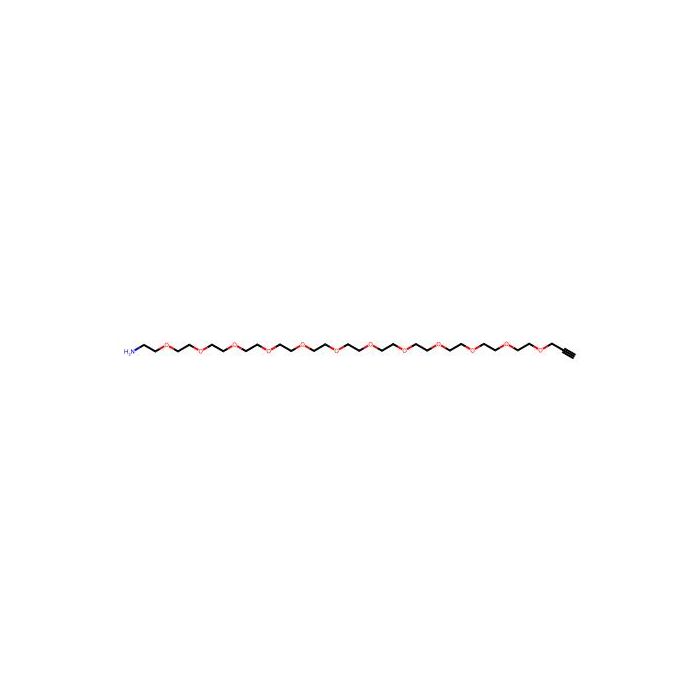
Propargyl-PEG24-amine is a PEG derivative containing a propargyl group and an amine group. The amine group is reactive with carboxylic acids, activated NHS esters, carbonyls (ketone, aldehyde) etc. The propargyl group can be reacted with azide-bearing compounds or biomolecules via copper catalyzed azide-alkyne Click Chemistry to yield a stable triazole linkage.
Molecular Formula:C51H101NO24
MW:1112.4
Especificaciones
Especificaciones y pureza
≥98%
Condiciones de almacenamiento de almacenamiento
Store at -20°C
Enviado en
Ice chest + Ice pads
Este producto requiere envío en cadena de frío. Los servicios terrestres y otros servicios económicos no están disponibles.
Pureza
≥98%
Datos avanzados
Certificados (CoA, COO, BSE/TSE y tabla de análisis)
C of A & Other Certificates(BSE/TSE, COO):
Analytical Chart:
Calculadoras de soluciones
Molarity Calculator
Determine the necessary mass, volume, or concentration for preparing a solution.
Dilution Calculator
Determine the dilution needed to prepare a stock solution.
Reconstitution Calculator
Reseñas
Reseñas de cliente
Application Protocols
No tested application protocols are provided for this catalog item.
For general guidance on typical uses (e.g., CuAAC, amide coupling, reductive amination), please refer to the Reaction Conditions section.
Item-specific protocols, recommended concentrations, or step-by-step procedures: Not specified for this item; refer to CoA/Spec Sheet and SDS.
Biological Roles
This product is a synthetic linker and does not have an intrinsic biological role. It is used to modify and connect biomolecules.
Bioconjugation utility (general/literature):
The PEG24 chain imparts high hydrophilicity and flexibility, which can reduce nonspecific interactions and improve solubility of conjugates.
The terminal amine enables coupling to carboxylate-bearing biomolecules (proteins, peptides, oligonucleotides via amide formation), while the propargyl terminus enables selective attachment to azide-containing partners via CuAAC.
The PEG spacer can increase apparent molecular size and circulation time of macromolecular constructs in research models; it also spaces functional groups from surfaces or protein backbones to enhance binding accessibility in assays.
Biochemical compatibility:
CuAAC performed in buffered aqueous media with appropriate copper ligands (e.g., THPTA) is widely used in chemical biology for site-selective labeling of azide-tagged biomolecules (introduced metabolically or via genetic code expansion; literature context).
Amine reactivity is pH-dependent; maintaining near-neutral to slightly basic conditions preserves protein integrity while enabling efficient coupling to NHS esters or activated carboxylates.
Note: No medical or clinical claims are implied. Use is restricted to research applications, as stated by the manufacturer.
Buffer Applications
This product is not a buffering agent and does not form classical buffer systems. It is typically used within buffers during conjugation.
Practical notes (general):
For NHS-ester couplings to the amine terminus: use phosphate or HEPES buffers at pH 7.5–8.5; avoid Tris and other primary amines that compete with coupling.
For reductive amination: acetate or phosphate buffers at pH 5–6 with sodium cyanoborohydride or picoline borane.
For CuAAC: phosphate, HEPES, or tris-triazolyl ligands in water; include copper sulfate and sodium ascorbate; avoid azide-incompatible buffers (e.g., high chloride can influence copper speciation; manage oxygen to limit side reactions).
Refer to Reaction Conditions for detailed guidance. No item-specific buffer capacity or pKa applies.
Green Alternatives
As a functional linker, Propargyl-PEG24-amine is typically chosen for performance rather than replaced. Sustainability considerations focus on reaction media and copper management during use.
Greener choices in use-phase (literature/general):
Solvents: favor water or water-rich mixtures for CuAAC and bioconjugation. Replace DMF/DMSO with ethanol/water or t-butanol/water where feasible.
Ligands and copper: use water-soluble ligands (e.g., THPTA) to enable efficient aqueous CuAAC at low copper loadings; rigorously remove copper post-reaction to minimize environmental impact.
Copper-free click: consider strain-promoted azide–alkyne cycloaddition (SPAAC) if compatible with your azide partner, though it requires cyclooctynes rather than a terminal alkyne; this avoids copper entirely but changes linker chemistry.
Alternative hydrophilic spacers (contextual comparison):
Shorter PEGn (e.g., PEG4–PEG12) reduce mass and copper demand but shorten reach and hydrophilicity.
Polyglycerol or zwitterionic linkers can provide superior antifouling in some systems but may involve more complex synthesis and different coupling profiles.
Comparison (general):
Aqueous CuAAC vs organic CuAAC
Medium: water/buffer vs anhydrous DMF/DMSO
Pros: safer, greener, biocompatible vs broader solubility for hydrophobic partners
Cons: substrate solubility limits vs organic waste and worker exposure
Select the greenest viable medium consistent with substrate solubility and reaction performance.
Pharmaceutical Uses
No pharmacopeial grade or excipient status is specified for this item; therefore it is offered for research use only.
General context (non-clinical, manufacturing/science focus):
PEG linkers such as Propargyl-PEG24-amine are widely used in process development and analytical research for:
Model antibody–drug conjugation (ADC) link-spacing studies.
Surface passivation of analytical devices and biosensors.
Preparation of hydrophilic prodrugs and polymers for in vitro evaluation.
Considerations for translational/manufacturing contexts (informational):
If intended for regulated applications, users typically require GMP documentation, tight control of polydispersity, residual solvent/metals data, and full end-group characterization. None of these are specified for this catalog item; consult Aladdin for availability.
Removal of copper and small-molecule reagents from conjugates is critical for biocompatibility assessments (dialysis, SEC, diafiltration).
No therapeutic claims are made or implied. For research use only.
Physical Properties
Item-specific physical specifications were not provided for this product. Confirm exact values on the CoA/SDS.
Appearance: Not specified for this item; refer to CoA/Spec Sheet.
Molecular Weight: Not specified for this item; refer to CoA/Spec Sheet.
Density, refractive index, UV cutoff, water/peroxide content: Not specified for this item; refer to CoA/Spec Sheet.
Literature/general characteristics for PEG24-based linkers (informational, not product specifications):
Average backbone mass estimate (literature/computed): PEG repeat unit ≈ 44.05 Da; 24 repeats ≈ 1057 Da. Adding terminal groups for a propargyl end and a primary amine end typically brings the average to roughly 1.1–1.2 kDa; exact value depends on precise end-group chemistry and salt form.
Physical state: low-melting waxy solid or viscous semi-solid at ambient temperature is common for PEGs in the ~1 kDa range.
Solubility: high in water and polar organic solvents (e.g., DMSO, DMF, methanol, ethanol); miscibility with nonpolar solvents (e.g., hexanes) is poor. PEGs also dissolve in acetonitrile to a moderate extent.
Hygroscopicity: PEG chains are hygroscopic and absorb atmospheric moisture readily.
LogP: effectively very low/negative apparent logP due to multiple ether oxygens (qualitative, literature).
pKa: terminal amine behaves as a typical primary aliphatic amine (conjugate acid pKa ≈ 9–10, literature range), modulated slightly by the PEG environment.
Always treat literature values as guidance only; use your CoA/SDS for batch-specific data.
Quality and Grades
Grade/Purity: Not specified for this item; refer to CoA/Spec Sheet.
Context for PEG linker quality (general, for interpretation of CoA when provided):
Degree of polymerization and dispersity: PEG24 denotes an average of 24 ethylene oxide units; a narrow dispersity (low Đ) is desirable for reproducible conjugation and biophysical properties.
End-group fidelity: For heterobifunctionals, the percentage of molecules bearing the correct functionality at both ends is critical. CoAs commonly report end-group verification by 1H/13C NMR and sometimes by MALDI-TOF/ESI-MS (reporting an average/most-intense m/z envelope consistent with target MW).
Residuals and assays: Residual solvents, catalyst traces (e.g., tin from polymerization), and water content may be reported. Lower residuals support sensitive applications.
Functional group availability: For amine-bearing PEGs, “free amine” content (e.g., via TNBS assay) may be provided; for propargyl termini, alkyne integrity may be assessed via NMR or a model CuAAC test.
UV profile: PEGs have minimal UV absorbance above 220–230 nm; HPLC-grade UV specifications are typically irrelevant for solid linkers unless used in LC applications.
If you require specified purity thresholds, end-group content, or GMP documentation, request the batch CoA/Spec Sheet and any quality statements relevant to your application.
Reaction and Applications
Propargyl-PEG24-amine is a versatile heterobifunctional linker enabling orthogonal conjugation strategies while imparting hydrophilicity and spacing.
Key applications (general/literature):
Click chemistry: terminal alkyne participates in Cu(I)-catalyzed azide–alkyne cycloaddition (CuAAC) to form 1,4-disubstituted triazoles; compatible with a wide range of azide-bearing biomolecules, polymers, and surfaces.
Amine-based couplings: the primary amine reacts with NHS esters, activated carboxylic acids (EDC/HOBt, HATU, PyBOP), isothiocyanates (thiourea linkages), aldehydes/ketones (reductive amination), and carbonates/activated carbonyls (carbamates/urethanes).
Surface and material modification: graft PEG to nanoparticles, resins, and planar substrates to improve colloidal stability, reduce nonspecific adsorption, and tune interfacial properties.
Bioconjugation/spacer: provide ~8–10 nm end-to-end fully extended length for spacing functional cargos, reducing steric hindrance and improving accessibility.
Practical considerations:
Maintain orthogonality by protecting one terminus if sequential coupling is required (e.g., Boc-protect the amine, or perform CuAAC first in neutral aqueous media).
Copper management in CuAAC: use copper-chelating ligands (TBTA, THPTA) and sodium ascorbate for in situ reduction; thoroughly remove copper after reaction for biological applications (e.g., EDTA dialysis, spin columns).
Control of stoichiometry: for monofunctionalization of proteins or surfaces, use limiting equivalents and optimized pH to bias toward single-site modification.
Analytical tracking:
Characterize conjugation by MALDI/ESI-MS (for small molecules), SDS-PAGE band shifts (proteins), GPC/SEC (polymers), and surface assays (XPS, contact angle).
Reaction Conditions
Guidance below summarizes commonly reported conditions for the two termini. Values are literature/general and should be optimized per substrate. They are not product specifications.
CuAAC (terminal alkyne with azide):
Solvent: water; water/t-BuOH (1:1); water/DMF; or neat buffered aqueous media for biomolecules.
Catalyst: CuSO4·5H2O (0.1–1.0 equiv % mol vs limiting partner) with sodium ascorbate (1–5 equiv relative to copper) to generate Cu(I) in situ; or CuBr/CuI with nitrogen ligands (e.g., TBTA, THPTA 1–2 equiv vs Cu).
Temperature: 20–37 °C (ambient to physiological); up to 50 °C for small molecules if substrates tolerate it.
Time: 1–16 h, often complete within 2–4 h for small-molecule partners.
pH: near neutral (pH 6.5–8.0) for biomolecules; broader for small molecules.
Notes: degas if needed; protect proteins with ligands to minimize oxidative damage; remove copper post-reaction (EDTA, dialysis, spin filters).
Amide coupling (amine terminus):
Solvent: anhydrous DMF, DCM/DMF, or DMSO; for aqueous bioconjugation use PBS or HEPES with NHS esters.
Reagents: HATU/HBTU (1.1–1.5 equiv), EDC (1.1–2.0 equiv) often with NHS or sulfo-NHS; base DIPEA (2–4 equiv) in organic media.
Temperature: 0–25 °C typically; up to 40 °C if needed.
Reductant: sodium cyanoborohydride (1–10 equiv) or picoline borane.
Temperature: ambient; time 2–16 h.
Always monitor by LC/MS, NMR, or gel methods appropriate to the system.
Safety and Handling
Item-specific GHS information was not provided for this listing. Consult the SDS for authoritative safety data.
GHS/labeling (this item):
Signal Word: Not specified for this item; refer to SDS.
Hazard Statements, Pictograms, Classification: Not specified for this item; refer to SDS.
General handling guidance for PEG linkers and amine/alkyne bifunctionals (informational):
Likely hazards: PEG-based linkers are typically of low acute toxicity and low volatility; irritation to skin/eyes is possible. Amines may be irritating/sensitizing in some individuals.
PPE: laboratory coat, suitable gloves (e.g., nitrile), and safety glasses. Avoid skin/eye contact and inhalation of dust/aerosols.
Engineering controls: handle powders in a fume hood to minimize particulate exposure and to control any reagent off-gassing from subsequent reactions (e.g., when using azides or copper salts).
Incompatibilities: strong oxidizers; reagents that acylate or alkylate amines; azides and copper salts used in CuAAC require standard precautions (avoid sodium azide contact with heavy metals; manage copper waste properly).
First aid (overview; see SDS): rinse eyes/skin with water for several minutes if contacted; remove contaminated clothing; if inhaled, move to fresh air; if ingested, rinse mouth and seek medical advice.
Fire safety: PEGs are combustible; use water spray, CO2, foam, or dry chemical. Thermal decomposition may generate CO/CO2.
Waste: collect aqueous copper-containing click reaction waste separately for proper disposal per institutional and local regulations.
Solvent Selection
This product is a solid linker rather than a solvent. Selection focuses on dissolution and reaction media.
Polarity/solubility profile (literature/general):
Highly soluble in water and polar organics: DMSO, DMF, NMP, methanol, ethanol.
Miscible/soluble to varying degrees in acetonitrile and isopropanol.
Poorly soluble in nonpolar solvents (hexanes, toluene without co-solvent).
Choosing media by application:
Bioconjugation in aqueous buffers: use PBS, HEPES, or borate buffer with co-solvents (≤20–30% v/v DMSO or DMF) to aid dissolution. Maintain pH appropriate for amine reactivity (pH 7.5–8.5 for NHS-ester couplings).
CuAAC “click” reactions: water/t-butanol, water/DMF, or pure water for biomolecule conjugations; anhydrous DMF/DMSO for small-molecule contexts. Degas if oxygen-sensitive reductants are used.
Amide couplings: anhydrous DMF, DCM/DMF mixtures, or DMSO with organic bases (DIPEA) and coupling agents.
Practical tips:
Pre-wet with a small volume of the chosen polar solvent, then dilute with buffer/solvent.
Gentle warming (≤40 °C) and vortex/sonication aid dissolution; avoid prolonged heating that may promote end-group degradation.
For nonpolar environments (surface grafting onto hydrophobic substrates), introduce a polar co-solvent to carry the PEG linker to the interface.
Alternatives for challenging matrices: consider carbonate/bicarbonate buffer (pH 8–9) to promote amine nucleophilicity while preserving many biomolecules.
Storage and Reconstitution
Storage conditions (item-specific):
Store at -20 °C (per product data).
Shipped in an ice chest with ice pads to maintain a cold chain.
General handling and stability (informational):
Keep tightly sealed under dry, inert atmosphere if possible; PEG linkers are hygroscopic and can absorb moisture, which may impact accurate weighing and some coupling reactions.
Allow container to equilibrate to room temperature in a desiccator before opening to minimize condensation.
Protect from prolonged exposure to light and elevated temperatures to preserve end-group integrity (alkyne and amine).
Reconstitution and working solutions (general):
Dissolve in water, PBS/HEPES (for bioconjugation), or polar organics such as DMSO or DMF. Typical stock solutions: 10–100 mM for small-molecule work; 1–10 mg/mL for bioconjugations, adjusted to application needs.
For aqueous buffers, filter sterilize (0.22 µm) if sterility is required.
Working solutions are best prepared fresh; if storage is necessary, aliquot and freeze at −20 °C. Avoid repeated freeze–thaw cycles.
Shelf life and specifications:
Appearance, water content, and purity: Not specified for this item; refer to CoA/Spec Sheet.
Research Use Note: For research use only.
Structure and Identity
Propargyl-PEG24-amine is a heterobifunctional polyethylene glycol linker featuring a terminal propargyl (alkynyl) group and a terminal primary amine, separated by a PEG spacer of 24 ethylene glycol repeat units.
Spacer: PEG24 [–(CH2–CH2–O)–]24 providing hydrophilicity, flexibility, and water solubility.
Heterobifunctional design enables orthogonal coupling at each end (CuAAC at the alkyne; amide/urea/thiourea formation via the amine).
2D structure (described)
A linear chain of 24 ether oxygens alternating with ethylene units, capped at one terminus by –CH2–C≡CH and at the opposite terminus by –NH2.
Notes on identity (literature/general)
PEG24 denotes an average of 24 EO repeats; actual preparations are typically polydisperse around the targeted degree of polymerization.
The termini may be presented as free base amine unless otherwise specified; salt form, exact MW, and dispersity are item-specific and should be confirmed on the CoA.
Synthetic Utility
Functional handles and representative transformations (general/literature guidance):
Alkyne terminus (propargyl):
CuAAC with azides → 1,4-disubstituted triazoles; tolerant of water, oxygen to an extent (with ligand), and many functional groups.
Hydroboration–oxidation of terminal alkyne → carbonyl derivatives via aldehyde after oxidative workup (less common for PEG linkers but synthetically feasible).
Sonogashira couplings when converted to appropriate halo-alkynes or used with aryl/vinyl halides (requires protecting the amine and managing PEG solubility).
Amine terminus:
Amide bond formation with activated carboxylic acids (HATU/EDC/NHS), giving robust linkages for bioconjugation.
Urea/carbamate formation with isocyanates/carbonates for polymer and surface functionalization.
Reductive amination with aldehydes/ketones, enabling conjugation to oxidized glycans or aldehyde-bearing probes.
Thiourea formation with isothiocyanates (e.g., fluorescein isothiocyanate labeling).
PEG24 spacer advantages:
Increases aqueous solubility and reduces aggregation; provides conformational flexibility.
Serves as an entropic spacer in multivalent constructs and improves accessibility in surface-bound assays.
Protecting group strategy:
Temporary protection of the amine (Boc, Fmoc) may be used to perform alkyne-side transformations first; alternatively, protect the alkyne (silyl-propargyl) if amine chemistry is performed first.
These utilities make Propargyl-PEG24-amine a robust hub for modular assembly in materials science and chemical biology.
Target Specificity
This product is a chemical linker and does not have biological target specificity.
Antigen/epitope, clone, isotype, or species reactivity: Not applicable.
Any target-related attributes: Not specified for this item; refer to CoA/Spec Sheet if specialized targeting moieties are present in a derivative (not indicated here).
Preguntas frecuentes
What is the purity of this product?
This product is supplied at ≥98% purity (chemical assay). Lot-specific values are stated on the Certificate of Analysis.
How should this product be stored?
Store at ?20 °C. Freezer storage is required to maintain the specified shelf life.
How is this product shipped?
This product ships in an insulated container with ice pads. Unpack on arrival and transfer it to the storage condition stated above.
What are the CAS number, molecular formula and molecular weight?
The CAS Number is 956348-61-1.
What documentation is provided?
Available product documentation, including Certificates of Analysis (COA), Safety Data Sheets (SDS), and specification sheets, is shown in the product document area. Document availability and access follow the current site policy.
Utilizamos cookies para garantizar el correcto funcionamiento del sitio web y, cuando esté permitido, para mejorar su experiencia. Puede gestionar sus preferencias en cualquier momento en Configuración. Más información en nuestra Política de Cookies.
¿Quieres que te enviemos un mensaje cuando tengamos descuentos disponibles?
Recordármelo más tarde
¡Gracias! Por favor, revisa tu bandeja de entrada de correo electrónico para confirmar.
Products are supplied to verified businesses, institutions, and qualified professionals for research and development use only. Not for use in humans, animals, diagnosis, or therapy.