
Determine the necessary mass, volume, or concentration for preparing a solution.
| Activity Type | Activity Value -log(M) | Mechanism of Action | Activity Reference | Publications (PubMed IDs) |
|---|
10mM in DMSO for sensitive chromatographic and analytical workflows requiring minimal baseline interference.
Store at -80°C Ships Dry ice packs + Cold packs Check lot-specific COA for exact specifications.
SDS, COA, datasheet, and spec sheet available for download. Lot-specific COA accessible via lot number lookup.
Cited in 0 peer-reviewed publications across chromatography, organic synthesis, and cross-coupling reactions.
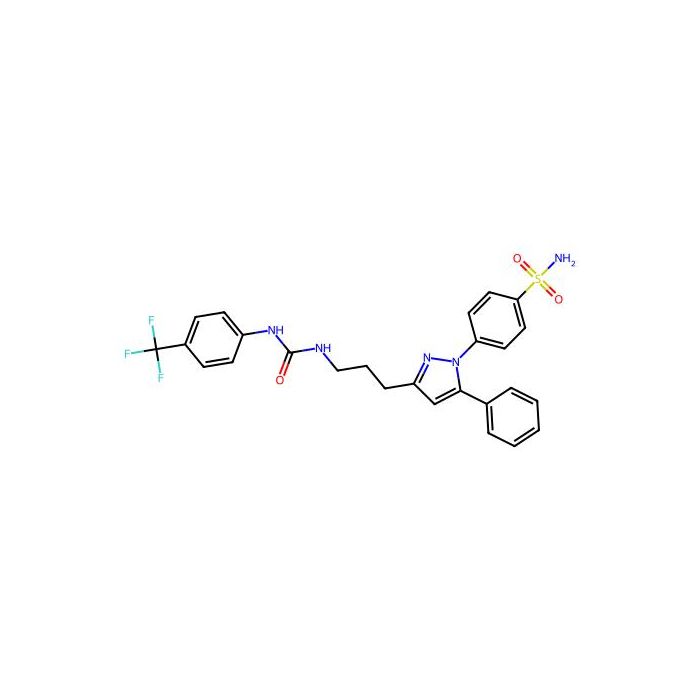
PTUPB is a potent and dual sEH and COX-2 enzymes inhibitor with IC 50 of 0.9 nM and 1.26 μM, respectively.
In Vitro
PTUPB (1-10 μM; 24 hours) shows an inhibitory activity against human 5-LOX, exhibits a 83% and 44% inhibition at 10 μM and 1 μM, respectively. PTUPB (10-20 μM; 72 hours) has minimal inhibitory effects on cell proliferation in multiple cancer cell lines, including human melanoma cell and a transformed endothelial cell, whereas it potently inhibits HUVEC proliferation after 3 days of application. PTUPB (10-20 μM; 72 hours) induces cell cycle arrest at the G0/1 phase at different various. The percentage of cell number of PTUPB are 65.15%, 66.87%,and 65.91% at 10 μM, 15 μM, and 20 μM, respectively. MCE has not independently confirmed the accuracy of these methods. They are for reference only. Cell Viability AssayCell Line: Multiple cancer cell lines: PC-3 cells, Met-1, H-1, A375, and transformed endothelial cell line (bEnd.3) Concentration: 10 μM, 15 μM, and 20 μM Incubation Time: 72 hours Result: Inhibited HUVEC proliferation after 3 days. Cell Cycle AnalysisCell Line: HUVECs Concentration: 10 μM, 15 μM, and 20 μM Incubation Time: 72 hours Result: Induced cell cycle arrest at the G0/1 phase.
In Vivo
PTUPB (subcutaneous injection; 30 mg/kg; 4 weeks) inhibits LLC tumor growth by 70-83% and exhibits with no overt toxicity, such as any weight loss when it is compared with the control group. After a period of treatment, the peak plasma concentration of PTUPB is high . PTUPB (subcutaneous injection; 5 mg/kg; once daily; 12 weeks) ameliorates high-fat diet-induced non-alcoholic fatty liver disease via inhibiting NLRP3 inflammasome activation. It reduces body weight, liver weight, liver triglyceride and cholesterol content. It also decreases the expression of lipolytic/lipogenic and lipid uptake related genes. MCE has not independently confirmed the accuracy of these methods. They are for reference only. Animal Model: C57BL/6 mice with LLC cells Dosage: 30 mg/kg; 4 weeks Administration: Subcutaneous injection via Alzet osmotic minipumps; once daily; 4 weeks Result: Inhibited LLC tumor growth and metastasis. Animal Model: High-fat diet (HFD)-induced obeseadult male C57BL/6 miceDosage: 5 mg/kg; 12 weeks Administration: Subcutaneous injection; once daily; 12 weeks Result: Arrested fibrotic progression and ameliorated high-fat diet-induced non-alcoholic fatty liver disease.
| Isómeros SMILES | C1=CC=C(C=C1)C2=CC(=NN2C3=CC=C(C=C3)S(=O)(=O)N)CCCNC(=O)NC4=CC=C(C=C4)C(F)(F)F |
|---|---|
| Términos de entrada MeSH | 1-(3-(5-phenyl-1-(4-sulfamoylphenyl)pyrazol-3-yl)propyl)-3-(4-(trifluoromethyl)phenyl)urea;dual inhibitor PTUPB |
| Peso molecular | 543.56 |
Comprehensive hazard, handling, storage, and regulatory compliance document.
Download SDS →Lot-specific quality data. Enter your lot number to retrieve the exact COA.
Look up COA →Full quality attributes and acceptance criteria for this grade.
View spec sheet →| Activity Type | Activity Value -log(M) | Mechanism of Action | Activity Reference | Publications (PubMed IDs) |
|---|