GRADE & PURITYMoligand™?Moligand™ — Aladdin's line of ligands and bioactive small molecules. Use for receptor, pathway, and binding studies needing defined small-molecule tools.10 mM in DMSO
Moligand™, 10 mM in DMSO Moligand™ for sensitive chromatographic and analytical workflows requiring minimal baseline interference.
🌡
Storage & shipping
Store at -80°C Ships Dry ice packs + Cold packs Check lot-specific COA for exact specifications.
📋
Quality documents
SDS, COA, datasheet, and spec sheet available for download. Lot-specific COA accessible via lot number lookup.
📚
Literature proof
Cited in 0 peer-reviewed publications across chromatography, organic synthesis, and cross-coupling reactions.
Descripción general
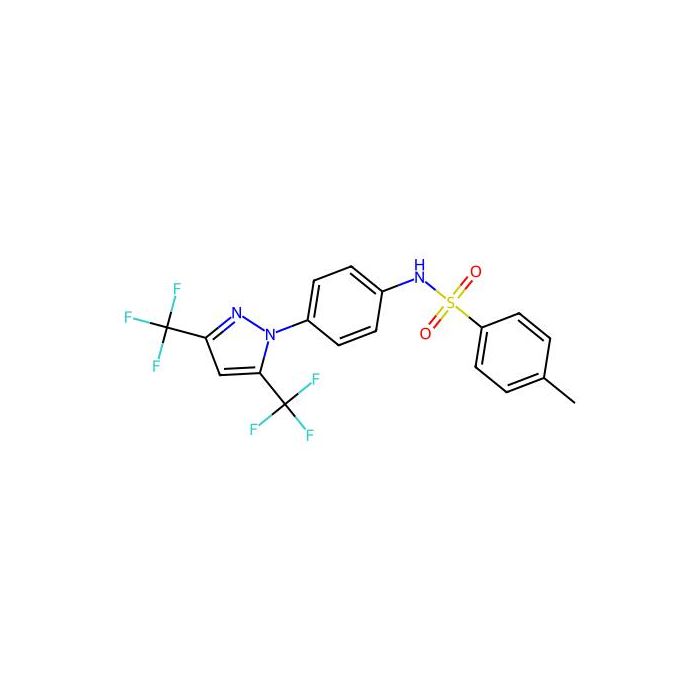
Pyr10 is a pyrazole derivative and a selective TRP cation 3 (TRPC3) inhibitor. Pyr10 inhibits Ca 2+ influx in carbachol-stimulated TRPC3 -transfected HEK293 cells with an IC 50 of 0.72 μM (IC 50 of 13.08 μM for store operated Ca 2+ entry in BRL-2H3 cells). Pyr10 has the ability to distinguish between receptor-operated TRPC3 and native stromal interaction molecule 1 (STIM1)/Orai1 channels.
Specifications
Especificaciones y pureza
Moligand™, 10 mM in DMSO
Condiciones de almacenamiento de almacenamiento
Store at -80°C
Enviado en
Dry ice packs + Cold packs
Este producto requiere envío en cadena de frío. Los servicios terrestres y otros servicios económicos no están disponibles.
Certificados (CoA, COO, BSE/TSE y tabla de análisis)
C of A & Other Certificates(BSE/TSE, COO):
Analytical Chart:
Calculadoras de soluciones
Molarity Calculator
Determine the necessary mass, volume, or concentration for preparing a solution.
Dilution Calculator
Determine the dilution needed to prepare a stock solution.
Reconstitution Calculator
Reseñas
Reseñas de cliente
Application Protocols
No item-specific validated application protocols (e.g., assay types, recommended dilutions, or controls) are provided for this product.
General protocol skeleton for preparing screening solutions (non-item-specific)
Stock preparation: Weigh the compound quickly at ambient conditions; dissolve in dry DMSO to 10–50 mM. Mix gently until fully dissolved.
Aliquoting: Dispense single-use aliquots (e.g., 10–50 µL) into low-bind tubes or microplates to avoid repeated freeze–thaw.
Working solutions: Dilute stocks into assay buffer to desired concentrations, targeting ≤0.5–1% DMSO in final volume. Include solvent controls and, if relevant, positive/negative assay controls.
Quality check: Confirm concentration by UV (if chromophore present) or LC–MS/UPLC. Inspect for precipitation after dilution and after incubation under assay conditions.
Adjust details to your assay modality and the confirmed structure. Always document lot number and preparation details in ELN/LIMS.
Biological Roles
No item-specific biological function, target assignment, or pathway role is provided for Pyr10.
General guidance for small-molecule screening ligands (non-item-specific)
Potential roles investigated in research settings include modulation of enzyme activity, receptor binding, or protein–protein interactions; actual relevance depends entirely on the verified structure and empirical data.
Before inferring mechanism, confirm batch identity/purity and control for aggregation or redox activity (e.g., use detergent controls, counterscreens, and PAINS filters once the structure is known).
Employ orthogonal assays (biophysical plus biochemical) to substantiate any observed activity and rule out assay interference (fluorescence quenching, metal chelation, redox cycling).
Note: For research use only. No clinical, diagnostic, or therapeutic claims are made or implied for this product.
Buffer Applications
This product is a small-molecule screening ligand, not a buffering agent. No item-specific pKa or buffering range is provided.
General guidance (non-item-specific)
Prepare working assay solutions by diluting DMSO stocks into your assay buffer (e.g., HEPES, Tris, PBS) ensuring final DMSO ≤1% v/v when possible.
If the compound is ionizable (structure-dependent), buffer pH can affect solubility and target interaction; run pH scouting studies after confirming the structure.
Include solvent-only controls and, when relevant, osmolarity-matched blanks.
For precise buffer recipes and pH windows, rely on the confirmed pKa values of the exact compound once available from the CoA or independent measurements.
Green Alternatives
While the compound itself is fixed, the green chemistry lever is typically solvent and workflow selection. Item-specific data are not provided; the following are general guidelines for preparing solutions and conducting assays more sustainably.
Greener solvent choices for stock preparation and analytics (general)
Prefer ethanol or water/ethanol when solubility allows; otherwise use minimal DMSO volume and dilute rapidly into aqueous buffer.
For HPLC, consider water–ethanol or water–acetonitrile gradients over DMF/NMP. Avoid chlorinated solvents where possible.
Comparison (general, non-item-specific)
DMSO vs 2-MeTHF/CPME: 2-MeTHF/CPME are greener for synthesis, but not practical for aqueous assay stocks. DMSO remains standard for HTS; minimize final v/v and waste.
ACN vs MeOH/Ethanol: ACN offers superior chromatographic performance; MeOH/Ethanol are greener but may impact separation and detector response.
Operational tips
Use small-volume, high-concentration master stocks to reduce solvent usage.
Adopt microplate formats compatible with low-dead-volume dispensing to cut waste.
Validate room-temperature solubilization to avoid unnecessary heating/cooling cycles.
Always balance green choices against assay performance and compound stability.
Pharmaceutical Uses
No pharmacopeial status, excipient role, or manufacturing use is provided for this item. It is supplied strictly for research use only.
General context (non-item-specific)
Small-molecule library members may be used in early discovery research (e.g., hit finding, SAR hypothesis generation) but are not qualified for human or veterinary applications.
If formulation studies are conducted for preclinical research, evaluate solubility/permeability using standard vehicles (e.g., PEG400/water, Captisol, lipid-based systems) only after confirming the exact structure and adhering to institutional research policies.
Compliance note
Not intended for API manufacture, GMP use, or clinical evaluation. Refer to CoA and SDS for any available quality attributes and handle under research-grade SOPs.
Physical Properties
Item-specific values
Molecular weight: Not specified for this item; refer to CoA/Spec Sheet.
Molecular formula: Not specified for this item; refer to CoA/Spec Sheet.
Melting point: Not specified for this item; refer to CoA/Spec Sheet.
Boiling point: Not specified for this item; refer to CoA/Spec Sheet.
Density: Not specified for this item; refer to CoA/Spec Sheet.
Refractive index: Not applicable/unknown for solids; Not specified for this item; refer to CoA/Spec Sheet.
UV/Vis characteristics (e.g., cutoff, ε): Not specified for this item; refer to CoA/Spec Sheet.
Purity specification, residual solvents, water/peroxide/metal limits: Not specified for this item; refer to CoA/Spec Sheet.
General/literature guidance for small-molecule screening compounds (non-item-specific)
Solubility: Most heteroaromatic ligands dissolve well in DMSO (10–50 mM stocks common). A co-solvent system (e.g., DMSO + aqueous buffer containing 0.5–1% v/v DMSO) is typical for assays.
Ionizability: If the scaffold contains basic nitrogens (e.g., pyridine), aqueous solubility may increase under mildly acidic conditions (pH 4–6); acidic substituents favor mildly basic media (pH 8–9). Verify for the exact structure.
LogP/logD: Screening ligands often span logP ~1–4 (literature, chemotype dependent). Confirm experimentally for this item.
Practical note: Establish solubility and stability experimentally on receipt (small DMSO titration, visual inspection, and analytic confirmation by HPLC/LC–MS).
Moligand™ indicates inclusion in a small-molecule/ligand collection intended for screening, SAR exploration, and hit validation. It typically emphasizes identity confirmation and suitability for assay preparation.
Exact purity, residual solvent limits, and analytical release criteria are Not specified for this item; refer to CoA/Spec Sheet.
What the grade generally implies (general guidance)
Identity control: Characterization by LC–MS and/or NMR is typical for library members to confirm molecular identity; confirm the actual techniques used from the CoA.
Assay readiness: Compounds are commonly suitable for preparation of DMSO stocks for biochemical or cell-free assays (research use only). Low water content and verified solubility ranges may be provided on the CoA.
Trace contaminants: For sensitive assays (e.g., fluorescence), check CoA for fluorescent impurities or strong UV absorbers at assay wavelengths.
Best practices on receipt
Verify identity and purity under your internal SOPs (e.g., LC–MS purity check at multiple wavelengths, orthogonal HPLC method, 1H NMR if quantity allows).
Establish a stability plan (aliquoting at −80°C, light protection, limited freeze–thaw) and record lot-specific observations (color, solubility, any precipitation upon dilution).
Research use note
For research use only; not for human or veterinary use. No pharmacopoeial grade is claimed for this item.
Reaction and Applications
This product is positioned as a screening ligand (Moligand™) rather than a synthetic reagent. No item-specific reaction roles are provided.
General research applications (non-item-specific)
Biochemical/biophysical assays: Evaluate binding to protein targets using fluorescence polarization, thermal shift (DSF), differential scanning calorimetry, or SPR.
Cell-free enzymology: Determine IC50 or Ki against purified enzymes; apply tight-binding analysis if warranted.
Chemical biology: Probe target engagement in lysates using CETSA or affinity-enrichment if a handle is available (requires derivative synthesis).
SAR exploration: Use as a reference chemotype; analog design guided by computed properties and docking when the exact structure is known.
If synthetic use is intended
Without a verified structure, reactivity cannot be prescribed. After obtaining the CoA structure, strategize functional group interconversions (FGIs) and late-stage diversification to build a small analog set (e.g., Suzuki/Negishi if aryl halides are present; amide couplings if carboxyl/amine functionality exists).
Important: Do not deploy in target-driven or mechanistic studies until the exact structure and purity are confirmed for your batch.
Reaction Conditions
No item-specific reactivity or optimal reaction conditions are supplied for this product.
General guidance (non-item-specific)
For any synthetic transformations involving the confirmed scaffold, choose conditions based on functional-group compatibility (e.g., palladium cross-couplings in polar aprotic solvents like DMAc/DMF at 60–100°C; amide couplings in DMF/DCM at 0–25°C; heteroaromatic substitutions under SNAr conditions in DMSO/DMF with bases such as Cs2CO3 or K2CO3).
For analytical stability, avoid prolonged exposure to strong acids/bases and oxidative environments until the compound’s stability profile is established.
If the compound is moisture/light sensitive (unknown), handle under inert atmosphere and protect from light as precautionary measures.
Because the exact structure is not provided here, treat these as general literature-informed ranges only; develop stepwise with in-process analytics.
Safety and Handling
GHS/SDS
GHS classification, signal word, pictograms, and H-statements: Not specified for this item; refer to the Safety Data Sheet (SDS).
General laboratory precautions (non-item-specific)
Handle in a chemical fume hood; avoid inhalation of dust/aerosols and skin/eye contact.
Personal protective equipment: lab coat, safety glasses, and appropriate chemically resistant gloves (e.g., nitrile). Change gloves regularly when working with DMSO solutions.
Avoid ingestion and environmental release; collect waste in appropriate organic waste streams.
First-aid overview (defer to SDS for authoritative steps)
Inhalation: Move to fresh air; seek medical attention if symptoms persist.
Skin contact: Wash with soap and water; remove contaminated clothing.
Eye contact: Rinse cautiously with water for several minutes; remove contact lenses if present and easy to do; seek medical advice.
Ingestion: Rinse mouth; do not induce vomiting; seek medical attention.
Stability/incompatibilities (general)
Protect from light and moisture until structure-specific stability is verified.
Avoid strong oxidizers and reactive bases/acids unless compatible with the confirmed structure.
Note: Unknown toxicological profile—treat as potentially harmful. Always consult the SDS accompanying your batch for exact hazard information.
Solvent Selection
Item-specific solvent properties are not provided; the following are general, structure-agnostic recommendations for small-molecule screening compounds.
Primary stock solvent
DMSO is the default for small-molecule libraries due to broad solvating power and assay compatibility at ≤1% v/v in final wells.
Secondary options
DMF or NMP for challenging cases; subsequently back-dilute into aqueous buffers.
For neutral/aromatic compounds with limited polarity: ACN or ethanol (then buffer). For ionizable scaffolds: adjust pH to favor ionized state during aqueous dilution.
Aqueous miscibility
DMSO, DMF, ACN, ethanol are fully miscible with water; pre-warm to 25–37°C if precipitation occurs upon dilution.
Additives
0.01–0.05% nonionic surfactant (e.g., Tween-20, Pluronic F-127) can improve dispersion for hydrophobic compounds; validate assay tolerance.
Small comparison (general)
DMSO: maximal solubility, common in HTS; potential cell toxicity above ~1–2% v/v.
ACN: volatile, LC–MS friendly; lower solubility for hydrophobes than DMSO.
Ethanol: benign but limited solubility window for many heteroaromatics.
Always confirm solvent choice empirically using the verified structure and assay constraints.
Storage and Reconstitution
Item-specific (from Product Data)
Storage conditions: Store at −80°C.
Shipping: Dry ice packs + cold packs.
General best practices for small-molecule screening compounds (non-item-specific)
Upon receipt: Allow the sealed container to warm to refrigerator temperature before opening to minimize moisture condensation. If provided as a solid, desiccate under inert gas if possible.
Aliquoting: Prepare small, single-use aliquots (e.g., 10–50 µL DMSO stocks at 10–50 mM) to avoid repeated freeze–thaw cycles.
Light/moisture protection: Store in amber vials/microtubes with PTFE-lined caps; include desiccant where appropriate.
Freeze–thaw: Minimize cycles; thaw on ice or at room temperature briefly, mix gently, and refreeze promptly. Discard aliquots showing precipitation or discoloration upon thawing.
Stability checks: Periodically assess by LC–MS/HPLC to monitor for degradation; record any mass shifts or new peaks.
Reconstitution guidance (structure-agnostic)
Start with dry DMSO to prepare a 10 mM stock; increase concentration stepwise if solubility allows. If insoluble, trial DMF or NMP, then back-dilute into buffer.
Note: Exact solubility, hygroscopicity, and light sensitivity are Not specified for this item; refer to CoA/Spec Sheet and confirm experimentally.
Structure and Identity
Brief overview: Pyr10 (SKU P1498865) is supplied as a Moligand-grade small-molecule library member intended for research screening.
Item-specific (from Product Data)
Product name: Pyr10
CAS: 1315323-00-2
PubChem CID: 53475435
Grade: Moligand™ (research screening library)
Storage: −80°C; shipped on dry ice + cold packs
Structure descriptors
Molecular formula: Not specified for this item; refer to CoA/Spec Sheet.
Molecular weight: Not specified for this item; refer to CoA/Spec Sheet.
SMILES: Not specified for this item; refer to CoA/Spec Sheet.
InChIKey: Not specified for this item; refer to CoA/Spec Sheet.
Structural features (general guidance)
The product name “Pyr10” often denotes a heteroaromatic chemotype (e.g., pyridine/pyrimidine/pyrrole motifs) in screening libraries; the exact ring system and substitution pattern for this item are not provided here. Consult the CoA/Spec Sheet or vendor record linked to the CAS/CID for definitive structure.
2D structural description (general)
Without an item-specific structure, only generic heteroaromatic features can be presumed for “Pyr-” series compounds (sp2 ring(s) with one or more ring nitrogens); do not rely on this for experimental design—verify the exact structure from the CoA.
Note: Always base mechanistic or SAR interpretations on the verified structure from the certificate of analysis.
Synthetic Utility
Item-specific functional groups and handles are not provided; therefore, concrete synthetic roles cannot be prescribed for Pyr10.
General considerations once the structure is confirmed (non-item-specific)
If the scaffold contains aryl halides or boron species: applicable to cross-coupling (Suzuki–Miyaura, Buchwald–Hartwig for aryl amination if halides are present with amine partners).
If carboxyl/amine functions exist: amide couplings (HATU/EDC), urea/carbamate formation, and salt formation for property tuning.
If heteroaromatic nitrogens are present: N-oxidation, quaternization, or directed metalation strategies can enable late-stage diversification.
If there are electrophilic motifs: consider nucleophile additions or conjugate additions for probe synthesis (e.g., attaching affinity tags or photo-crosslinkers).
Use in SAR
The supplied molecule can serve as a benchmark for analog design. With the structure in hand, map vector positions for substitution and perform property-based design (cLogP, Fsp3, TPSA) to target assay-relevant space.
Always verify reactivity with small-scale scouting experiments and analytical follow-up (LC–MS, NMR).
Target Specificity
No target assignment, binding data, or selectivity profile is provided for Pyr10.
Guidance for users (non-item-specific)
Determine specificity empirically using orthogonal assays (e.g., DSF/thermal shift, SPR/BLI, enzymatic inhibition, and competition studies) once the structure is confirmed.
Incorporate selectivity panels against related targets; measure kinetic parameters (kon/koff) if feasible.
Control for promiscuity and assay interference (detergent sensitivity, redox/covalent reactivity, aggregation) using standard counterscreens.
Preguntas frecuentes
What is Moligand??
Moligand? is one of Aladdin Scientific's premium product lines, formulated for high-purity applications across multiple workflows. Compared to standard grades in the same workflow, Moligand? products typically offer tighter specifications, more rigorous QC, and stronger lot-to-lot consistency.
How should this product be stored?
Store at ?80 °C. Ultra-low temperature storage is required to maintain the specified shelf life.
How is this product shipped?
This product ships frozen with dry ice and cold packs. Unpack on arrival and transfer it to the storage condition stated above; handle dry ice with insulated gloves in a ventilated area.
What are the CAS number, molecular formula and molecular weight?
The CAS Number is 1315323-00-2, the molecular formula is C18H13F6N3O2S, and the molecular weight is 449.37 g/mol.
What documentation is provided?
Available product documentation, including Certificates of Analysis (COA), Safety Data Sheets (SDS), and specification sheets, is shown in the product document area. Document availability and access follow the current site policy.
Need help choosing the grade?
Our grade selection guide covers purity, stabilizer status, and application suitability for all variants in our catalog.
We use cookies to ensure the website functions properly and, where permitted, to improve your experience. You can manage your preferences at any time in Settings. Learn more in our Cookie Policy.
Shall we send you a message when we have discounts available?
Remind me later
Thank you! Please check your email inbox to confirm.
Products are supplied to verified businesses, institutions, and qualified professionals for research and development use only. Not for use in humans, animals, diagnosis, or therapy.