
Determine the necessary mass, volume, or concentration for preparing a solution.
| Activity Type | Relation | Activity value | Units | Action Type | Journal | PubMed Id | doi | Assay Aladdin ID |
|---|
10mM in DMSO for sensitive chromatographic and analytical workflows requiring minimal baseline interference.
Store at -80°C Ships Dry ice packs + Cold packs Check lot-specific COA for exact specifications.
SDS, COA, datasheet, and spec sheet available for download. Lot-specific COA accessible via lot number lookup.
Cited in 6 peer-reviewed publications across chromatography, organic synthesis, and cross-coupling reactions.
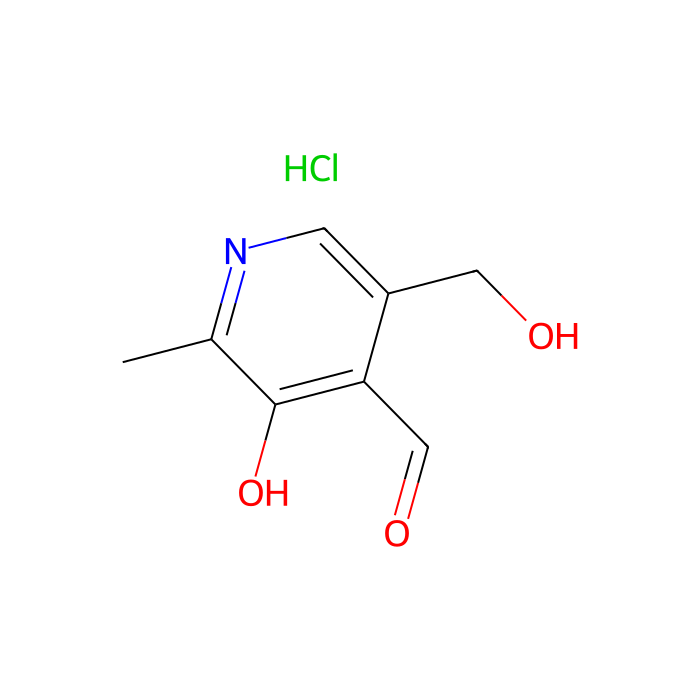
Pyridoxal hydrochloride is used in labeling of amino acids for their detection. It finds application in neurotransmitters, sphingolipids and aminolevulinic acid. It is also used as a nutritional agent. It is also applied in research studies like biochemical, drugs and in media supplements.
| Sonrisas canónicas | CC1=NC=C(C(=C1O)C=O)CO.Cl |
|---|---|
| IUPAC Name | 3-hydroxy-5-(hydroxymethyl)-2-methylpyridine-4-carbaldehyde;hydrochloride |
| InChIKey | FCHXJFJNDJXENQ-UHFFFAOYSA-N |
| INCHI | 1S/C8H9NO3.ClH/c1-5-8(12)7(4-11)6(3-10)2-9-5;/h2,4,10,12H,3H2,1H3;1H |
| Isómeros SMILES | CC1=NC=C(C(=C1O)C=O)CO.Cl |
| WGK Alemania | 2 |
| RTECS | UV1225000 |
| Peso molecular | 203.62 |
| Beilstein | 3656994 |
| Reaxy-Rn | 3656994 |
| Reaxys-RN_link_address | https://www.reaxys.com/reaxys/secured/hopinto.do?context=S&query=IDE.XRN=3656994&ln= |
Comprehensive hazard, handling, storage, and regulatory compliance document.
Download SDS →Lot-specific quality data. Enter your lot number to retrieve the exact COA.
Look up COA →Full quality attributes and acceptance criteria for this grade.
View spec sheet →Taxonomy Tree
| Kingdom | Organic compounds |
|---|---|
| Superclass | Organoheterocyclic compounds |
| Clase | Pyridines and derivatives |
| Subclass | Pyridine carboxaldehydes |
| Intermediate Tree Nodes | Not available |
| Direct Parent | Pyridoxals and derivatives |
| Alternative Parents | Methylpyridines Hydroxypyridines Aryl-aldehydes Vinylogous acids Heteroaromatic compounds Azacyclic compounds Primary alcohols Organopnictogen compounds Organonitrogen compounds Organic oxides Hydrochlorides Hydrocarbon derivatives Aromatic alcohols |
| Molecular Framework | Aromatic heteromonocyclic compounds |
| Substituents | Pyridoxal - Aryl-aldehyde - Methylpyridine - Hydroxypyridine - Vinylogous acid - Heteroaromatic compound - Azacycle - Alcohol - Hydrocarbon derivative - Organic oxide - Hydrochloride - Organopnictogen compound - Organic oxygen compound - Aromatic alcohol - Organic nitrogen compound - Primary alcohol - Organooxygen compound - Organonitrogen compound - Aldehyde - Aromatic heteromonocyclic compound |
| Descripción | This compound belongs to the class of organic compounds known as pyridoxals and derivatives. These are compounds containing a pyridoxal moiety, which consists of a pyridine ring substituted at positions 2,3,4, and 5 by a methyl group, a hydroxyl group, a carbaldehyde group, and a hydroxymethyl group, respectively. |
| External Descriptors | Not available |
| Activity Type | Relation | Activity value | Units | Action Type | Journal | PubMed Id | doi | Assay Aladdin ID |
|---|
| Activity Type | Relation | Activity value | Units | Action Type | Journal | PubMed Id | doi | Assay Aladdin ID |
|---|
| Activity Type | Relation | Activity value | Units | Action Type | Journal | PubMed Id | doi | Assay Aladdin ID |
|---|
| Activity Type | Relation | Activity value | Units | Action Type | Journal | PubMed Id | doi | Assay Aladdin ID |
|---|
| Sensibilidad | Light Sensitive,Air Sensitive |
|---|---|
| Punto de fusión (°C) | 172°C |
| Peso molecular | 203.620 g/mol |
| XLogP3 | |
| Hydrogen Bond Donor Count | 3 |
| Hydrogen Bond Acceptor Count | 4 |
| Rotatable Bond Count | 2 |
| Exact Mass | 203.035 Da |
| Monoisotopic Mass | 203.035 Da |
| Topological Polar Surface Area | 70.400 Ų |
| Heavy Atom Count | 13 |
| Formal Charge | 0 |
| Complexity | 162.000 |
| Isotope Atom Count | 0 |
| Defined Atom Stereocenter Count | 0 |
| Undefined Atom Stereocenter Count | 0 |
| Defined Bond Stereocenter Count | 0 |
| Undefined Bond Stereocenter Count | 0 |
| The total count of all stereochemical bonds | 0 |
| Covalently-Bonded Unit Count | 2 |
| 1. Deng Hao-Hua, Yang Hui-Jing, Huang Kai-Yuan, Zheng Yi-Jing, Xu Ying-Ying, Peng Hua-Ping, Liu Yin-Huan, Chen Wei, Hong Guo-Lin. (2022) Antenna effect of pyridoxal phosphate on the fluorescence of mitoxantrone-silicon nanoparticles and its application in alkaline phosphatase assay. ANALYTICAL AND BIOANALYTICAL CHEMISTRY, 414 (17): (4877-4884). [PMID:35576012] [10.1007/s00216-022-04110-7] |
| 2. Hao-Hua Deng, Kai-Yuan Huang, Quan-Hui Fang, Ya-Ping Lv, Shao-Bin He, Hua-Ping Peng, Xing-Hua Xia, Wei Chen. (2020) Schiff base and Lewis acid-base interaction-regulated aggregation/dispersion of gold nanoparticles for colorimetric recognition of rare-earth Sc3+ ions. SENSORS AND ACTUATORS B-CHEMICAL, [PMID:] [10.1016/j.snb.2020.127925] |
| 3. Q. Huang, Y. T. Chen, Y. W. Ren, Z. Y. Wang, Y. X. Zhu, Y. Zhang. (2018) A rapid and naked-eye visible rhodamine 6G-based chemosensor for sensitive detection of copper(II) ions in aqueous solution. Analytical Methods, 10 (47): (5731-5737). [PMID:] [10.1039/C8AY02019A] |
| 4. Su Yao, Gongke Li, Yanqing Liu, Shoulian Wei, Hongwu Wang, Xiqing Huang, Zetao Luo. (2018) Electrochemical detection of pyridoxal using a sonoelectrochemical prepared highly-oxidized carbon nanosheets modified electrode. SENSORS AND ACTUATORS B-CHEMICAL, [PMID:] [10.1016/j.snb.2018.07.106] |
| 5. Qi Huang, Qingyou Zhang, Enze Wang, Yanmei Zhou, Han Qiao, Lanfang Pang, Fang Yu. (2015) A new “off–on” fluorescent probe for Al3+ in aqueous solution based on rhodamine B and its application to bioimaging. SPECTROCHIMICA ACTA PART A-MOLECULAR AND BIOMOLECULAR SPECTROSCOPY, [PMID:26196932] [10.1016/j.saa.2015.07.062] |
| 6. Jinnian Wang, Haoming Zhao, Shijun Tong, Xingjian Zhang, Shuyu Ding, Han Zhang, Zhong-Hua Yang. (2026) Cascade biocatalysis for pyridoxal 5′-phosphate synthesis with ATP autonomy via polyphosphate kinase. BIOORGANIC CHEMISTRY, [PMID:41564697] [10.1016/j.bioorg.2026.109518] |