Background Introduction
The Bradford Protein Assay Kit is a ready-to-use, stable traditional Bradford assay formulation for determining total protein concentration relative to a protein standard. The kit includes Bradford assay solution and ready-to-use diluted BSA standard solution, which was originally described by Bradford in 1976. When mixed with protein solutions, the color of the acidic Coomassie dye reagent changes from brown to blue in a manner proportional to the amount of protein present in the sample. Protein determination is performed by comparing the color response with that of a protein detection standard prepared as a known dilution series, typically as bovine serum albumin (BSA) or bovine gamma globulin (BGG). The simple procedure is suitable for almost any volume scale, including test tubes, cuvettes, and microplates. The protein detection is compatible with most salts, solvents, buffers, thiols, reducing substances, and metal chelators encountered in protein samples.
Product Features
1. The detection speed is extremely fast, with 10 to 80 samples completed in less than 10 minutes.
2. Convenient and efficient, it provides ready-to-use standards, eliminating the need for cumbersome dilution procedures.
3. It has high sensitivity, with a detection concentration lower limit of 25 μg/mL.
4. It has a good linear relationship within the concentration range of 50-2000 μg/mL.
5. The Bradford method for protein concentration determination is not affected by most chemical substances in the samples. However, it is affected by slightly higher concentrations of detergents. It is necessary to ensure Triton X-100 is less than 0.1%, and Tween 20 less than 0.008%. For samples containing detergents, it is recommended to use our BCA Protein Assay Kit (catalog number B1507333) or Ready-to-use Bradford Protein Assay Kit (Detergent Compatible) (catalog number B1509656).
6. Applicable to spectrophotometers or microplate readers.

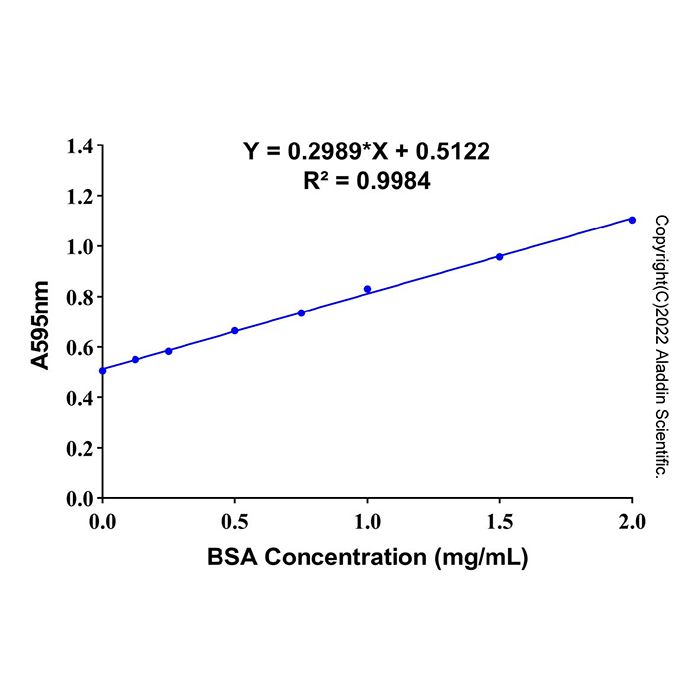
Figure 1. The actual measurement result of the protein standard curve of this kit. The data shown in the figure are for reference only; the actual detection outcome may vary slightly.
Instruction for use
A. Microplate quantification assay (detection range = 50-2000 μg/mL)
1. Take 5 μL of the BSA standard and unknown samples respectively to the corresponding labeled microplate wells.
2. Add 250 μL of the bradford sssay solution to each well, mix well and shake thoroughly for 30 seconds.
3. Stop shaking. For most cases, incubate the samples at room temperature for 10 minutes.
4. Measure the absorbance at 595 nm in the reading instrument. The absorbance can be measured immediately, or within 2 hours. There is no significant change in the detection data within 2 hours.
5. Draw a standard curve and calculate the protein concentration in the sample.
B. Micro-microplate quantification assay (detection range = 1-25 μg/mL)
1. Take 150 μL of the BSA standard and unknown samples respectively to the corresponding labeled microplate wells.
2. Add 150 μL of bradford assay solution to each well, mix well and shake thoroughly for 30 seconds.
3. Stop shaking. For most cases, incubate the sample at room temperature for 10 minutes.
4. Measure the absorbance value at 595 nm in the reading instrument. The absorbance can be determined immediately or within 2 hours. There is no significant change in the detection data within 2 hours.
5. Draw a standard curve and calculate the protein concentration in the sample.
Matters needing attention
1. Reverting the G250 staining solution to room temperature before use is beneficial for enhancing the sensitivity of the detection. Before using the G250 staining solution, please invert it 3-5 times and mix well.
2. Some cations, such as K⁺, Na⁺, Mg²⁺, (NH₄)₂SO₄, ethanol and other substances do not interfere with the measurement, but large amounts of detergents such as TritonX-100, SDS, etc. severely interfere with the measurement.
3. It is recommended that a standard curve be plotted each time the concentration of the protein sample is determined, in order to obtain accurate data. If the protein concentration is not within the range of the standard curve, please dilute the sample and measure it again.
4. For your safety and health, please wear laboratory coats and use disposable gloves during the operation.
Interferon Substance Table


 ZJ26F0434207