GRADE & PURITYAnimal Free?Animal-free — produced without animal-derived components to reduce contamination risk. Use in biomanufacturing and culture avoiding animal-origin material.Carrier Free?Carrier-free — supplied without added carrier protein/stabilizer. Use when carriers (e.g. BSA) would interfere with conjugation or sensitive assays.Azide Free?Azide-free — without sodium azide preservative. Use in conjugations, cell work, or assays where azide is toxic or inhibitory.His Tag?His tag grade — recombinant protein bearing a His tag for affinity purification/detection. Use to purify, immobilize, or detect the tagged protein.PBS Only?PBS-only formulation — supplied in phosphate-buffered saline with no other additives. Use when you need a clean PBS buffer free of stabilizers/carriers.≥95%(SDS-PAGE)
Animal Free,Carrier Free,Azide Free,His Tag,PBS Only,≥95%(SDS-PAGE) Animal Free,Azide Free,Carrier Free,His Tag,PBS Only for sensitive chromatographic and analytical workflows requiring minimal baseline interference.
🌡
Storage & shipping
Store at -20°C,Avoid repeated freezing and thawing Ships Ice chest + Ice pads Check lot-specific COA for exact specifications.
📋
Quality documents
SDS, COA, datasheet, and spec sheet available for download. Lot-specific COA accessible via lot number lookup.
📚
Literature proof
Cited in 0 peer-reviewed publications across chromatography, organic synthesis, and cross-coupling reactions.
Descripción general
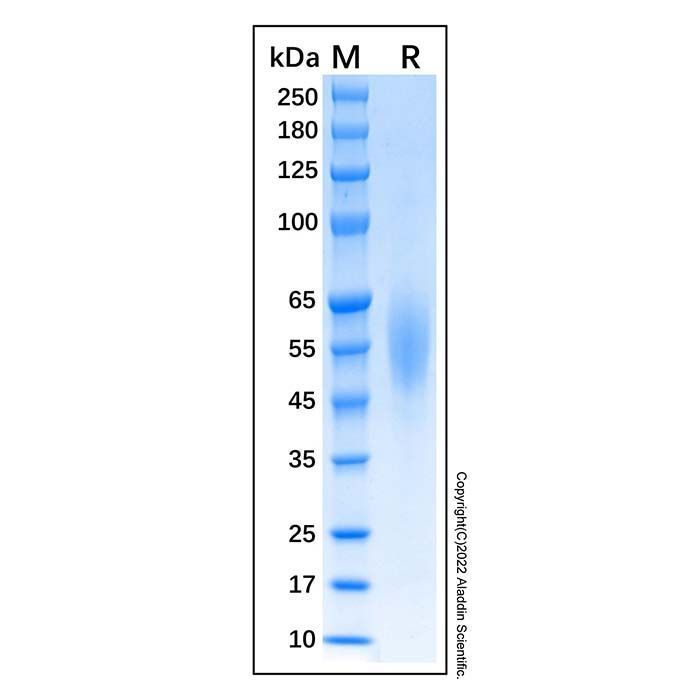
Purity:>95%, by SDS-PAGE visualized with Coomassie® Blue Staining. Description: CD200 R1, also known as OX-2 receptor, is a 90 kDa transmembrane protein in the immunoglobulin superfamily and is important in the regulation of myeloid cell activity. The human CD200 R1 cDNA encodes a 325 amino acid (aa) precursor that includes a 28 aa signal sequence, a 215 aa extracellular domain (ECD), a 21 aa transmembrane segment, and a 61 aa cytoplasmic domain. The ECD is composed of one Ig-like V-type domain and one Ig-like C2-type domain. Within the ECD, human CD200 R1 shares 56% aa sequence identity with both mouse and rat CD200 R1. Alternate splicing of the human CD200 R1 mRNA generates four isoforms, two of which are truncated in the Ig-C2 domain and are likely secreted. In human, a separate CD200 RL gene encodes a protein that shares 81% ECD aa identity with CD200 R1. In mouse, at least four genes for CD200 R1-like molecules have been described. CD200 R1 expression is restricted primarily to mast cells, basophils, macrophages, and dendritic cells, while its ligand, CD200, is widely distributed. Disruption of this receptor-ligand system by knockout of the CD200 gene in mice leads to increased macrophage number and activation and predisposition to autoimmune disorders. Association of CD200 with CD200 R1 takes place between their respective N-terminal Ig-like domains. The capacity of CD200 R1-like molecules to interact with CD200 is controversial. CD200 R1 propagates inhibitory signals despite lacking a cytoplasmic ITIM (immunoreceptor tyrosine-based inhibitory motif). CD200 R1-like molecules, in contrast, are potentially activating receptors by means of their association with DAP12. CD200R1 signaling inhibits the expression of proinflammatory molecules including TNFs, IFNs, and inducible nitric oxide synthase in response to selected stimuli, which implicate that CD200/CD200R1 inhibitory signaling pathway plays a prominent role in limiting inflammation in a wide range of inflammatory diseases. Furthermore, the CD200/CD200R inhibitory signaling constitutes one of the most suitable endogenous immunoregulatory molecule candidate to restore the immune suppressive status of the CNS altered in chronic neuroinflammatory situations.
Specifications
Product Name
Recombinant Human CD200R1 Protein, >95% (SDS-PAGE)
We recommend that this vial be briefly centrifuged prior to opening to bring the contents to the bottom. Reconstitute at 0.5 mg/mL in sterile distilled water. Stock solutions should be apportioned into working aliquots and stored at ≤ -20 °C. Further dilutions should be made in appropriate buffered solutions.
Condiciones de almacenamiento de almacenamiento
Store at -20°C,Avoid repeated freezing and thawing
Enviado en
Ice chest + Ice pads
Estabilidad y almacenamiento
Store at -20°C for 1 year. Avoid freeze / thaw cycle.
Imágenes
Recombinant Human CD200R1 Protein (rp176725) - SDS-PAGE 3 μg/lane of Recombinant Human CD200R1 Protein was resolved with SDS-PAGE under reducing (R) conditions and visualized by Coomassie® Blue staining, showing a band at 50.0-65.0 kDa under reducing conditions.
Documentation
📋 Safety Data Sheet (SDS)
Comprehensive hazard, handling, storage, and regulatory compliance document.
We use cookies to ensure the website functions properly and, where permitted, to improve your experience. You can manage your preferences at any time in Settings. Learn more in our Cookie Policy.
Shall we send you a message when we have discounts available?
Remind me later
Thank you! Please check your email inbox to confirm.
Products are supplied to verified businesses, institutions, and qualified professionals for research and development use only. Not for use in humans, animals, diagnosis, or therapy.

 ZJ24F0303507