GRADE & PURITYCarrier Free?Carrier-free — supplied without added carrier protein/stabilizer. Use when carriers (e.g. BSA) would interfere with conjugation or sensitive assays.Bioactive?Bioactive grade — verified to retain biological activity in functional assays. Use when the molecule must be functionally active, not just pure.ActiBioPure™?ActiBioPure™ — Aladdin's premier line for bioactive and recombinant products. Use when both high purity and preserved biological activity are required.High Performance?High-performance grade with optimized purity and performance characteristics. Use for sensitive analyses where ordinary grades fall short.≥95%(SDS-PAGE)
Expression System
E. coli
Accession #
P05230
Protein Tag
No tag
Expression system
E. coli
Endotoxin Concentration
<1.0 EU/μg
Bioactivity
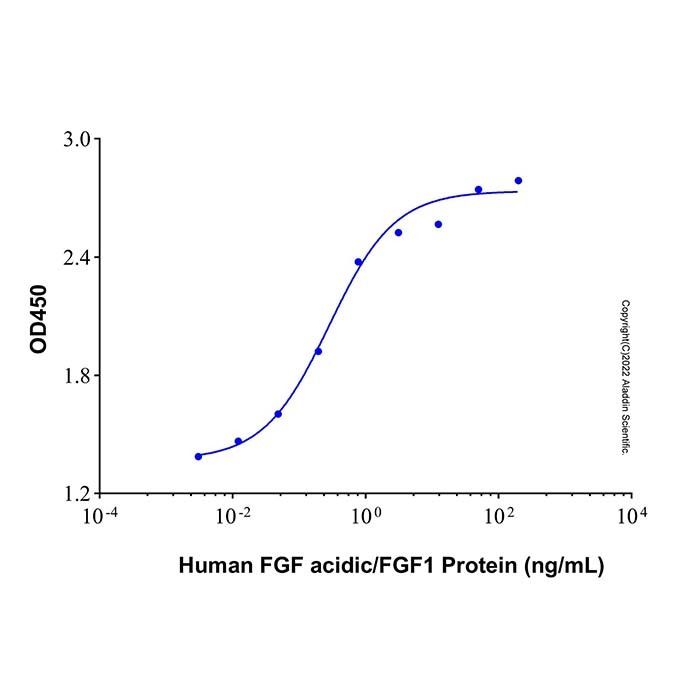
Measured in a cell proliferation assay using BALB/3T3 mouse embryo fibroblasts cell line in the presence of 10 µg/mL heparin sodium (H104201). The ED50 for this effect is typically 0.28 ng/mL.
ActiBioPure™, Bioactive, Carrier Free, High performance, ≥95%(SDS-PAGE) ActiBioPure™,Bioactive,Carrier Free,High Performance for sensitive chromatographic and analytical workflows requiring minimal baseline interference.
🌡
Storage & shipping
Store at -20°C,Avoid repeated freezing and thawing Ships Ice chest + Ice pads Check lot-specific COA for exact specifications.
📋
Quality documents
SDS, COA, datasheet, and spec sheet available for download. Lot-specific COA accessible via lot number lookup.
📚
Literature proof
Cited in 0 peer-reviewed publications across chromatography, organic synthesis, and cross-coupling reactions.
Descripción general
Protein Function: FGF acidic, also known as FGF1, ECGF, and HBGF-1, is a 17 kDa nonglycosylated member of the FGF family of mitogenic peptides. FGF acidic, which is produced by multiple cell types, stimulates the proliferation of all cells of mesodermal origin and many cells of neuroectodermal, ectodermal, and endodermal origin. It plays a number of roles in development, regeneration, and angiogenesis. Human FGF acidic shares 54% amino acid sequence identity with FGF basic and 17%‑33% with other human FGFs. It shares 92%, 96%, 96%, and 96% aa sequence identity with bovine, mouse, porcine, and rat FGF acidic, respectively, and exhibits considerable species crossreactivity. Alternate splicing generates a truncated isoform of human FGF acidic that consists of the N-terminal 40% of the molecule and functions as a receptor antagonist. During its nonclassical secretion, FGF acidic associates with S100A13, copper ions, and the C2A domain of synaptotagmin 1. It is released extracellularly as a disulfide-linked homodimer and is stored in complex with extracellular heparan sulfate. The ability of heparan sulfate to bind FGF acidic is determined by its pattern of sulfation, and alterations in this pattern during embryogenesis thereby regulate FGF acidic bioactivity. The association of FGF acidic with heparan sulfate is a prerequisite for its subsequent interaction with FGF receptors. Ligation triggers receptor dimerization, transphosphorylation, and internalization of receptor/FGF complexes. Internalized FGF acidic can translocate to the cytosol with the assistance of Hsp90 and then migrate to the nucleus by means of its two nuclear localization signals. The phosphorylation of FGF acidic by nuclear PKC delta triggers its active export to the cytosol where it is dephosphorylated and degraded. Intracellular FGF acidic functions as a survival factor by inhibiting p53 activity and proapoptotic signaling.
ActiBioPure™, Bioactive, Carrier Free, High Performance
Especificaciones y pureza
ActiBioPure™, Bioactive, Carrier Free, High performance, ≥95%(SDS-PAGE)
Bioactividad
Measured in a cell proliferation assay using BALB/3T3 mouse embryo fibroblasts cell line in the presence of 10 µg/mL heparin sodium (H104201). The ED50 for this effect is typically 0.28 ng/mL.
14.3 kDa, under reducing conditions; 14.2 kDa, under non-reducing conditions
Tipo de molécula
Protein
Almacenamiento y envío
Reconstitución
We recommend that this vial be briefly centrifuged prior to opening to bring the contents to the bottom. Reconstitute at 1.0 mg/mL in sterile distilled water. Stock solutions should be apportioned into working aliquots and stored at ≤ -20 °C. Further dilutions should be made in appropriate buffered solutions.
Condiciones de almacenamiento de almacenamiento
Store at -20°C,Avoid repeated freezing and thawing
Enviado en
Ice chest + Ice pads
Estabilidad y almacenamiento
Store at -20°C for 1 year. Avoid freeze / thaw cycle.
Imágenes
Recombinant Human FGF acidic/FGF1 Protein (rp170413) - Protein Bioactivity Measured in a cell proliferation assay using BALB/3T3 mouse embryo fibroblasts cell line in the presence of 10 µg/mL heparin sodium (H104201). The ED₅₀ for this effect is typically 0.28 ng/mL.
Recombinant Human FGF acidic/FGF1 Protein (rp170413) - SDS-PAGE 3 μg/lane of Recombinant Human FGF acidic/FGF1 Protein was resolved with SDS-PAGE under reducing (R) and non-reducing (N) conditions and visualized by Coomassie® Blue staining, showing a band at 14.3 kDa under reducing conditions and 14.2 kDa under non-reducing conditions.
Documentation
📋 Safety Data Sheet (SDS)
Comprehensive hazard, handling, storage, and regulatory compliance document.
We use cookies to ensure the website functions properly and, where permitted, to improve your experience. You can manage your preferences at any time in Settings. Learn more in our Cookie Policy.
Shall we send you a message when we have discounts available?
Remind me later
Thank you! Please check your email inbox to confirm.
Products are supplied to verified businesses, institutions, and qualified professionals for research and development use only. Not for use in humans, animals, diagnosis, or therapy.

 ZJ24F1013042