GRADE & PURITYAnimal Free?Animal-free — produced without animal-derived components to reduce contamination risk. Use in biomanufacturing and culture avoiding animal-origin material.Carrier Free?Carrier-free — supplied without added carrier protein/stabilizer. Use when carriers (e.g. BSA) would interfere with conjugation or sensitive assays.His Tag?His tag grade — recombinant protein bearing a His tag for affinity purification/detection. Use to purify, immobilize, or detect the tagged protein.≥95%(SDS-PAGE)
Animal Free,Carrier Free,His-Tag,≥95%(SDS-PAGE) Animal Free,Carrier Free,His Tag for sensitive chromatographic and analytical workflows requiring minimal baseline interference.
🌡
Storage & shipping
Store at -20°C,Avoid repeated freezing and thawing Ships Ice chest + Ice pads Check lot-specific COA for exact specifications.
📋
Quality documents
SDS, COA, datasheet, and spec sheet available for download. Lot-specific COA accessible via lot number lookup.
📚
Literature proof
Cited in 0 peer-reviewed publications across chromatography, organic synthesis, and cross-coupling reactions.
Descripción general
Protein Function: Integrins alpha-4/beta-1 (VLA-4) and alpha-4/beta-7 are receptors for fibronectin. They recognize one or more domains within the alternatively spliced CS-1 and CS-5 regions of fibronectin. They are also receptors for VCAM1. Integrin alpha-4/beta-1 recognizes the sequence Q-I-D-S in VCAM1. Integrin alpha-4/beta-7 is also a receptor for MADCAM1. It recognizes the sequence L-D-T in MADCAM1. On activated endothelial cells integrin VLA-4 triggers homotypic aggregation for most VLA-4-positive leukocyte cell lines. It may also participate in cytolytic T-cell interactions with target cells. ITGA4 binds to fractalkine (CX3CL1) and may act as its coreceptor in CX3CR1-dependent fractalkine signaling. ITGA4 binds to PLA2G2A via a site (site 2) which is distinct from the classical ligand-binding site (site 1) and this induces integrin conformational changes and enhanced ligand binding to site 1. Integrin ITGA4 represses PRKCA-mediated L-type voltage-gated channel Ca2+ influx and ROCK-mediated calcium sensitivity in vascular smooth muscle cells via its interaction with SVEP1, thereby inhibiting vasocontraction.
Specifications
Product Name
Recombinant Human Integrin alpha 4 Protein
Sinónimos
Antigen CD49D, alpha 4 subunit of VLA 4 receptor | 269C wild type | CD49 antigen like family member D | CD49 antigen-like family member D | CD49d | IA4 | Integrin alpha 4 | Integrin alpha 4 subunit | Integrin alpha IV | Integrin alpha-4 | Integrin alpha-I
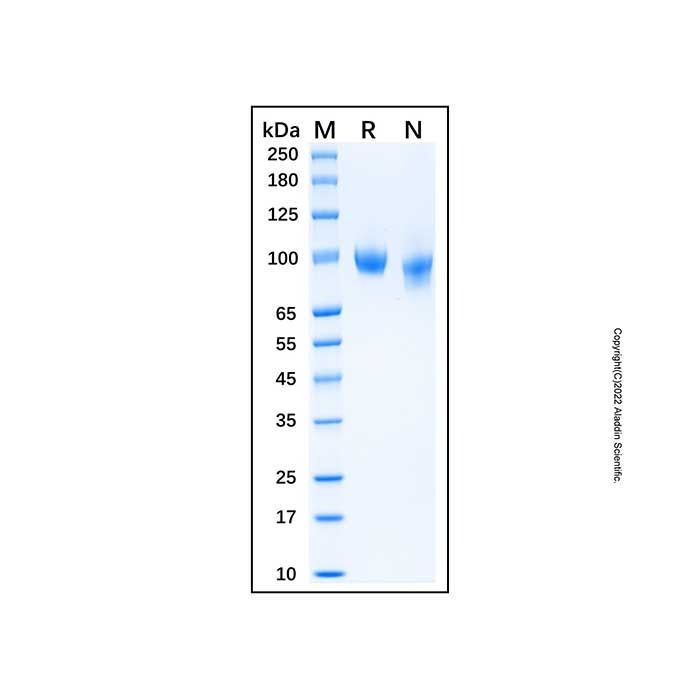
95.8 kDa, under reducing conditions; 92.3 kDa, under non-reducing conditions
Tipo de molécula
Protein
Almacenamiento y envío
Reconstitución
We recommend that this vial be briefly centrifuged prior to opening to bring the contents to the bottom. Reconstitute at 0.5 mg/mL in sterile distilled water. Stock solutions should be apportioned into working aliquots and stored at ≤ -20 °C. Further dilutions should be made in appropriate buffered solutions.
Condiciones de almacenamiento de almacenamiento
Store at -20°C,Avoid repeated freezing and thawing
Enviado en
Ice chest + Ice pads
Estabilidad y almacenamiento
Store at -20°C for 1 year. Avoid freeze / thaw cycle.
Imágenes
Recombinant Human Integrin alpha 4 Protein (rp181256) - SDS-PAGE 3 μg/lane of Recombinant Human Integrin alpha 4 Protein was resolved with SDS-PAGE under reducing (R) and non-reducing (N) conditions and visualized by Coomassie® Blue staining, showing a band at 95.8 kDa under reducing conditions and 92.3 kDa under non-reducing conditions.
Documentation
📋 Safety Data Sheet (SDS)
Comprehensive hazard, handling, storage, and regulatory compliance document.
We use cookies to ensure the website functions properly and, where permitted, to improve your experience. You can manage your preferences at any time in Settings. Learn more in our Cookie Policy.
Shall we send you a message when we have discounts available?
Remind me later
Thank you! Please check your email inbox to confirm.
Products are supplied to verified businesses, institutions, and qualified professionals for research and development use only. Not for use in humans, animals, diagnosis, or therapy.

 ZJ24R0800859