Determine the necessary mass, volume, or concentration for preparing a solution.
BioReagent, sterile-filtered, for cell culture, 10x BioReagent,for Cell culture,Sterile-filtered for sensitive chromatographic and analytical workflows requiring minimal baseline interference.
Store at 2-8°C Ships Wet ice Check lot-specific COA for exact specifications.
SDS, COA, datasheet, and spec sheet available for download. Lot-specific COA accessible via lot number lookup.
Cited in 0 peer-reviewed publications across chromatography, organic synthesis, and cross-coupling reactions.
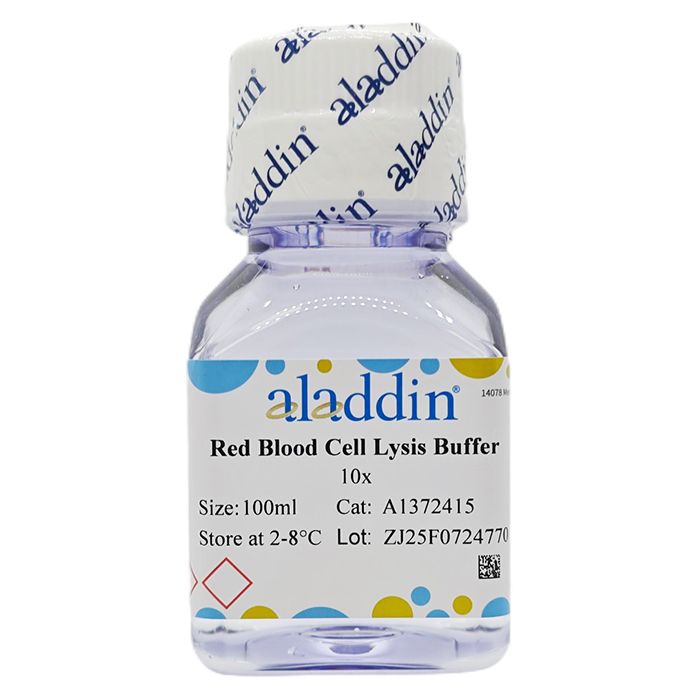
Red Blood Cell Lysis Buffer has been designed, formulated, and tested to ensure optimal lysis of RBCs in single cell suspensions with minimal effects on leukocytes. RBC Lysis Buffer is supplied as a 10X solution based ammonium chloride, and should be diluted in deionized water prior to use.
Instructions for Use:
Lysis of Human Peripheral Blood:
1. Dilute the 10X concentrate 1:10 with distilled water to prepare the 1x lysis buffer. Warm the 1X solution to room temperature prior to use.
2. Add 20 ml of 1X RBC Lysis Buffer to each tube containing up to 1mL of whole blood.
3. Gently vortex each tube immediately after adding the lysing solution. Incubate at room temperature for 10-15 minutes.
4. Centrifuge 350 x g for 5 minutes. Aspirate supernatant without disturbing pellet.
5. Resuspend the pellet in the appropriate buffer, e.g. cell staining buffer
6. Resuspend and proceed with further procedures.
Lysis of Mouse Spleen:
1. Harvest mouse spleen and prepare a single cell suspension.
2. Pellet the cells by centrifugation and aspirate the supernatant.
3. Dilute the 10X Red Blood Cell Lysis Buffer to 1X working concentration with deionized water and resuspend the pellet in 5 ml of 1X Lysis Buffer. Incubate on ice for 4-5 minutes.
4. Stop the reaction by diluting the Lysis Buffer with 20-30 ml of 1X PBS.
5. Centrifuge 350 x g for 5 minutes and discard the supernatant.
6. Resuspend the pellet in the appropriate buffer, e.g. cell staining buffer.
7. Count cells, adjust density, and proceed with cell staining procedures.
| PH | 7.4 |
|---|
Comprehensive hazard, handling, storage, and regulatory compliance document.
Download SDS →Lot-specific quality data. Enter your lot number to retrieve the exact COA.
Look up COA →Full quality attributes and acceptance criteria for this grade.
View spec sheet →Find and download the COA for your product by matching the lot number on the packaging.
| Lot Number | Certificate Type | Fecha | Articulo |
|---|---|---|---|
| Certificate of Analysis | Jun 16, 2026 | A1372415 | |
| Certificate of Analysis | May 19, 2026 | A1372415 | |
| Certificate of Analysis | Apr 30, 2026 | A1372415 |
Our grade selection guide covers purity, stabilizer status, and application suitability for all variants in our catalog.
View Sterile-filtered grade guide → View BioReagent grade guide → View for Cell culture grade guide →