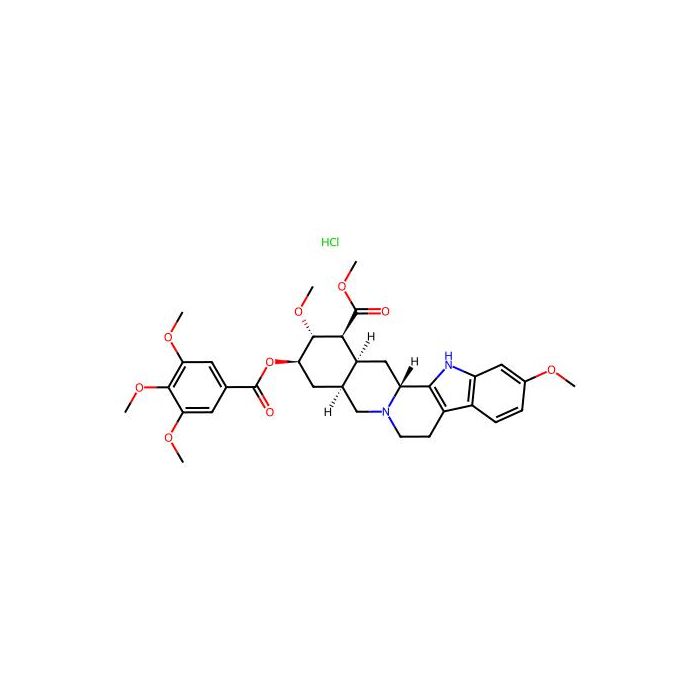
Reserpine hydrochloride - ≥99% , CAS No.16994-56-2

CAS: 16994-56-2 Cat. No.: R646133 Peso molecular: 645.1 PubChem CID: 21155894
Disponible para pedir
GRADE & PURITY ≥99%
Synonyms
Reserpine hydrochloride | UNII-GWN3C4FTI8 | EINECS 241-074-6 | 3.BETA.,20.ALPHA.-YOHIMBAN-16.BETA.-CARBOXYLIC ACID, 18.BETA.-HYDROXY-11,17.ALPHA.-DIMETHOXY-METHYL ESTER 3,4,5-TRIMETHOXYBENZOATE (ESTER), MONOHYDROCHLORIDE | Q27279318 | C73268 | SCHEMBL2699
Storage
Store at 2-8°C,Protected from light,Desiccated
Shipped In
Wet ice
 ·  off list, applied to all prices below.
Size
Estado
Price
Qty
100mg
R646133-100mg
8-12 wks(?) Production requires sourcing of materials. We appreciate your patience and understanding.

25,90US$

38,90US$
Guardar 13,00 US$ (33.42%)
Enter a quantity for the sizes you want to add.
🧪

Why this grade

≥99% for sensitive chromatographic and analytical workflows requiring minimal baseline interference.

🌡

Storage & shipping

Store at 2-8°C,Protected from light,Desiccated Ships Wet ice Check lot-specific COA for exact specifications.

📋

Quality documents

SDS, COA, datasheet, and spec sheet available for download. Lot-specific COA accessible via lot number lookup.

📚

Literature proof

Cited in 0 peer-reviewed publications across chromatography, organic synthesis, and cross-coupling reactions.

Descripción general

Reserpine hydrochloride is an inhibitor of the vesicular monoamine transporter 2 ( VMAT2 ).

In Vitro

Reserpine hydrochloride is an inhibitor of the vesicular monoamine transporter 2 (VMAT2). Reserpine hydrochloride displays a significant on the density of dopamine D1 receptors (F 2,12 =8.81, p<0.01) in the rat striatum. The affinity (Kd) for the dopamine D1 and D2 receptors during withdrawal from acute and chronic administration of reserpine is not change. IC 50 values of 43.9 and 54.9 μM are obtained after 1 day of treatment with Reserpine hydrochloride in JB6 P+ and HepG2-C8 cells, respectively. Reserpine hydrochloride induces luciferase activity in a dose-dependent manner at concentrations ranging from 5 to 50 μM, and no significant induction is observed at concentrations lower than 5 μM. Results demonstrate that Reserpine hydrochloride (2.5 to 10 μM) also increases the protein expression of Nrf2, HO-1, and NQO1. Reserpine hydrochloride at concentrations of 2.5 to 10 μM decreases the mRNA expression of DNMT1, DNMT3a, and DNMT3b in a concentration-dependent manner in JB6 P+ cells after 7 days of treatment. Reserpine hydrochloride at 10 μM generates a significant difference for DNMT3a expression (p<0.05). MCE has not independently confirmed the accuracy of these methods. They are for reference only.

In Vivo

Withdrawal (48 h) from chronic (14-day) but not acute Reserpine hydrochloride administration in a dose of 0.2 mg/kg i.p. produces a significant reduction of the immobility time (F 2,18 =3.68, p<0.05), but increases the climbing time (F 2,18 =4.48, p<0.02), and does not change the swimming time (F 2,18 =1.78; NS) in the forced swim test (FST) in rats . Reserpine hydrochloride at a dose of 5 mg/kg body weight produces significant increase in the urinary excretion profile of vanillylmandelic acid (VMA) compare to control animals. The amount of 5-hydroxyindoleacetic acid (5-HIAA) excreted in animals treated with Reserpine is found to be more than in the control. Dose dependent hypotension is observed with Reserpine hydrochloride. Reserpine hydrochloride at doses of 0.5, 1, 5, 10 and 15 μg/kg produce significant (p<0.01) reduction in blood pressure compare to control. MCE has not independently confirmed the accuracy of these methods. They are for reference only.

Cell Assay

JB6 P+ cells are seeded in 96-well plates containing Minimum essential media (MEM) at a density of 1×10 4 cells/mL ( 100 μL/well ) for 1, 3, and 5 days, and HepG2-C8 cells are seeded in plates containing DMEM. After incubation for 24 h, the cells are treated with either DMSO or various concentrations of Reserpine hydrochloride . For JB6 P+ cells, the medium is changed every 2 days for the 3-day and 5-day treatments. Cell viability is assessed using a MTS assay kit according to the manufacturer’s instructions. The absorbance of the formazan product is read at 490 nm, and the cell viability is calculated and compared with the DMSO control group. MCE has not independently confirmed the accuracy of these methods. They are for reference only.

Form:Solid

IC50& Target:VMAT2

Specifications

Sinónimos
Reserpine hydrochloride | UNII-GWN3C4FTI8 | EINECS 241-074-6 | 3.BETA., 20.ALPHA.-YOHIMBAN-16.BETA.-CARBOXYLIC ACID, 18.BETA.-HYDROXY-11, 17.ALPHA.-DIMETHOXY-METHYL ESTER 3, 4, 5-TRIMETHOXYBENZOATE (ESTER), MONOHYDROCHLORIDE | Q27279318 | C73268 | SCHEMBL2699
Especificaciones y pureza
≥99%
Mecanismos bioquímicos y fisiológicos
Reserpine hydrochloride is an inhibitor of the vesicular monoamine transporter 2 ( VMAT2 ).
Condiciones de almacenamiento de almacenamiento
Store at 2-8°C, Protected from light, Desiccated
Enviado en
Wet ice
Este producto requiere envío en cadena de frío. Los servicios terrestres y otros servicios económicos no están disponibles.
Pureza
≥99%
Nombres e identificadores
Sonrisas canónicasCOC1C(CC2CN3CCC4=C(C3CC2C1C(=O)OC)NC5=C4C=CC(=C5)OC)OC(=O)C6=CC(=C(C(=C6)OC)OC)OC.Cl
IUPAC Namemethyl (1R,15S,17R,18R,19S,20S)-6,18-dimethoxy-17-(3,4,5-trimethoxybenzoyl)oxy-1,3,11,12,14,15,16,17,18,19,20,21-dodecahydroyohimban-19-carboxylate;hydrochloride
InChIKeyZYWIWGUMKCZKOO-BQTSRIDJSA-N
INCHI1S/C33H40N2O9.ClH/c1-38-19-7-8-20-21-9-10-35-16-18-13-27(44-32(36)17-11-25(39-2)30(41-4)26(12-17)40-3)31(42-5)28(33(37)43-6)22(18)15-24(35)29(21)34-23(20)14-19;/h7-8,11-12,14,18,22,24,27-28,31,34H,9-10,13,15-16H2,1-6H3;1H/t18-,22+,24-,27-,28+,31+;/m1./s1
Isómeros SMILES CO[C@H]1[C@@H](C[C@@H]2CN3CCC4=C([C@H]3C[C@@H]2[C@@H]1C(=O)OC)NC5=C4C=CC(=C5)OC)OC(=O)C6=CC(=C(C(=C6)OC)OC)OC.Cl
PubChem CID 21155894
Peso molecular 645.1

Documentation

📋 Safety Data Sheet (SDS)

Comprehensive hazard, handling, storage, and regulatory compliance document.

Download SDS →

✅ Certificate of Analysis (COA)

Lot-specific quality data. Enter your lot number to retrieve the exact COA.

Look up COA →

📊 Datasheet

Quick-reference summary of product specifications and applications.

View datasheet →

🔬 Specification Sheet

Full quality attributes and acceptance criteria for this grade.

View spec sheet →

Advanced Data

Taxonomic Classification

Taxonomy Tree

KingdomOrganic compounds
SuperclassAlkaloids and derivatives
ClaseYohimbine alkaloids
SubclassNot available
Intermediate Tree Nodes Not available
Direct ParentYohimbine alkaloids
Alternative Parents Corynanthean-type alkaloids  Beta carbolines  Gallic acid and derivatives  P-methoxybenzoic acids and derivatives  M-methoxybenzoic acids and derivatives  3-alkylindoles  Benzoic acid esters  Phenoxy compounds  Anisoles  Benzoyl derivatives  Methoxybenzenes  Alkyl aryl ethers  Aralkylamines  Piperidines  Pyrroles  Methyl esters  Heteroaromatic compounds  Trialkylamines  Amino acids and derivatives  Monocarboxylic acids and derivatives  Azacyclic compounds  Dialkyl ethers  Carbonyl compounds  Hydrochlorides  Organic oxides  Organopnictogen compounds  Hydrocarbon derivatives  
Molecular FrameworkAromatic heteropolycyclic compounds
Substituents Yohimbine - Corynanthean skeleton - Yohimbine alkaloid - Pyridoindole - Beta-carboline - Gallic acid or derivatives - P-methoxybenzoic acid or derivatives - M-methoxybenzoic acid or derivatives - 3-alkylindole - Benzoate ester - Benzoic acid or derivatives - Indole - Indole or derivatives - Methoxybenzene - Phenol ether - Anisole - Phenoxy compound - Benzoyl - Aralkylamine - Alkyl aryl ether - Monocyclic benzene moiety - Benzenoid - Piperidine - Pyrrole - Methyl ester - Heteroaromatic compound - Tertiary aliphatic amine - Amino acid or derivatives - Tertiary amine - Carboxylic acid ester - Monocarboxylic acid or derivatives - Organoheterocyclic compound - Ether - Dialkyl ether - Azacycle - Carboxylic acid derivative - Organooxygen compound - Carbonyl group - Hydrochloride - Hydrocarbon derivative - Organic oxide - Organopnictogen compound - Organic nitrogen compound - Organic oxygen compound - Amine - Organonitrogen compound - Aromatic heteropolycyclic compound
DescripciónThis compound belongs to the class of organic compounds known as yohimbine alkaloids. These are alkaloids containing the pentacyclic yohimban skeleton. The Yohimbinoid alkaloids contain a carbocyclic ring E arising through C-17 to C-18 bond formation in a corynantheine precursor.
External Descriptors Not available
Estructura 3D
Modelo de Estructura Química Interactiva


Certificados (CoA, COO, BSE/TSE y tabla de análisis)
C of A & Other Certificates(BSE/TSE, COO):
Analytical Chart:
Propiedades químicas y físicas
SolubilidadDMSO : 50 mg/mL (77.50 mM; Need ultrasonic) H2O : 1 mg/mL (1.55 mM; ultrasonic and warming and heat to 80°C)
Peso molecular645.100 g/mol
XLogP3
Hydrogen Bond Donor Count2
Hydrogen Bond Acceptor Count10
Rotatable Bond Count10
Exact Mass644.25 Da
Monoisotopic Mass644.25 Da
Topological Polar Surface Area118.000 Ų
Heavy Atom Count45
Formal Charge0
Complexity1000.000
Isotope Atom Count0
Defined Atom Stereocenter Count6
Undefined Atom Stereocenter Count0
Defined Bond Stereocenter Count0
Undefined Bond Stereocenter Count0
The total count of all stereochemical bonds0
Covalently-Bonded Unit Count2
Calculadoras de soluciones
Reseñas

Reseñas de cliente

Shall we send you a message when we have discounts available?

Remind me later

Thank you! Please check your email inbox to confirm.

Oops! Notifications are disabled.