
Determine the necessary mass, volume, or concentration for preparing a solution.
| Activity Type | Activity Value -log(M) | Mechanism of Action | Activity Reference | Publications (PubMed IDs) |
|---|
Moligand™, ≥95%, A solution in ethanol Moligand™ for sensitive chromatographic and analytical workflows requiring minimal baseline interference.
Protected from light,Store at -80°C Ships Dry ice packs + Cold packs Check lot-specific COA for exact specifications.
SDS, COA, datasheet, and spec sheet available for download. Lot-specific COA accessible via lot number lookup.
Cited in 1 peer-reviewed publications across chromatography, organic synthesis, and cross-coupling reactions.
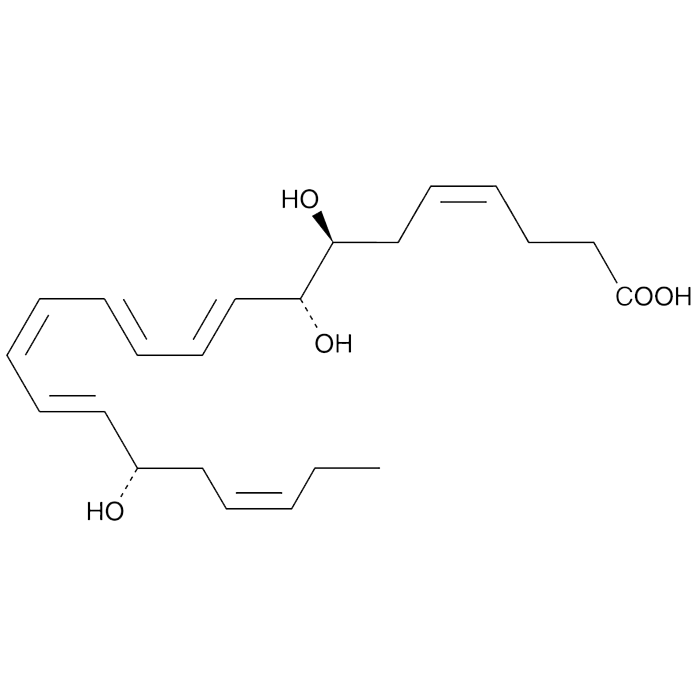
Resolvin D1 is from a family of potent lipid mediators derived from both eicosapentaenoic acid (EPA) and docosahexaenoic (DHA)(1), it is an anti-inflammatory and promotes the resolution of the inflammatory response back to a non-inflamed state.2 RvD1 is produced physiologically from the sequential oxygenation of DHA by 15- and 5-lipoxygenase. It reduces human polymorphonuclear leukocyte (PMNL) transendothelial migration, the earliest event in acute inflammation, with EC50 values of ~30 nM. It exhibits a dose-dependent reduction in leukocyte infiltration in a murine model of peritonitis with a maximal inhibition of ~35% at a 10-100 ng dose.
Resolvin D1 (RvD1) is supplied as a solution in ethanol. To change the solvent, simply evaporate the ethanol under a gentle stream of nitrogen and immediately add the solvent of choice. It is recommended that this product be stored and handled in an ethanol solution. Resolvins can isomerize and degrade when put into freeze thaw conditions and/or in solvents such as dimethyl formamide or DMSO.
| Sonrisas canónicas | CCC=CCC(C=CC=CC=CC=CC(C(CC=CCCC(=O)O)O)O)O |
|---|---|
| IUPAC Name | 7,8,17-trihydroxydocosa-4,9,11,13,15,19-hexaenoic acid |
| InChIKey | OIWTWACQMDFHJG-UHFFFAOYSA-N |
| INCHI | 1S/C22H32O5/c1-2-3-9-14-19(23)15-10-6-4-5-7-11-16-20(24)21(25)17-12-8-13-18-22(26)27/h3-12,15-16,19-21,23-25H,2,13-14,17-18H2,1H3,(H,26,27) |
| Isómeros SMILES | CCC=CCC(C=CC=CC=CC=CC(C(CC=CCCC(=O)O)O)O)O |
| PubChem CID | 53394122 |
| Peso molecular | 376.5 |
Comprehensive hazard, handling, storage, and regulatory compliance document.
Download SDS →Lot-specific quality data. Enter your lot number to retrieve the exact COA.
Look up COA →Full quality attributes and acceptance criteria for this grade.
View spec sheet →| Activity Type | Activity Value -log(M) | Mechanism of Action | Activity Reference | Publications (PubMed IDs) |
|---|
| Activity Type | Activity Value -log(M) | Mechanism of Action | Activity Reference | Publications (PubMed IDs) |
|---|
| Activity Type | Activity Value -log(M) | Mechanism of Action | Activity Reference | Publications (PubMed IDs) |
|---|
Find and download the COA for your product by matching the lot number on the packaging.
| Lot Number | Certificate Type | Fecha | Articulo |
|---|---|---|---|
 C2610370 C2610370 | Certificate of Analysis | Dec 31, 2025 | R341442 |
| L2515619 | Certificate of Analysis | Nov 26, 2025 | R341442 |
| H2501723 | Certificate of Analysis | Jul 23, 2025 | R341442 |
| C2505776 | Certificate of Analysis | Dec 25, 2024 | R341442 |
| H2422504 | Certificate of Analysis | Aug 15, 2024 | R341442 |
| E2429501 | Certificate of Analysis | Apr 23, 2024 | R341442 |
| H2309197 | Certificate of Analysis | Jul 25, 2023 | R341442 |
| G2303071 | Certificate of Analysis | Jun 09, 2023 | R341442 |
| Solubilidad | Soluble in water (0.05 mg/mL) at 25° C, PBS pH 7.2 (~0.05 mg/mL), DMSO (~50 mg/mL), DMF (~50 mg/mL), and ethanol. |
|---|---|
| Sensibilidad | Light sensitive |
| Punto de ebullición (°C) | 78° C |
| 1. Ding Peng-Fei, Zhang Jia-Tong, Zhu Xiao-Long, Cui Yue, Chen Chun-Lei, Liu Xun-Zhi, Shen Jun-Da, Zou Le-Xuan, Lu Yue, Zhuang Zong, Hang Chun-Hua, Li Wei. (2025) P2X7-CaMKII drives 5-LOX nuclear translocation to impair microglial function after subarachnoid hemorrhage. Journal of Neuroinflammation, 22 (1): (1-16). [PMID:40877894] [10.1186/s12974-025-03530-3] |
Our grade selection guide covers purity, stabilizer status, and application suitability for all variants in our catalog.
View Moligand™ grade guide →