Determine the necessary mass, volume, or concentration for preparing a solution.
Moligand™, 10mM in DMSO Moligand™ for sensitive chromatographic and analytical workflows requiring minimal baseline interference.
Store at -80°C Ships Dry ice packs + Cold packs Check lot-specific COA for exact specifications.
SDS, COA, datasheet, and spec sheet available for download. Lot-specific COA accessible via lot number lookup.
Cited in 10 peer-reviewed publications across chromatography, organic synthesis, and cross-coupling reactions.
Information
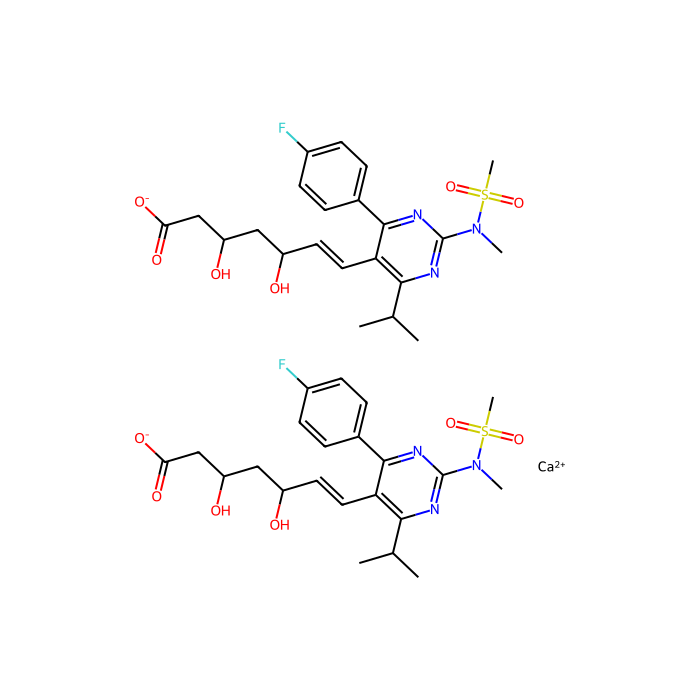
Rosuvastatin Calcium (ZD4522) is a competitive inhibitor ofHMG-CoA reductasewithIC50of 11 nM in a cell-free assay.
In vitro
Rosuvastatin is relatively hydrophilic and is highly selective for hepatic cells; its uptake is mediated by the liver-specific organic anion transporter OATP-C. Rosuvastatin is a high-affinity substrate for OATP-C with apparent association constant of 8.5 μM. Rosuvastatin inhibits cholesterol biosynthesis in rat liver isolated hepatocytes with IC50 of 1.12 nM. Rosuvastatin causes approximately 10 times greater increase of mRNA of LDL receptors than pravastatin. Rosuvastatin (100 μM) decreases the extent of U937 adhesion to TNF-α-stimulated HUVEC. Rosuvastatin inhibits the expressions of ICAM-1, MCP-1, IL-8, IL-6, and COX-2 mRNA and protein levels through inhibition of c-Jun N-terminal kinase and nuclear factor-kB in endothelial cells.
In vivo
Rosuvastatin is efficient on reducing plasma liquids. Rosuvastatin (3 mg/kg) daily administration for 14 days decreases plasma cholesterol levels by 26% in male beagle dogs with normal cholesterol levels. In cynomolgus monkeys, Rosuvastatin decreases plasma cholesterol levels by 22% Rosuvastatin (20 mg/kg/day) administration for 2 weeks, significantly reduces very low-density lipoproteins (VLDL) in diabetes mellitus rats induced by Streptozocin. Rosuvastatin shows antiatherothromhotic effects in vivo. Rosuvastatin (1.25 mg/kg) significantly inhibits thrombin-induced transmigration of monocvtes across mesenteric venules via inhibition of the endothelial cell surface expression of P-selectin, and increases the basal rate of nitric oxide in aortic segments by 2-fold times. Rosuvastatin (20 mg/kg) inhibits ROS production, normalizes NO-dependent endothelial function and reduces platelet activation in diabetic rats induced by Streptozocin. Rosuvastatin displays cardioprotective effects in vivo. Rosuvastatin (80 mg) is shows to decrease infarct size and improve cardiac mechanical function after ischemia/reperfusion in animal model. The cardioprotective properties of Rosuvastatin may be due to the improvement of coronary blood flow, decrease in resistance of coronary arteries mediated by enhanced eNOS expression, and the subsequent increase in the production of vascular endothelial NO. Rosuvastatin (2.0 mg/kg) attenuates left ventricular hypertrophy produced by transaortic constriction in mice through regulation of Racl protein and NADPH oxidase activities.
Cell Data
cell lines:HL-60, U937, and NB-4 cells
Concentrations:
Incubation Time:
Powder Purity:≥99%
| Isómeros SMILES | CC(C1=NC(=NC(=C1/C=C/[C@@H](O)C[C@@H](O)CC(=O)[O-])C2=CC=C(C=C2)F)N(S(=O)(=O)C)C)C.CC(C1=NC(=NC(=C1/C=C/[C@@H](O)C[C@@H](O)CC(=O)[O-])C2=CC=C(C=C2)F)N(S(=O)(=O)C)C)C.[Ca+2] |
|---|---|
| PubChem CID | 5282455 |
| Peso molecular | 500.57 |
Comprehensive hazard, handling, storage, and regulatory compliance document.
Download SDS →Lot-specific quality data. Enter your lot number to retrieve the exact COA.
Look up COA →Full quality attributes and acceptance criteria for this grade.
View spec sheet →| Solubilidad | Solubility (25°C) In vitro Water: 5 mg/mL (38.11 mM); DMSO: Insoluble; |
|---|---|
| Rotación específica [α] | -8° (C=1,CHCl3) |
| Punto de fusión (°C) | 160 °C |
| 1. Yuan-yuan Zhai, Qiang Wang, Qi-yao Nong, Mei-yu Gao, Ying Zhang, Qin-wen Xiao, Yuan Tian, Zun-jian Zhang, Feng-guo Xu, Pei Zhang. (2025) Pitavastatin overcomes multi-drug resistance in CRC and NSCLC by targeting the NRP1-ZFX axis. BIOCHEMICAL PHARMACOLOGY, [PMID:40684995] [10.1016/j.bcp.2025.117183] |
| 2. Meng Yan, Yuan Zhong, Sheng Ni, Shirong Zhang, Yingying Jiang, Li Zhu, Kun Zhang, Kaiyong Cai, Kai Qu, Chuanwei Li, Wei Wu. (2025) CCR2-Engineered Macrophage Membrane-Coated Metal-Polyphenol Nanozyme to Enhance Antioxidation Activity for Inhibiting the Atherosclerotic Progression. Advanced Healthcare Materials, [PMID:40974123] [10.1002/adhm.202502151] |
| 3. Jie Yang, Xiuhua Pan, Jun Zhang, Siyu Ma, Jianeng Zhou, Zengguang Jia, Yawen Wei, Zengyi Liu, Ning Yang, Qi Shen. (2022) Reprogramming dysfunctional dendritic cells by a versatile metabolism nano-intervenor for enhancing cancer combinatorial immunotherapy. Nano Today, [PMID:] [10.1016/j.nantod.2022.101618] |
| 4. Jie Yang, Zengguang Jia, Jun Zhang, Xiuhua Pan, Yawen Wei, Siyu Ma, Ning Yang, Zengyi Liu, Qi Shen. (2022) Metabolic Intervention Nanoparticles for Triple-Negative Breast Cancer Therapy via Overcoming FSP1-Mediated Ferroptosis Resistance. Advanced Healthcare Materials, 11 (13): (2102799). [PMID:35395704] [10.1002/adhm.202102799] |
| 5. Xie Qiu-shi, Zhang Jia-xin, Liu Ming, Liu Pei-hua, Wang Zhong-jian, Zhu Liang, Jiang Ling, Jin Meng-meng, Liu Xiao-nan, Liu Li, Liu Xiao-dong. (2020) Short-chain fatty acids exert opposite effects on the expression and function of p-glycoprotein and breast cancer resistance protein in rat intestine. ACTA PHARMACOLOGICA SINICA, 42 (3): (470-481). [PMID:32555444] [10.1038/s41401-020-0402-x] |
| 6. Kyeong-Ju Lee, Yoon-Mi Lee, Seong-Bin Yang, Jun-Hyuck Lee, Ha Rin Kim, Ji-Hong Lim, Jooho Park. (2024) A novel chemically engineered multifunctional statin conjugate as self-assembled nanoparticles inhibiting bile acid transporters. JOURNAL OF CONTROLLED RELEASE, [PMID:38971425] [10.1016/j.jconrel.2024.07.008] |
| 7. Hao Hao, Juntao Hu, Ziyu Kuai, Fengjie Hao, Wantong Jiang, Nana Ran, Yuting He, Yanping Zhang, Yibing Huang, Yanfei Qi, Quan Luo. (2024) Enzyme-mediated multifunctional self-healing lysozyme hydrogel for synergistic treatment of chronic diabetic wounds. INTERNATIONAL JOURNAL OF BIOLOGICAL MACROMOLECULES, [PMID:39437956] [10.1016/j.ijbiomac.2024.136719] |
| 8. Kyeong-Ju Lee, Seong-Bin Yang, Jae-Hyeon Lee, Bison Seo, Hyung-Sik Won, Jooho Park. (2025) Preparation and Therapeutic Evaluation of Engineered Semaglutide and Statin–Lipid Conjugate-Based Nanoparticle. Pharmaceutics, 17 (4): (480). [PMID:40284475] [10.3390/pharmaceutics17040480] |
| 9. Xuesheng Hu, Lu Han, Yiying Tan, Peitong Wu, Yajing Li, Wanjie Liu, Jiaming Shen, Yishan Li, Ming Yang, Chunnan Li, Jiaming Sun. (2026) A new lanostane-type triterpene with lipid-lowering activity from Ganoderma lucidum and an additional analogue. Frontiers in Chemistry, [PMID:41647298] [10.3389/fchem.2025.1726447] |
| 10. Xianzheng Sang, Yichao Ye, Chengzi Yang, Xiaoxiang Hou, Yangu Guo, Hantong Shi, Chunhui Wang, Wen Chen, Danfeng Zhang, Lijun Hou. (2026) Microglia as a key mediator in rosuvastatin-associated cognitive impairment. NEUROTOXICOLOGY, [PMID:41690424] [10.1016/j.neuro.2026.103405] |
Our grade selection guide covers purity, stabilizer status, and application suitability for all variants in our catalog.
View Moligand™ grade guide →