Determine the necessary mass, volume, or concentration for preparing a solution.
10mM in DMSO for sensitive chromatographic and analytical workflows requiring minimal baseline interference.
Store at -80°C Ships Dry ice packs + Cold packs Check lot-specific COA for exact specifications.
SDS, COA, datasheet, and spec sheet available for download. Lot-specific COA accessible via lot number lookup.
Cited in 8 peer-reviewed publications across chromatography, organic synthesis, and cross-coupling reactions.
Information
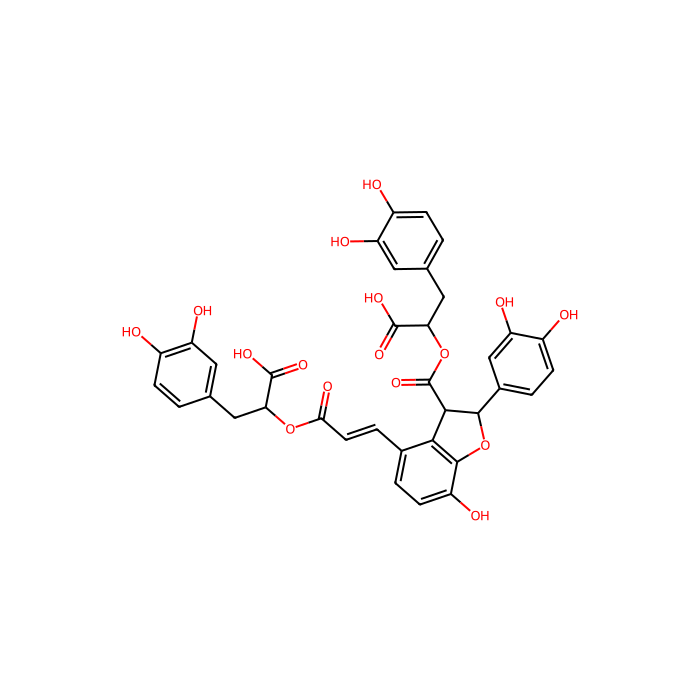
Salvianolic acid B Salvianolic acid B (Sal B, Lithospermate B, Lithospermic acid B), an antioxidant and free radical scavenging compound, is the most abundant bioactive compound extracted from the root of Salvia miltiorrhiza Bunge.
In vitro
Salvianolic acid B, also known as satanic acid B or lithospermic acid B, is a new generation of the natural antioxidants. It can influence Ca2+ aggregation and endothelial cell NO release of hypoxia/ reoxygenation-induced cell. When acid B concentration is 2.5, 5, and 10\u2009mg/l, cell viability and superoxide dismutase (SOD) activity are enhanced, and the formation of malondialdehyde (MDA) in human umbilical vein endothelial cells (ECV304) is inhibited. SalB inhibits HG-induced oxidative stress and reduces the generation of ROS and 8-hydroxy-2-deoxyguanosine (8-OHDG) and mitochondrial depolarization and apoptosis in a dose-dependent manner. It can downregulate the expression of Bax and AIF nuclear translocation and cytochrome c release mediated by HG, but upregulate the expression of Bcl-2 induced by HG. Besides, SalB attenuates HG-induced caspase of the enzyme 3, 9 and minimize PARP cleavage of Schwann cells (SCs). SalB inhibits angiotensin II or H2O2 and TNF-α-induced gelatinolytic activity in human aortic smooth muscle cells (HASMCs) in a concentration-dependent manner. Salvianolic acid B can inhibit platelet aggregation and adhesion. Salvianolic acid B can promote cardiac angiogenesis effect. SalB can enhance cell activity and reduce the number of sub-G1 and apoptotic nuclei of ischemic cell model in order to show its antiapoptotic effects. Salvianolic acid B inhibits ischemia and hypoxia of myocardial injury. Salvianolic acid B inhibits the synthesis of type I collagen of non-TGF-1 stimulated human hepatic stellate cell line (LX-2). SalB activates mammalian sirtuins 1 (SIRT1), an NAD-dependent class III histone deacetylase (HDAC) that plays important roles in several physiological processes, including gene transcription, senescence, energy metabolism, oxidative stress and inflammation. (HG:High glucose)
In vivo
Salvianolic acid B can significantly reduce the myocardial infarct size and blood lactate dehydrogenase level of model rat with acute myocardial infarction, improve cardiac function and myocardial tissue structure, thus inhibiting ischemia and hypoxia of myocardial injury. salvianolic acid B can improve blood hemorheology, reduce oxidative damage, improve the vascular endothelial cell function, and prevent the development of coronary artery disease. Salvianolic acid B could selectively inhibit the activity of MMP-9 in a rat model of myocardial infarction. Salvianolic acid B can also effectively increase the thickness of the left ventricular wall in the myocardial infarction rats to improve the contraction of the heart, and reduce cardiac fibrosis. SalB treatment ameliorates ethanol-induced hepatic inflammation by decreasing the levels of hepatotoxic cytokines such as tumor necrosis factor-α (TNF-α) and interleukin-6 (IL-6). SalB has beneficial effects against hepatic fibrosis in animal models and has been shown to possess cardioprotective and neuroprotective activity via anti-oxidative and anti-inflammatory actions.
Cell Data
cell lines:
Concentrations:8 μM
Incubation Time:3 h
Powder Purity:≥98%
| Isómeros SMILES | C1=CC(=C(C=C1C[C@H](C(=O)O)OC(=O)/C=C/C2=C3[C@@H]([C@H](OC3=C(C=C2)O)C4=CC(=C(C=C4)O)O)C(=O)O[C@H](CC5=CC(=C(C=C5)O)O)C(=O)O)O)O |
|---|---|
| WGK Alemania | 3 |
| PubChem CID | 6451084 |
| Peso molecular | 718.61 |
Comprehensive hazard, handling, storage, and regulatory compliance document.
Download SDS →Lot-specific quality data. Enter your lot number to retrieve the exact COA.
Look up COA →Full quality attributes and acceptance criteria for this grade.
View spec sheet →| Rotación específica [α] | 108° (C=1,MeOH) |
|---|---|
| Punto de ebullición (°C) | 1020.3°C/760mmHg |
| Punto de fusión (°C) | 169 °C |
| 1. Jingtong Xia, Minhua Qian, Jiahao Zhou, Zhaoyan Wang, Hongli Li, Lei Zhou, Qiaosheng Pu. (2022) Integrated strategy of derivatization and separation for sensitive analysis of salvianolic acids using capillary electrophoresis with laser-induced fluorescence detection. JOURNAL OF CHROMATOGRAPHY A, [PMID:36334567] [10.1016/j.chroma.2022.463607] |
| 2. Min Shi, Ruiyan Zhu, Yi Zhang, Siwei Zhang, Tingyao Liu, Kunlun Li, Shucan Liu, Leran Wang, Yao Wang, Wei Zhou, Qiang Hua, Guoyin Kai. (2022) A novel WRKY34-bZIP3 module regulates phenolic acid and tanshinone biosynthesis in Salvia miltiorrhiza. METABOLIC ENGINEERING, [PMID:35934177] [10.1016/j.ymben.2022.08.002] |
| 3. Shuxia Tian, Min Chen, Bing Wang, Yonglong Han, Haonan Shang, Junming Chen. (2020) Salvianolic acid B blocks hepatic stellate cell activation via FGF19/FGFR4 signaling. Annals of Hepatology, [PMID:32980439] [10.1016/j.aohep.2020.07.013] |
| 4. Feng-Qin Wang, Qian Zhang, Chun-Hong Li, Yin-Zhen Wang, Yuan-Jia Hu, Qi-Hui Zhang, Zhi-Ning Xia, Feng-Qing Yang. (2015) Evaluation of affinity interaction between small molecules and platelets by open tubular affinity capillary electrochromatography. ELECTROPHORESIS, [PMID:26541914] [10.1002/elps.201500414] |
| 5. Xin Peng, Wei Qi, Renliang Huang, Rongxin Su, Zhimin He. (2015) Elucidating the Influence of Gold Nanoparticles on the Binding of Salvianolic Acid B and Rosmarinic Acid to Bovine Serum Albumin. PLoS One, 10 (4): (e0118274). [PMID:25861047] [10.1371/journal.pone.0118274] |
| 6. Yong Jiang, Wenjun Ji, Ying Lu, Qin Wang, Linwei Chen. (2025) Integrating Plasma Metabolomics, Network Pharmacology, and Experimental Validation to Investigate the Action Mechanism of Qiangxin Lishui Prescription in Chronic Heart Failure. BIOMEDICAL CHROMATOGRAPHY, 39 (2): (e6065). [PMID:39748248] [10.1002/bmc.6065] |
| 7. Jing Wen, Shue Jin, Xue Luo, Chunhong Chen, Huan Liu, Yubao Li, Jidong Li. (2025) Functionalized gelatin/poly(l-lactide-co-ε-caprolactone) fibrous membrane promotes scarless wound healing by modulating inflammation and reducing fibrosis. INTERNATIONAL JOURNAL OF BIOLOGICAL MACROMOLECULES, [PMID:40054818] [10.1016/j.ijbiomac.2025.141785] |
| 8. Huang Yuebo, Sun Yuxiang, Guo Dandan, Lin Hongchun, Wu Lingzhi, Zhou Pan, Wu Dongxuan, Sun Juan, Zhou Hu, Hu Zhaoyong, Peng Hui. (2025) CXCL6 Orchestrates Macrophage-Driven Inflammation in Diabetic Kidney Disease and Represents a Druggable Target. Kidney Diseases, 11 (1): (812-834). [PMID:41321788] [10.1159/000548806] |