
Determine the necessary mass, volume, or concentration for preparing a solution.
| Activity Type | Activity Value -log(M) | Mechanism of Action | Activity Reference | Publications (PubMed IDs) |
|---|
Moligand™, ≥99% Moligand™ for sensitive chromatographic and analytical workflows requiring minimal baseline interference.
Store at -20°C Ships Ice chest + Ice pads Check lot-specific COA for exact specifications.
SDS, COA, datasheet, and spec sheet available for download. Lot-specific COA accessible via lot number lookup.
Cited in 0 peer-reviewed publications across chromatography, organic synthesis, and cross-coupling reactions.
Information
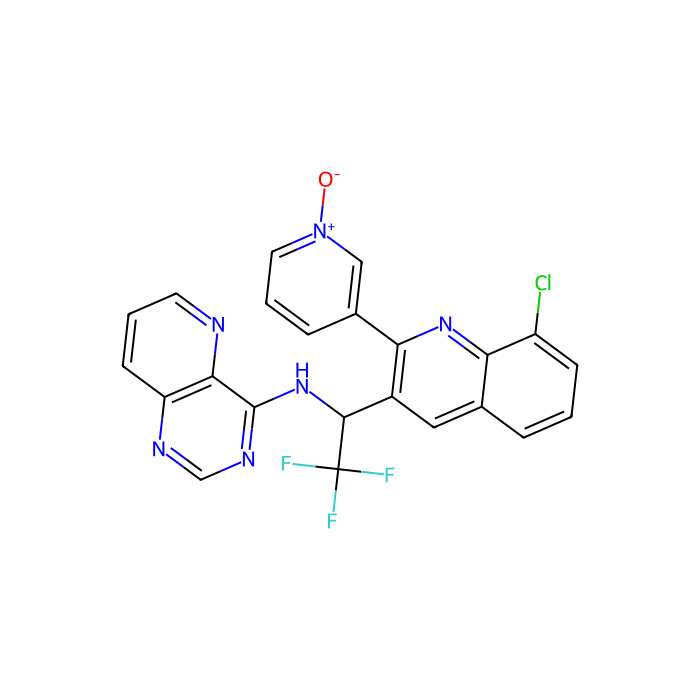
Seletalisib (UCB-5857) is a novel small-molecule inhibitor ofPI3Kδwith an IC50 value of 12 nM and shows significant selectivity to PI3Kδ with respect to the other class I PI3K isoforms (between 24- and 303-fold).
Targets
PI3Kδ (Cell-free assay); PI3Kγ (Cell-free assay) 12 nM; 282 nM
In vitro
Seletalisib is a potent, ATP-competitive, and selective PI3Kδ inhibitor able to block protein kinase B (AKT) phosphorylation following activation of the B-cell receptor in a B-cell line. Moreover, seletalisib inhibited N-formyl peptide-stimulated but not phorbol myristate acetate–stimulated superoxide release from human neutrophils, consistent with a PI3Kδ-specific activity. Findings from cellular assays of adaptive immunity demonstrated that seletalisib blocks human T-cell production of several cytokines from activated T-cells. Additionally, seletalisib inhibited B-cell proliferation and cytokine release. In human whole blood assays, seletalisib inhibited CD69 expression upon B-cell activation and anti-IgE-mediated basophil degranulation. From 239 kinases screened, seletalisib at a concentration of 10 μM showed no inhibitory activity greater than 47% (MAP4K4) against non-PI3K kinase enzymes. Against nonkinase enzymes, seletalisib showed weak activities against phosphodiesterase (PDE)3A, PDE2A1, and PDE4D2, with inhibition varying between 32 and 74% at 10 μM. When screened at a concentration of 10 μM against 55 receptors and ion channels, the highest inhibitory activity of seletalisib observed was 20%. One receptor, neuropeptide Y receptor (Y1) showed 54% activation. In vitro receptor binding and enzyme assays across a broad range of target classes showed that seletalisib is selective for PI3Kδ. Seletalisib potently inhibited the phosphorylation of AKT following anti-IgM stimulation of the BCR on Ramos cells with an IC50 of 15 nM. When profiled in a wide range of primary cell assay systems, including fibroblasts, epithelial, endothelial and vascular smooth muscle cells, seletalisib showed significant activity only in those systems containing lymphocytes, demonstrating its functional selectivity towards PI3Kδ-expressing cells.
In vivo
Seletalisib shows dose-dependent inhibition in an in vivo rat model of anti-CD3-antibody-induced interleukin 2 release. Analysis of the relationship between inhibition of IL-2 release and seletalisib blood concentration, using combined data across experiments, demonstrated that seletalisib has potent in vivo effects with an estimated IC50 value of <10 nM. In first-in-man studies, mean seletalisib plasma concentration-time profiles increased with increasing dose after single and multiple dosing, with no major deviations from dose proportionality. There was no unexpected accumulation or loss of exposure after multiple dosing (time-independent pharmacokinetic (PK) profile) and apparent t1/2 values (approx. 20h) were supportive of once-daily dosing.
Cell Research(from reference)
Cell lines:Ramos B-cell line
Concentrations:0.1 nM-10 μM
Incubation Time:10 min
| ALogP | 4.436 |
|---|---|
| Recuento HBD | 1 |
| Enlace rotable | 5 |
| Pubchem Sid | 504771491 |
|---|---|
| Pubchem Sid Url | https://pubchem.ncbi.nlm.nih.gov/substance/504771491 |
| Sonrisas canónicas | C1=CC2=CC(=C(N=C2C(=C1)Cl)C3=C[N+](=CC=C3)[O-])C(C(F)(F)F)NC4=NC=NC5=C4N=CC=C5 |
| IUPAC Name | N-[(1R)-1-[8-chloro-2-(1-oxidopyridin-1-ium-3-yl)quinolin-3-yl]-2,2,2-trifluoroethyl]pyrido[3,2-d]pyrimidin-4-amine |
| InChIKey | LNLJHGXOFYUARS-OAQYLSRUSA-N |
| INCHI | 1S/C23H14ClF3N6O/c24-16-6-1-4-13-10-15(18(31-19(13)16)14-5-3-9-33(34)11-14)21(23(25,26)27)32-22-20-17(29-12-30-22)7-2-8-28-20/h1-12,21H,(H,29,30,32)/t21-/m1/s1 |
| Isómeros SMILES | C1=CC2=CC(=C(N=C2C(=C1)Cl)C3=C[N+](=CC=C3)[O-])[C@H](C(F)(F)F)NC4=NC=NC5=C4N=CC=C5 |
| CAS alternativo | 1362850-20-1 |
| PubChem CID | 56928390 |
| Términos de entrada MeSH | N-(1-(8-chloro-2-(1-oxidopyridin-1-ium-3-yl)-3-quinolyl)-2,2,2-trifluoroethyl)pyrido(3,2-d)pyrimidin-4-amine;seletalisib |
| Peso molecular | 482.85 |
Comprehensive hazard, handling, storage, and regulatory compliance document.
Download SDS →Lot-specific quality data. Enter your lot number to retrieve the exact COA.
Look up COA →Full quality attributes and acceptance criteria for this grade.
View spec sheet →Taxonomy Tree
| Kingdom | Organic compounds |
|---|---|
| Superclass | Organoheterocyclic compounds |
| Clase | Pyridines and derivatives |
| Subclass | Bipyridines and oligopyridines |
| Intermediate Tree Nodes | Not available |
| Direct Parent | Bipyridines and oligopyridines |
| Alternative Parents | Chloroquinolines Pyridopyrimidines Secondary alkylarylamines Aminopyrimidines and derivatives Pyridinium derivatives Aryl chlorides Benzenoids Imidolactams Heteroaromatic compounds Azacyclic compounds Hydrocarbon derivatives Organofluorides Alkyl fluorides Organic oxides Organic salts Organochlorides Organic cations |
| Molecular Framework | Aromatic heteropolycyclic compounds |
| Substituents | Bipyridine - Chloroquinoline - Haloquinoline - Pyridopyrimidine - Quinoline - Aminopyrimidine - Secondary aliphatic/aromatic amine - Aryl chloride - Aryl halide - Pyridinium - Pyrimidine - Benzenoid - Imidolactam - Heteroaromatic compound - Azacycle - Secondary amine - Alkyl fluoride - Organic oxygen compound - Hydrocarbon derivative - Amine - Organonitrogen compound - Organofluoride - Organochloride - Organohalogen compound - Organic nitrogen compound - Alkyl halide - Organic oxide - Organic salt - Organic cation - Aromatic heteropolycyclic compound |
| Descripción | This compound belongs to the class of organic compounds known as bipyridines and oligopyridines. These are organic compounds containing two pyridine rings linked to each other. |
| External Descriptors | Not available |
| Activity Type | Activity Value -log(M) | Mechanism of Action | Activity Reference | Publications (PubMed IDs) |
|---|
| Activity Type | Activity Value -log(M) | Mechanism of Action | Activity Reference | Publications (PubMed IDs) |
|---|
| Activity Type | Activity Value -log(M) | Mechanism of Action | Activity Reference | Publications (PubMed IDs) |
|---|
| Activity Type | Activity Value -log(M) | Mechanism of Action | Activity Reference | Publications (PubMed IDs) |
|---|
| Activity Type | Relation | Activity value | Units | Action Type | Journal | PubMed Id | doi | Assay Aladdin ID |
|---|
| Activity Type | Relation | Activity value | Units | Action Type | Journal | PubMed Id | doi | Assay Aladdin ID |
|---|
Find and download the COA for your product by matching the lot number on the packaging.
| Lot Number | Certificate Type | Fecha | Articulo |
|---|---|---|---|
 I2226169 I2226169 | Certificate of Analysis | Jul 10, 2025 | S414058 |
| J2209137 | Certificate of Analysis | Jul 10, 2025 | S414058 |
| J2209138 | Certificate of Analysis | Jul 10, 2025 | S414058 |
| J2209139 | Certificate of Analysis | Jul 10, 2025 | S414058 |
| Solubilidad | Solubility (25°C) In vitro DMSO: 97 mg/mL (200.89 mM); Ethanol: 97 mg/mL (200.89 mM); Water: Insoluble; |
|---|---|
| DMSO (mg/ml) Solubilidad máxima | 97 |
| DMSO (mM) Solubilidad máxima | 200.890545718132 |
| Agua (mg/ml) Solubilidad máxima | <1 |
| Peso molecular | 482.800 g/mol |
| XLogP3 | 4.000 |
| Hydrogen Bond Donor Count | 1 |
| Hydrogen Bond Acceptor Count | 9 |
| Rotatable Bond Count | 4 |
| Exact Mass | 482.087 Da |
| Monoisotopic Mass | 482.087 Da |
| Topological Polar Surface Area | 89.100 Ų |
| Heavy Atom Count | 34 |
| Formal Charge | 0 |
| Complexity | 690.000 |
| Isotope Atom Count | 0 |
| Defined Atom Stereocenter Count | 1 |
| Undefined Atom Stereocenter Count | 0 |
| Defined Bond Stereocenter Count | 0 |
| Undefined Bond Stereocenter Count | 0 |
| The total count of all stereochemical bonds | 0 |
| Covalently-Bonded Unit Count | 1 |
Our grade selection guide covers purity, stabilizer status, and application suitability for all variants in our catalog.
View Moligand™ grade guide →