Determine the necessary mass, volume, or concentration for preparing a solution.
≥99% for sensitive chromatographic and analytical workflows requiring minimal baseline interference.
Store at 2-8°C,Desiccated Ships Wet ice Check lot-specific COA for exact specifications.
SDS, COA, datasheet, and spec sheet available for download. Lot-specific COA accessible via lot number lookup.
Cited in 0 peer-reviewed publications across chromatography, organic synthesis, and cross-coupling reactions.
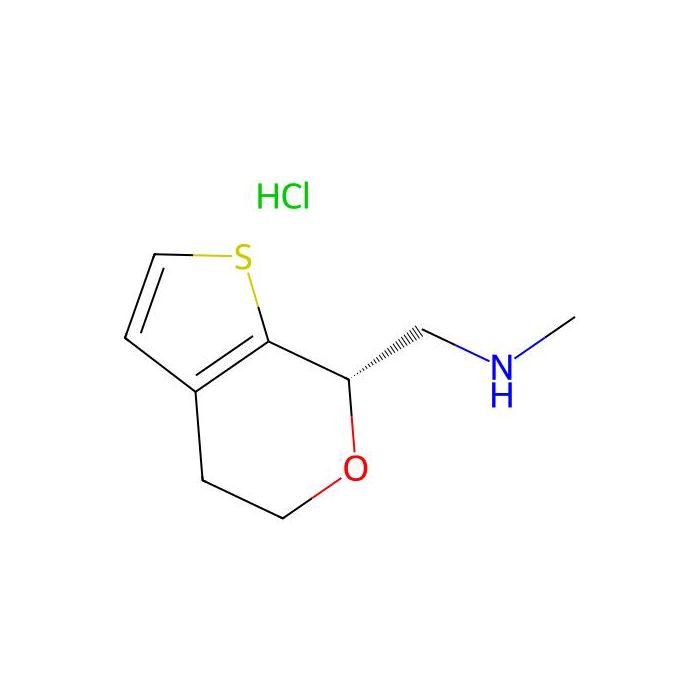
SEP-363856 hydrochloride (SEP-856 hydrochloride), an orally active and CNS active psychotropic agent with a unique, non-D2/5-HT2A mechanism of action, exerts its antipsychotic-like effects. SEP-363856 hydrochloride (SEP-856 hydrochloride) has the potential for the study of schizophrenia
In Vitro
SEP-856 (10 μM) shows >50% inhibition of specific binding at α 2A , α 2B , D 2 , 5-HT 1A , 5-HT 1B , 5-HT 1D , 5-HT 2A , 5-HT 2B , 5-HT 2C , and 5-HT 7 receptors. MCE has not independently confirmed the accuracy of these methods. They are for reference only.
In Vivo
SEP-856 (0.3, 1 and 10 mg/kg, i.p.) is CNS active and exhibits a behavioral signature similar to known antipsychotic drugs . SEP-856 (0.3, 1 and 10 mg/kg, orally once) significantly reduces PCP-induced hyperactivity . Oral SEP-856 administration (1, 3 and 10 mg/kg) produces a dosedependent decrease in REM sleep, increase in latency to REM sleep and increase in cumulative wake (W) time . MCE has not independently confirmed the accuracy of these methods. They are for reference only. Animal Model: Acute treatment with phencyclidine (PCP), which induces robust hyperactivity in rodents . Dosage: 0.3, 1 and 3 mg/kg. Administration: Orally once. Result: Resulted in a dose-dependent inhibition of PCP-induced hyperactivity responses in C57Bl/6J mice (1-way ANOVA F (5, 59) = 18.96, p < 0.0001; Tukey’s post-hoc test, p < 0.05) with a 50% effective dose (ED 50 ) of approximately 0.3 mg/kg. Animal Model: Male Sprague Dawley rats . Dosage: 1, 2, and 5 mg/kg. Administration: I.V. injection. (Pharmacokinetic Analysis). Result: Rapidly absorbed with maximum plasma and brain concentrations reached within 0.25 to 0.5 hours in mice and rats and maximum plasma concentrations reached within 6 ± 2.83 hours in monkeys. Penetrated mouse and rat brains after oral administration (10 mg/kg), with average brain-to-plasma AUC ratios of ~3 respectively.
Form:Solid
IC50& Target:TAAR1 0.140 μM (EC 50 ) 5-HT 1A Receptor 2.3 μM (EC 50 ) 5-HT 1B Receptor 15.6 μM (EC 50 ) 5-HT 1D Receptor 0.262 μM (EC 50 ) 5-HT 2A Receptor >10 μM (EC 50 ) 5-HT 2C Receptor 30 μM (EC 50 ) 5-HT 7 Receptor 6.7 μM (EC 50 )
| Sonrisas canónicas | CNCC1C2=C(CCO1)C=CS2.Cl |
|---|---|
| IUPAC Name | 1-[(7S)-5,7-dihydro-4H-thieno[2,3-c]pyran-7-yl]-N-methylmethanamine;hydrochloride |
| InChIKey | JRDQGVVFSHRVTL-QRPNPIFTSA-N |
| INCHI | 1S/C9H13NOS.ClH/c1-10-6-8-9-7(2-4-11-8)3-5-12-9;/h3,5,8,10H,2,4,6H2,1H3;1H/t8-;/m0./s1 |
| Isómeros SMILES | CNC[C@H]1C2=C(CCO1)C=CS2.Cl |
| CAS alternativo | 1310422-41-3 |
| PubChem CID | 139415154 |
| Peso molecular | 219.73 |
Comprehensive hazard, handling, storage, and regulatory compliance document.
Download SDS →Lot-specific quality data. Enter your lot number to retrieve the exact COA.
Look up COA →Full quality attributes and acceptance criteria for this grade.
View spec sheet →Taxonomy Tree
| Kingdom | Organic compounds |
|---|---|
| Superclass | Organoheterocyclic compounds |
| Clase | Thienopyrans |
| Subclass | Not available |
| Intermediate Tree Nodes | Not available |
| Direct Parent | Thienopyrans |
| Alternative Parents | Pyrans Thiophenes Heteroaromatic compounds Oxacyclic compounds Dialkylamines Dialkyl ethers Organosulfur compounds Organopnictogen compounds Hydrochlorides Hydrocarbon derivatives |
| Molecular Framework | Aromatic heteropolycyclic compounds |
| Substituents | Thienopyran - Pyran - Heteroaromatic compound - Thiophene - Oxacycle - Secondary amine - Ether - Secondary aliphatic amine - Dialkyl ether - Organic nitrogen compound - Organic oxygen compound - Organopnictogen compound - Hydrocarbon derivative - Hydrochloride - Organosulfur compound - Organooxygen compound - Organonitrogen compound - Amine - Aromatic heteropolycyclic compound |
| Descripción | This compound belongs to the class of organic compounds known as thienopyrans. These are heterocyclic compounds containing a thiophene ring fused to a pyran ring. Thiophene is 5-membered ring consisting of four carbon atoms and one sulfur atom. Pyran a six-membered heterocyclic, non-aromatic ring, made up of five carbon atoms and one oxygen atom and containing two double bonds. |
| External Descriptors | Not available |
| Solubilidad | H2O : 100 mg/mL (455.10 mM; Need ultrasonic) DMSO : 62.5 mg/mL (284.44 mM; Need ultrasonic) |
|---|---|
| Peso molecular | 219.730 g/mol |
| XLogP3 | |
| Hydrogen Bond Donor Count | 2 |
| Hydrogen Bond Acceptor Count | 3 |
| Rotatable Bond Count | 2 |
| Exact Mass | 219.048 Da |
| Monoisotopic Mass | 219.048 Da |
| Topological Polar Surface Area | 49.500 Ų |
| Heavy Atom Count | 13 |
| Formal Charge | 0 |
| Complexity | 153.000 |
| Isotope Atom Count | 0 |
| Defined Atom Stereocenter Count | 1 |
| Undefined Atom Stereocenter Count | 0 |
| Defined Bond Stereocenter Count | 0 |
| Undefined Bond Stereocenter Count | 0 |
| The total count of all stereochemical bonds | 0 |
| Covalently-Bonded Unit Count | 2 |