Determine the necessary mass, volume, or concentration for preparing a solution.
≥99% para flujos de trabajo cromatográficos y analíticos sensibles que requieren una interferencia mínima de la línea base.
Store at 2-8°C,Desiccated Envío Wet ice. Consulte el COA específico del lote para conocer las especificaciones exactas.
SDS, COA, ficha técnica y hoja de especificaciones disponibles para descargar. COA específico del lote accesible mediante búsqueda por número de lote.
Citado en 0 publicaciones revisadas por pares sobre cromatografía, síntesis orgánica y reacciones de acoplamiento cruzado.
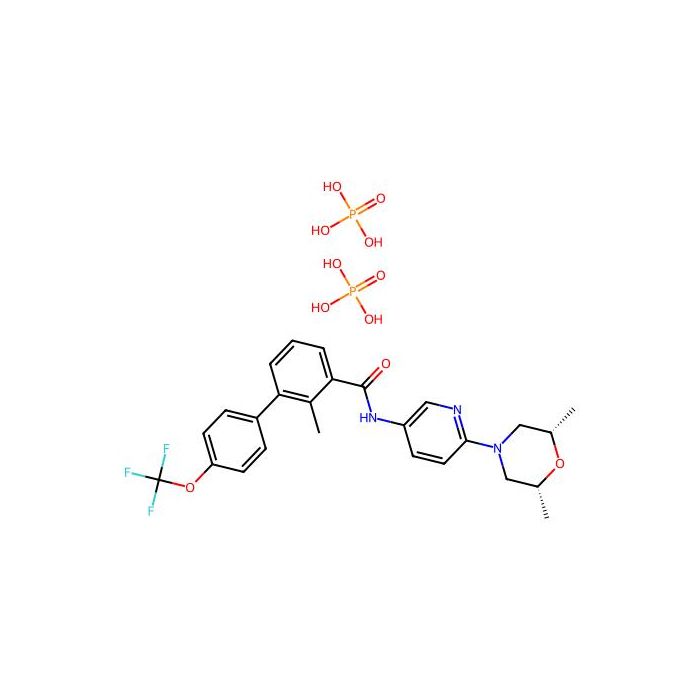
Sonidegib diphosphate (Erismodegib diphosphate) is a potent and selective Smo antagonist with IC 50 of 1.3 nM and 2.5 nM for mouse and human Smo in binding assay, respectively
In Vitro
The IC 50 values for Sonidegib (NVP-LDE225) for the major human CYP450 drug metabolizing enzymes is greater than 10 μM. Sonidegib (LDE225), a small molecule, clinically investigated SMO inhibitor, used alone and in combination with Nilotinib, inhibits the Hh pathway in CD34 + chronic phase (CP)-chronic myeloid leukaemia (CML) cells, reducing the number and self-renewal capacity of CML leukaemia stem cell (LSC). Sonidegib interacts directly with SMO, in a similar fashion to cyclopamine, to reduce expression of downstream Hh signaling targets. Primary CD34 + CP-CML cells are cultured in serum free media (SFM)±Sonidegib for 6, 24 and 72 hours (h). At 72 h, while there is variability between the biological samples, GLI1 is significantly downregulated following exposure to Sonidegib (10 nM; 0.78-fold and 100 nM; 0.73-fold, respectively (p<0.01). MCE has not independently confirmed the accuracy of these methods. They are for reference only.
In Vivo
Sonidegib (NVP-LDE225) is a weak base with a measured pK a of 4.2 and exhibits relatively poor aqueous solubility. In the subcutaneous Ptch +/- p53 -/- medulloblastoma allograft mouse model, Sonidegib demonstrates dose-related antitumor activity after 10 days of oral administration of a suspension of the diphosphate salt. At a dose of 5 mg/kg/day qd, Sonidegib significantly inhibits tumor growth, corresponding to a T/C value of 33% (p<0.05 as compared to vehicle controls). When dosed at 10 and 20 mg/kg/day qd, Sonidegib affords 51 and 83% regression, respectively . Bone marrow cells and spleen cells from a subset of treated mice are transplanted into secondary recipient mice. Transplantation of either bone marrow (BM) or spleen cells from mice treated with Sonidegib (LDE225)+Nilotinib results in reduced white cell count (WCC) and reduces leukaemia development in secondary recipients compared to Sonidegib or Nilotinib alone. MCE has not independently confirmed the accuracy of these methods. They are for reference only.
Cell Assay
CD34 + CP-CML cells are seeded in SFM alone±Sonidegib±Nilotinib and cultured for 24-72 h prior to assessment. Proliferation is measured using colorimetric assessment of BrDU incorporation. Proportion of viable cells versus those in early and late apoptosis is assessed by flow cytometry using annexin V-FITC and 7-amino-actinomycin D (7-AAD, Via-Probe solution). Cell cycle status is assessed using Ki67 (FITC) expression and 7-AAD incorporation. MCE has not independently confirmed the accuracy of these methods. They are for reference only.
Animal administration
Mice The transgenic EGFP + /SCLtTA/TRE-BCR-ABL mouse model is used to investigate the effect of Sonidegib treatment on CML LSC in vivo. Scl-tTa-BCR-ABL mice in the FVB/N background are crossed with transgenic GFP-expressing mice. Bone marrow cells are obtained 4 weeks post induction, GFP + cells are selected by flow cytometry and transplanted by tail vein injection (10 6 cells/mouse) into wild-type FVB/N recipient mice, irradiated at 900 cGy, generating a large cohort of mice with similar time of onset of leukemia. Blood samples obtained 4 weeks post transplantation confirmed a neutrophilic leukocytosis in recipient mice. Mice are treated with Nilotinib (50 mg/kg by gavage, daily), Sonidegib (80 mg/kg by gavage, daily), Sonidegib+Nilotinib, or with vehicle alone (control). After 3 weeks of treatment, animals are euthanised and marrow content of femurs and tibiae, spleen cells and blood obtained. Total white cell count (WCC), GFP-expressing WCC, myeloid cells, and GFP+ progenitors and stem cells are measured by flow cytometry. Survival is assessed in a subset of mice for 120d post discontinuation of treatment. Spleen and BM cells from a subset of mice in each arm are pooled and 5×10 6 cells/mouse (8 mice/condition) are transplanted into wild-type FVB/N recipient mice irradiated at 900 cGy. Engraftment is monitored by drawing peripheral blood (PB) every 4 weeks. The percentage of GFP + cells in PB is analyzed by flow cytometry. aladdin has not independently confirmed the accuracy of these methods. They are for reference only.
Form:Solid
IC50& Target:IC50: 1.3 nM (mSmo), 2.5 nM (hSmo)
Documento completo sobre peligros, manipulación, almacenamiento y cumplimiento normativo.
<<<<<<< HEAD Descargar SDS → ======= Descargar SDS → >>>>>>> release248-p3Datos de calidad específicos del lote. Introduzca su número de lote para obtener el COA exacto.
Buscar COA →Resumen de referencia rápida de las especificaciones y aplicaciones del producto.
Ver ficha técnica →Atributos de calidad completos y criterios de aceptación para esta calidad.
Ver hoja de especificaciones →Taxonomy Tree
| Kingdom | Organic compounds |
|---|---|
| Superclass | Benzenoids |
| Clase | Benzene and substituted derivatives |
| Subclass | Biphenyls and derivatives |
| Intermediate Tree Nodes | Not available |
| Direct Parent | Biphenyls and derivatives |
| Alternative Parents | o-Toluamides Benzamides Phenoxy compounds Phenol ethers Benzoyl derivatives Dialkylarylamines Aminopyridines and derivatives Organic phosphoric acids and derivatives Morpholines Imidolactams Heteroaromatic compounds Trihalomethanes Secondary carboxylic acid amides Oxacyclic compounds Azacyclic compounds Dialkyl ethers Organofluorides Organopnictogen compounds Alkyl fluorides Organic oxides Hydrocarbon derivatives |
| Molecular Framework | Aromatic heteromonocyclic compounds |
| Substituents | Biphenyl - Benzamide - Benzoic acid or derivatives - O-toluamide - Toluamide - Phenoxy compound - Benzoyl - Phenol ether - Dialkylarylamine - Aminopyridine - Toluene - Morpholine - Organic phosphoric acid derivative - Oxazinane - Pyridine - Imidolactam - Heteroaromatic compound - Secondary carboxylic acid amide - Trihalomethane - Carboxamide group - Azacycle - Oxacycle - Organoheterocyclic compound - Carboxylic acid derivative - Dialkyl ether - Ether - Alkyl fluoride - Halomethane - Organohalogen compound - Hydrocarbon derivative - Organofluoride - Organonitrogen compound - Organooxygen compound - Organic oxide - Organopnictogen compound - Organic oxygen compound - Organic nitrogen compound - Alkyl halide - Aromatic heteromonocyclic compound |
| Descripción | This compound belongs to the class of organic compounds known as biphenyls and derivatives. These are organic compounds containing to benzene rings linked together by a C-C bond. |
| External Descriptors | Not available |
| Solubilidad | DMSO : 100 mg/mL (146.74 mM; Need ultrasonic) H2O : 0.25 mg/mL (0.37 mM; Need ultrasonic) |
|---|---|
| Peso molecular | 681.500 g/mol |
| XLogP3 | |
| Hydrogen Bond Donor Count | 7 |
| Hydrogen Bond Acceptor Count | 16 |
| Rotatable Bond Count | 5 |
| Exact Mass | 681.146 Da |
| Monoisotopic Mass | 681.146 Da |
| Topological Polar Surface Area | 219.000 Ų |
| Heavy Atom Count | 45 |
| Formal Charge | 0 |
| Complexity | 741.000 |
| Isotope Atom Count | 0 |
| Defined Atom Stereocenter Count | 2 |
| Undefined Atom Stereocenter Count | 0 |
| Defined Bond Stereocenter Count | 0 |
| Undefined Bond Stereocenter Count | 0 |
| The total count of all stereochemical bonds | 0 |
| Covalently-Bonded Unit Count | 3 |
Only product-data-sourced protocols may be listed here.
General guidance (not item specifications)
Item-specific (Product Data)
Literature/general context (not product specifications; for research background only)
Note: The above information summarizes general scientific literature to aid experimental design. For this specific catalog item, no target specificity or potency data are provided; consult primary literature and verify activity in your system of interest.
Not typically applicable. Sonidegib diphosphate is a bioactive small-molecule salt, not a buffering reagent. For practical handling:
No specific buffer formulations are specified for this item; refer to your assay’s validated conditions.
This product is a bioactive small molecule, not a process solvent or bulk reagent; green-alternative considerations are therefore limited.
Applicability
General greener-practice guidance (literature/general)
Tradeoffs
This product is supplied strictly for research use only.
Item-specific (Product Data)
Literature/general (formulation science context; no medical claims)
No pharmacopeial monograph or excipient role is specified for this item. Do not use in humans or animals. Any discussion of dosage forms in the literature is outside the scope of this catalog entry and must not be inferred as an approved use.
Item-specific (Product Data)
Literature/general values and guidance (do not treat as item specifications)
Practical note: Because salt stoichiometry (e.g., mono-, di-, or tri-phosphate equivalents; hydration state) can change physical constants, rely on the lot-specific CoA for precise formula weight and solubility parameters when preparing analytic standards or dose–response series.
Item-specific (Product Data)
How to interpret grade/purity (general guidance)
What is specific vs general
Quality tips
This product is supplied as a research bioactive; it is not typically used as a synthetic reagent. Applications focus on chemical biology and screening.
Item-specific (Product Data)
Literature/general applications (context only)
Practical notes (general)
Not typically applicable as a transformation substrate. This product is intended for biological assays and analytical work rather than for use as a reagent in chemical reactions.
For any synthetic manipulation of the molecule, refer to medicinal chemistry literature for the free-base form and validated stepwise conditions; no reaction conditions are specified for this catalog item.
Item-specific (Product Data)
General laboratory safety (literature/standard best practices; defer to SDS for authority)
Special notes
Context: Sonidegib diphosphate is a bioactive small-molecule salt. Solvent choice impacts solubility, stability, and assay compatibility.
Item-specific (Product Data)
Literature/general guidance (not item specifications)
When to choose alternatives
Item-specific (Product Data)
Reconstitution guidance (general; not item specifications)
Stability considerations (general)
Always refer to the lot-specific CoA and SDS for definitive guidance on storage, handling, and reconstitution for this item.
Brief overview: Sonidegib diphosphate is the diphosphate salt of the small molecule sonidegib, provided here for research screening and assay development.
Item-specific (Product Data)
Literature/general (for context; not item-specific specifications)
2D structural description (qualitative, literature): The free base consists of an aromatic/heteroaromatic scaffold bearing basic nitrogen functionality; conversion to the diphosphate generates a multi-ionic salt. Please verify exact ring systems and substituents with an authenticated structure file (SDF/SMILES) from the CoA or a curated database.
Not a typical synthetic building block.
Applicability
Literature/general guidance
Recommendation
Only product-data-sourced details may be listed here.
Note: While the broader literature discusses biological targets for sonidegib, no target specificity is provided for this specific catalog entry. Users should verify target engagement and activity empirically in their systems.