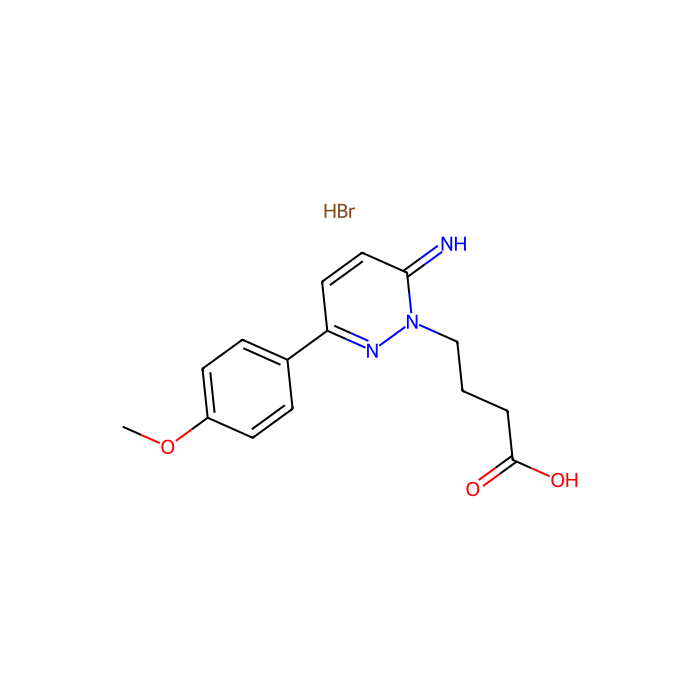
SR-95531 is a specific GABAA receptor antagonist that does not affect GABA-transaminase or glutamate-decarboxylase activities.
Condiciones de almacenamiento de almacenamiento
Store at -20°C
Enviado en
Ice chest + Ice pads
Este producto requiere envío en cadena de frío. Los servicios terrestres y otros servicios económicos no están disponibles.
Nota
Wherever possible, you should prepare and use solutions on the same day. However, if you need to make up stock solutions in advance, we recommend that you store the solution as aliquots in tightly sealed vials at -20°C. Generally, these will be useable for up to one month. Before use, and prior to opening the vial we recommend that you allow your product to equilibrate to room temperature for at least 1 hour. Need more advice on solubility, usage and handling? Please visit our frequently asked questions (FAQ) page for more details.
This compound belongs to the class of organic compounds known as phenylpyridazines. These are organic compounds containing a pyridazine ring substituted by a phenyl group.
External Descriptors
Not available
1. Djoumbou Feunang Y, Eisner R, Knox C, Chepelev L, Hastings J, Owen G, Fahy E, Steinbeck C, Subramanian S, Bolton E, Greiner R, and Wishart DS. ClassyFire: Automated Chemical Classification With A Comprehensive, Computable Taxonomy. Journal of Cheminformatics, 2016, 8:61.
Determine the necessary mass, volume, or concentration for preparing a solution.
Dilution Calculator
Determine the dilution needed to prepare a stock solution.
Reconstitution Calculator
Reseñas
Reseñas de cliente
Application Protocols
Only protocols explicitly provided by the manufacturer may be listed here.
Tested applications: Not specified for this item; refer to product page or CoA.
Recommended working concentrations/dilutions: Not specified for this item; refer to product page or CoA.
Positive/negative controls: Not specified for this item; refer to product page or CoA.
General note: For assay development, consult primary literature and optimize conditions (vehicle percentage, exposure time, temperature, and buffer composition) for your specific biological system. Validate results with appropriate controls and replicate experiments.
Biological Roles
The source record does not include biological target information for this item. The following context is provided as literature background only; verify target, potency, and assay recommendations from primary sources before use.
Literature context: SR-95531 is widely referred to as “gabazine,” a small-molecule ligand used as a selective antagonist of GABA_A receptors in neurobiology research. It is employed to suppress GABA_A-mediated inhibitory signaling in cultured neurons, brain slices, and in vitro electrophysiology to dissect neuronal circuitry and receptor pharmacology.
Selectivity considerations (literature): Reported as a competitive antagonist at GABA_A receptors; off-target profiles, subtype selectivity, and species differences should be reviewed in up-to-date literature for your application.
Experimental implications: Blocking inhibitory chloride conductance can increase network excitability; use with appropriate safety and assay controls.
Formulation notes (general): Stocks are commonly prepared in DMSO and diluted into artificial cerebrospinal fluid (ACSF) or recording buffers with attention to final vehicle percentage.
Important: The above constitutes general literature background and does not represent item-specific claims. This product is for research use only and is not intended for diagnostic, therapeutic, or other clinical uses.
Buffer Applications
No item-specific buffer recipes or pKa data are provided. Buffer usage, when applicable, is driven by the biological assay rather than by the compound acting as a buffer.
General practice for small-molecule ligands in physiological experiments:
Vehicle preparation: Dissolve in DMSO to make a concentrated stock; dilute into the working buffer (e.g., ACSF, HBSS, PBS, or intracellular pipette solution) immediately before use. Keep final DMSO at assay-tolerated levels.
Compatibility: Check for precipitation upon dilution into high-ionic-strength or high-protein buffers; pre-warm solutions and add slowly with mixing to reduce microprecipitation.
pH considerations: If using the free-base/neutral form, slight pH adjustment may help dissolution; confirm that pH changes do not perturb your assay.
Sterility: For cell culture, pass solutions through a 0.22 µm filter and prepare fresh aliquots as needed.
Not a buffering agent: SR-95531 is not typically used to establish or maintain buffer pH. Choose standard biological buffers (e.g., HEPES, phosphate, Tris) appropriate to your experimental pH range and ionic strength requirements.
Green Alternatives
Green chemistry considerations depend on how the compound is used (e.g., as a probe in aqueous buffers versus in organic synthesis). Since SR-95531 is typically a research ligand rather than a process reagent, “greener alternatives” most often refer to solvent choices and waste minimization rather than replacement of the active itself.
Solvent choices (general guidance):
• Prefer water or buffered aqueous media when solubility permits.
• If an organic cosolvent is required, DMSO and ethanol are generally more benign than DMF or dichloromethane for laboratory-scale work.
Operational improvements:
• Use small-volume, high-concentration stock solutions to reduce solvent waste.
• Adopt microscale screening formats (96-/384-well) to decrease chemical use.
• Evaluate closed, low-exposure handling (e.g., positive-displacement tips) to minimize volatilization and operator exposure.
Illustrative comparison (general):
DMSO vs DMF for stock solutions:
• Worker/environmental profile: DMSO typically preferred over DMF.
• Solubility: Both high; confirm compound-specific performance.
• Assay tolerance: DMSO often acceptable at ≤0.1–0.5% v/v; verify for your system.
Note: Where SR-95531 is integral to mechanism-of-action studies, “alternative actives” are not directly substitutable; instead, optimize formulation and handling to reduce footprint.
Pharmaceutical Uses
This product is supplied strictly for research use only and is not intended for human or veterinary use.
Pharmacopeial status: Not specified for this item; refer to CoA/Spec Sheet.
Excipient/formulation role: Not applicable; SR-95531 is a bioactive research ligand rather than an excipient.
Process development: If used in preclinical discovery biology, prepare and handle under research laboratory quality systems; this product is not qualified for cGMP manufacturing.
Practical guidance for formulation research (general):
Solubilization: Employ concentrated DMSO stocks; consider co-solvent systems (DMSO/PEG 400/saline) for exploratory in vivo formulation research in appropriate animal models conducted under approved protocols.
Stability assessment: Verify stability in intended vehicles (light, temperature, pH) by LC–MS or HPLC before longer studies.
Documentation: Maintain full traceability (lot number, CoA, SDS) and perform identity/purity checks upon receipt.
Note: No medical or therapeutic claims are made or implied. For any regulated use, source material qualified to the required standards is necessary.
Physical Properties
Item-specific specifications are not provided in the source data. Use the following notes as general guidance only and verify on the CoA/Spec Sheet prior to use.
Appearance: Not specified for this item; refer to CoA/Spec Sheet.
Molecular weight: Not specified for this item; refer to CoA/Spec Sheet.
Molecular formula: Not specified for this item; refer to CoA/Spec Sheet.
Melting point: Not specified for this item; refer to CoA/Spec Sheet.
Boiling point/decomposition: Not specified for this item; refer to CoA/Spec Sheet.
Density: Not specified for this item; refer to CoA/Spec Sheet.
Refractive index: Not applicable for a solid; if liquid, not specified for this item; refer to CoA/Spec Sheet.
pKa/logP/logD: Not specified for this item; refer to CoA/Spec Sheet.
Solubility: Not specified for this item; refer to CoA/Spec Sheet.
General handling considerations for small-molecule research ligands (literature/common practice):
Many heteroaromatic salts show good solubility in polar, aprotic solvents (e.g., DMSO) and mixed aqueous buffers when appropriately pH-adjusted; free-base or neutral forms can have markedly lower aqueous solubility.
If the exact salt form is unknown, prepare a small solubility screen (water, PBS, DMSO, MeOH, EtOH) at room temperature, with gentle warming (<40 °C) as needed.
Hygroscopicity can vary widely; minimize atmospheric exposure until the item’s behavior is confirmed.
Always calculate concentrations on the basis of the confirmed formula weight and salt form listed on the CoA.
Quality and Grades
Item-specific grade and purity are not provided in the source data.
Grade/purity: Not specified for this item; refer to CoA/Spec Sheet.
Stabilizers/inhibitors: Not specified for this item; refer to CoA/Spec Sheet.
Guidance on interpreting grades (general):
Research grade: Suitable for most discovery biology and screening; impurities may be present at levels acceptable for non-regulated research.
Analytical (AR) grade: Meets tighter inorganic impurity limits; appropriate when trace metal content can bias assay readouts.
HPLC grade solvents/reagents: Low UV background and particulate; selected for chromatographic applications.
≥95–99% purity (typical small-molecule lots): Higher purity reduces ambiguity in dose–response work; verify with lot-specific LC, NMR, and water/volatile content data where relevant.
Best practices:
Request and retain the item’s CoA for: assay purity (and method), residual solvent profile, water content, and salt/counterion identity.
If you require low UV absorbance, defined polymorph, or specific counterion/solvate, contact Technical Support for a fit-for-purpose lot selection.
For pharmacology experiments, confirm identity/purity by an orthogonal technique (e.g., LC–MS) upon receipt, especially when reproducing literature results.
Reaction and Applications
This material is primarily used as a small-molecule research tool rather than as a synthetic reagent. No manufacturer application notes are provided for this catalog entry.
Manufacturer Applications: Not specified for this item; refer to product page updates or Technical Support.
Synthetic reagent use: Not typically used as a catalyst, coupling partner, or stoichiometric reagent in standard organic transformations.
Analytical/biological research use (general): Often employed as a defined small-molecule probe in neurobiological and electrophysiological studies (literature). Exact assay conditions, targets, and concentrations should be taken from primary literature and adjusted to your system.
Practical guidance (general):
Prepare concentrated DMSO stocks to minimize freeze–thaw cycles; aliquot and store at the recommended temperature.
Validate identity and purity (LC–MS/1H NMR) and confirm the salt form to ensure accurate dosing in receptor/ion-channel assays.
Include appropriate vehicle controls and, if relevant, positive/negative control ligands per your assay design.
If surface adsorption or nonspecific binding is suspected at low concentrations, consider low-binding plastics and carrier proteins (where compatible) to stabilize solutions.
Note: For research use only.
Reaction Conditions
Not typically applicable. SR-95531 is primarily used as a research ligand in biological assays rather than as a reagent in chemical reactions.
Chemical reactivity: Without item-specific structural details and functional-group confirmation, no reliable reaction-condition guidance can be provided.
If conducting derivatization: Employ small-scale scouting with literature-informed conditions appropriate to the confirmed scaffold; monitor by LC–MS and characterize intermediates to avoid misassignment due to salt/counterion effects.
For users seeking assay conditions instead of chemical reaction conditions:
Prepare validated stock solutions (concentration based on confirmed formula weight) and titrate in the relevant biological buffer with appropriate vehicle controls.
Consult recent literature for concentration ranges, exposure times, and compatibility with your recording or imaging setup.
Item-specific parameters such as melting point, stability, or degradation pathways under synthetic conditions are not specified for this item; refer to CoA/Spec Sheet and SDS.
Safety and Handling
Safety data specific to this item are not provided in the source record. Treat as a laboratory chemical of unknown hazards and consult the SDS for authoritative guidance.
GHS classification: Not specified for this item; refer to SDS.
Signal word / pictograms / H-statements: Not specified for this item; refer to SDS.
General laboratory precautions (good practice):
Engineering controls: Work in a chemical fume hood or ventilated enclosure when weighing, dissolving, or aliquoting powders/solutions.
PPE: Lab coat, safety glasses, and appropriate chemical-resistant gloves (e.g., disposable nitrile). Upgrade PPE for splash or aerosol-generating operations.
Avoid: Inhalation of dust/aerosols; skin/eye contact; ingestion. Prevent contamination of shared equipment.
First aid (overview; defer to SDS):
• Inhalation: Move to fresh air, monitor for symptoms; seek medical evaluation.
• Skin: Remove contaminated clothing, wash with soap and water.
• Eyes: Rinse cautiously with water for several minutes; remove contact lenses if easy; continue rinsing.
• Ingestion: Rinse mouth; do not induce vomiting; obtain medical attention.
Incompatibilities: Unknown for this specific item; as a precaution, segregate from strong oxidizers/reductants and acids/bases until compatibility is established.
Spill/cleanup: Avoid dust generation; collect with inert absorbent, dispose per institutional and local regulations.
Waste: Manage as hazardous chemical waste unless a validated nonhazard classification exists.
Note: For research use only. Not for human or animal use.
Solvent Selection
No item-specific solubility data are provided. The following is general guidance for preparing small-molecule research ligands; verify with a small-scale solubility test and the item’s CoA.
Likely solvent choices:
• DMSO: First-line for stock solutions (10–100 mM typical in practice) due to broad solvency for heteroaromatics and salts.
• Water/aqueous buffers: Depends strongly on salt form and ionization state; pH adjustment may be required for neutral/free-base forms.
• Alcohols (MeOH, EtOH) and polar aprotics (DMF, acetonitrile): Useful for intermediate solubility when DMSO minimization is desired.
Miscibility and handling: DMSO stock solutions are readily diluted into most physiological buffers; keep final DMSO below assay-specific limits (commonly ≤0.1–0.5% v/v) to avoid vehicle effects.
Filtration: If sterile solutions are required, dissolve completely before 0.22 µm filtration to prevent analyte loss on the membrane.
Comparison snapshot (general):
DMSO vs DMF: DMSO is less volatile and more biocompatible at low %; DMF offers similar solvency but higher toxicity and volatility.
Water vs alcohols: Water is ideal for biological compatibility but may limit maximum concentration; alcohols improve solubility at the cost of assay tolerance.
Tip: Confirm the exact molar mass and salt/counterion on the CoA before preparing molar stocks.
Storage and Reconstitution
Follow item-specific storage guidance and verify any additional details on the CoA.
Storage conditions (provided): Store at -20°C.
Shipping conditions (provided): Shipped in ice chest with ice pads (cold pack).
Item-specific solution guidance:
Reconstitution solvent: Not specified for this item; refer to CoA/Spec Sheet.
Working/stock concentration: Not specified for this item; refer to CoA/Spec Sheet.
Stabilizers: Not specified for this item; refer to CoA/Spec Sheet.
General best practices for small-molecule ligands:
Prepare concentrated stock solutions (commonly in DMSO) based on the confirmed molecular weight and salt form; vortex and, if necessary, gently warm (<40 °C) to aid dissolution.
Aliquot stocks to single-use volumes to avoid repeated freeze–thaw cycles; store tightly sealed at -20 °C or below, protected from light and moisture as appropriate.
Thaw on ice or at room temperature; inspect for precipitation or discoloration before use.
For aqueous working solutions, prepare fresh on the day of use or validate short-term stability by LC–MS/HPLC.
Document lot number, preparation date, solvent, and final concentration on each aliquot.
Note: For research use only.
Structure and Identity
Brief overview: SR-95531 is supplied as a small-molecule research reagent. Detailed structural identifiers for this catalog item are not provided below; consult the CoA/Spec Sheet for definitive item-specific identity data.
SKU: S165603
Product name: SR-95531
CAS: 104104-50-9 (literature identifier for SR-95531)
PubChem CID: 107895 (literature)
InChIKey: Not specified for this item; refer to CoA/Spec Sheet.
• Note: A placeholder “101082” appears in the source data but does not conform to standard InChIKey format; do not use as an identifier.
SMILES: Not specified for this item; refer to CoA/Spec Sheet.
Molecular formula: Not specified for this item; refer to CoA/Spec Sheet.
Molecular weight: Not specified for this item; refer to CoA/Spec Sheet.
Structural features (general/literature context):
SR-95531 is widely known in the neuroscience literature as a small heteroaromatic ligand (often referred to as “gabazine”). Item-specific stereochemistry/tautomer/salt-form details are not provided here.
2D description (general): cationic/heteroaromatic scaffold bearing aryl substitution and polar functionality; exact functional group assignment and counterion must be verified on the item CoA.
Identity verification guidance:
Confirm exact salt form, counterion, and hydrate state (if any) on the CoA before calculating molar concentrations.
Match CAS, lot number, and spectral data (NMR/HRMS/LC-MS) against your internal quality criteria prior to critical use.
Synthetic Utility
SR-95531 is not commonly used as a building block or reagent in preparative organic synthesis.
Functional role: Predominantly a bioactive probe compound rather than a synthetic intermediate.
Transformations: No widely established named-reaction applications as a reagent. If derivatization is desired (e.g., prodrug or affinity-tag analogs for chemical biology), consult the primary literature for substitution patterns and stability considerations of the parent scaffold.
Analytical reference: It may serve as a reference standard for analytical methods development (e.g., LC–MS quantification) in pharmacology workflows; ensure you have a characterized reference lot and suitable internal standards.
Recommendation: If your goal is synthetic elaboration, obtain structural and salt-form details (including counterion and any solvation) from the CoA and confirm by NMR/HRMS prior to planning transformations or protecting-group strategies.
Target Specificity
Only information explicitly provided in the product data may be listed here.
Target/epitope: Not specified for this item; refer to product page or CoA.
Species reactivity: Not specified for this item; refer to product page or CoA.
Clone/isotype (if antibody): Not applicable.
Note: Although SR-95531 is discussed in literature as a small-molecule ligand with defined pharmacological activity, item-specific target specifications are not provided in the source data and are therefore not stated here.
We use cookies to ensure the website functions properly and, where permitted, to improve your experience. You can manage your preferences at any time in Settings. Learn more in our Cookie Policy.
Shall we send you a message when we have discounts available?
Remind me later
Thank you! Please check your email inbox to confirm.
Products are supplied to verified businesses, institutions, and qualified professionals for research and development use only. Not for use in humans, animals, diagnosis, or therapy.

 K2520115