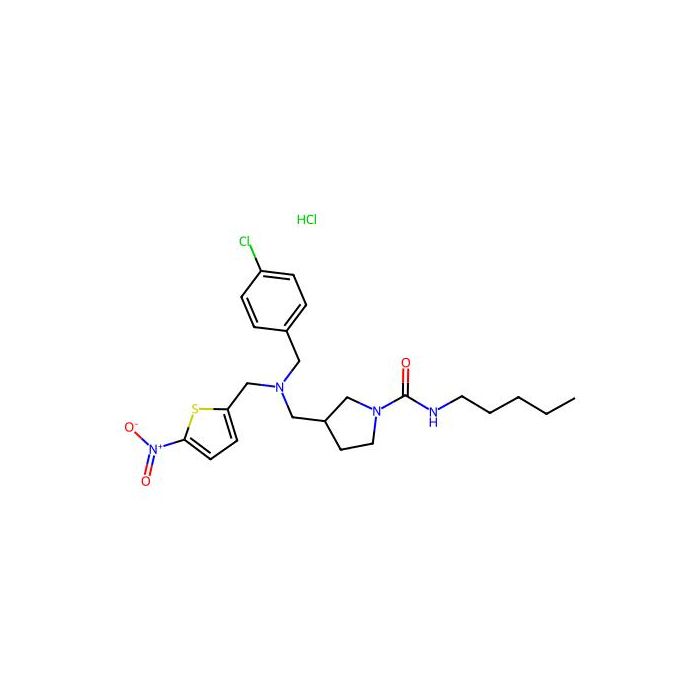
SR9011 hydrochloride is a REV-ERBα / β agonist with IC 50 s of 790 nM and 560 nM for REV-ERBα and REV-ERBβ, respectively.
In Vitro
SR9011 dose-dependently increases the REV-ERB-dependent repressor activity assessed in HEK293 cells expressing a chimeric Gal4 DNA Binding Domain (DBD) - REV-ERB ligand binding domain (LBD) α or β and a Gal4-responsive luciferase reporter (REV-ERBα IC 50 =790 nM, REV-ERBβ IC 50 =560 nM). SR9011 potently and efficaciously suppresses transcription in a cotransfection assay using full-length REV-ERBα along with a luciferase reporter driven by the Bmal1 promoter (SR9011 IC 50 =620 nM). SR9011 suppresses the expression ofBMAL1 mRNA in HepG2 cells in a REV-ERBα/β -dependent mannerSR9011 suppresses proliferation of the breast cancer cell lines regardless of their ER or HER2 status. SR9011 appears to pause the cell cycle of the breast cancer cells prior to M phase. Cyclin A ( CCNA2 ) is identified as a direct target gene of REV-ERB suggesting that suppression of expression of this cyclin by SR9011 may mediate the cell cycle arrest. Treatment with SR9011 results in an increase in cells in the G 0 /G 1 phase and a decrease of cells in S and G 2 /M phase suggesting that activation of REV-ERB may be resulting in decreased transition from G 1 to S phase and/or from S to G 2 /M phase. MCE has not independently confirmed the accuracy of these methods. They are for reference only.
In Vivo
SR9011 displays reasonable plasma exposure, thus, the expression of REV-ERB responsive genes is examined in the liver of mice treated with various doses of SR9011 for 6-days. The plasminogen activator inhibitor type 1 gene ( Serpine1 ) is a REV-ERB target gene and displays dose-dependent suppression of expression in response to SR9011. The cholesterol 7α-hydroxylase ( Cyp7a1 ) and sterol response element binding protein ( Srepf1 ) genes have also been shown to be responsive to REV-ERB and are dose-dependently suppressed with increasing amounts of SR9011. After 12 days in D:D conditions mice are injected with a single dose of SR9011 or vehicle at CT6 (peak expression of Rev-erbα ). Vehicle injection causes no disruption in circadian locomotor activity. However, administration of a single dose of SR9011 results in loss of locomotor activity during the subject dark phase. Normal activity returns the next circadian cycle, consistent with clearance of the drugs in less than 24h. The SR9011-dependent decrease in wheel running behavior in the mice under constant darkness conditions is dose-dependent and that the potency (ED 50 =56 mg/kg) is similar to the potency of SR9011-mediated suppression of a REV-ERB responsive gene, Srebf1 , in vivo (ED 50 =67mg/kg) . MCE has not independently confirmed the accuracy of these methods. They are for reference only.
Cell Assay
MCF10A, MDA-MB-231, MCF-7, MDA-MB-361, SKBR3, BT474 cells are plated in 6-well plates one day before treatment. The MTT cell proliferation assays are performed. Briefly, 3×10 3 to 5 × 10 3 cells per well are plated in 96-well plates. Twenty-four hours later, cells are treated with SR9011 (0, 2, 4, 6, 8 and 10 μM) or DMSO. Seventy-two hours after treatment, the cells are labeled with 1.2 mM MTT and incubated for 4 hours. DMSO is then added and readings are taken on a plate reader at 540 nm. MCE has not independently confirmed the accuracy of these methods. They are for reference only.
Form:Solid
IC50& Target:IC50: 790 nM (Rev-ErbBα), 560 nM (Rev-ErbBβ)