GRADE & PURITYMoligand™?Moligand™ — Aladdin's line of ligands and bioactive small molecules. Use for receptor, pathway, and binding studies needing defined small-molecule tools.10 mM in DMSO
Moligand™, 10 mM in DMSO Moligand™ for sensitive chromatographic and analytical workflows requiring minimal baseline interference.
🌡
Storage & shipping
Store at -80°C Ships Dry ice packs + Cold packs Check lot-specific COA for exact specifications.
📋
Quality documents
SDS, COA, datasheet, and spec sheet available for download. Lot-specific COA accessible via lot number lookup.
📚
Literature proof
Cited in 0 peer-reviewed publications across chromatography, organic synthesis, and cross-coupling reactions.
Descripción general
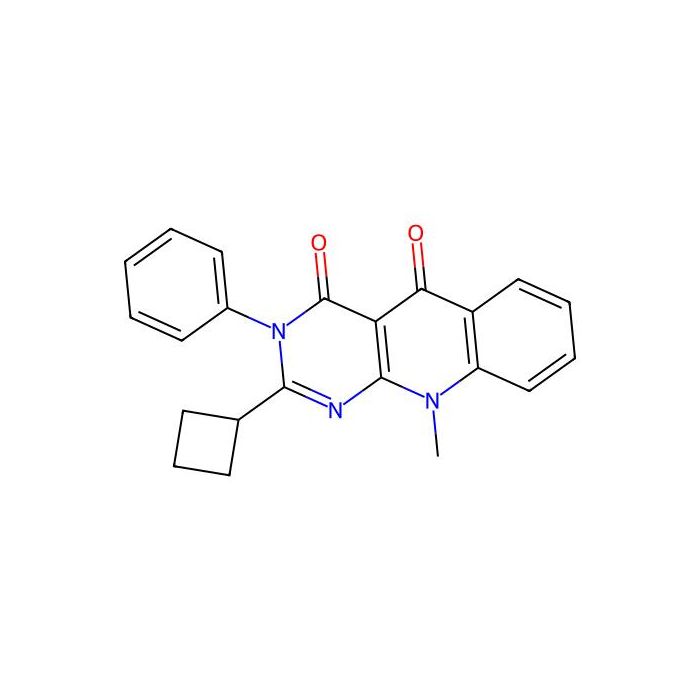
SRI-41315 induces a prolonged pause at stop codons and suppresses PTCs (premature termination codons) associated with cystic fibrosis in immortalized and primary human bronchial epithelial cells, restoring CFTR (cystic fibrosis transmembrane conductance regulator) expression and function. SRI-41315 suppresses PTCs by reducing the abundance of the termination factor eRF1 . SRI-41315 also potentiates aminoglycoside-mediated readthrough, leading to synergistic increases in CFTR activity.
Specifications
Especificaciones y pureza
Moligand™, 10 mM in DMSO
Condiciones de almacenamiento de almacenamiento
Store at -80°C
Enviado en
Dry ice packs + Cold packs
Este producto requiere envío en cadena de frío. Los servicios terrestres y otros servicios económicos no están disponibles.
Grado
Moligand™
Nombres e identificadores
Peso molecular
357.41
Documentation
📋 Safety Data Sheet (SDS)
Comprehensive hazard, handling, storage, and regulatory compliance document.
Certificados (CoA, COO, BSE/TSE y tabla de análisis)
C of A & Other Certificates(BSE/TSE, COO):
Analytical Chart:
Calculadoras de soluciones
Molarity Calculator
Determine the necessary mass, volume, or concentration for preparing a solution.
Dilution Calculator
Determine the dilution needed to prepare a stock solution.
Reconstitution Calculator
Reseñas
Reseñas de cliente
Application Protocols
There are no item-specific, validated application protocols provided for SRI-41315 in this listing.
General workflow suggestions for screening compounds (not item-specific)
Stock preparation: Dissolve the compound in anhydrous DMSO to 10–50 mM. Vortex and, if needed, sonicate briefly. Record exact concentration by weight and purity correction if available from the CoA.
Plate formatting: Use acoustic or pintool transfer to minimize DMSO volume. Seal plates to limit evaporation. Include vehicle controls and positive/negative controls.
Assay execution: Aim for a final DMSO concentration ≤0.5–1% v/v. Perform serial dilutions for CRCs (8–12 points, 2–3× step) to derive potency with confidence intervals.
Interference controls: Include redox, fluorescence, and detergent-sensitive counterscreens as appropriate. Check for precipitation by visual inspection or light scattering.
Data handling: Normalize to plate controls, remove outliers with predefined rules, and confirm hits in independent runs and orthogonal assay formats.
For specialized applications (e.g., biophysical binding, live-cell imaging), tailor concentrations, buffers, and controls to the platform and confirm compound stability over the assay window.
Biological Roles
Item-specific biological targets, pathways, or mechanisms for SRI-41315 are not provided in this listing. No target specificity or mode-of-action claims can be made without structural and bioactivity data.
General guidance (not item-specific)
Screening role: As a Moligand-grade small molecule, this item is suitable for exploratory screening in biochemical or cellular assays to uncover potential modulators of enzymes, receptors, transporters, or protein–protein interactions.
Data curation: If used in discovery workflows, record exact batch identifiers, plate locations, and solvent histories. Follow up any activity with orthogonal counterscreens to exclude assay interference, redox cycling, or aggregation artifacts.
ADME flags: Once structure is known, computational profiling (cLogP, TPSA, pKa) can guide permeability and solubility expectations. Early solubility and stability testing in assay media is recommended.
Important: For research use only. No claims are made regarding biological function, safety, or efficacy in humans or animals.
Buffer Applications
This product is a small-molecule screening compound and is not a buffering reagent. Therefore, conventional buffer system guidance (e.g., phosphate, HEPES, Tris) does not apply directly.
Practical notes for assay buffers (general, not item-specific)
Vehicle control: Maintain constant DMSO concentration across all wells when diluting stocks into buffers to avoid solvent-dependent signal changes.
Surfactants: For hydrophobic or aggregation-prone compounds, include a low level of nonionic detergent (e.g., 0.01–0.05% Tween 20 or Triton X-100) if compatible with the assay.
Protein binding: High protein content in buffers (e.g., serum, BSA) can decrease free concentration; consider this in EC50/IC50 interpretation.
pH stability: Without structural information, avoid extreme pH and strong oxidants/reductants during incubations to minimize decomposition risk.
Green Alternatives
Because the structure and synthetic role of SRI-41315 are not provided, green chemistry considerations focus on solvent and workflow choices during screening and handling (general guidance):
Greener solvent choices for stock preparation and handling (general)
Prefer DMSO over DMF or NMP where possible due to lower toxicity concerns and better biodegradability profile.
For wash steps and chromatography (if purification is undertaken), consider ethyl acetate/ethanol/heptane systems over chlorinated solvents when compatible with the compound.
Miniaturization and waste reduction
Utilize low-volume assay formats (384/1536-well) and acoustic dispensing to reduce DMSO usage and chemical waste.
Implement plate reformatting and sealed storage to extend the lifetime of master plates and reduce freeze–thaw cycles and waste.
Comparison snapshot (general, not item-specific)
DMSO: Broad solubility, low volatility, acceptable eco-profile; viscous and hygroscopic.
2-MeTHF/EtOAc for workups: Greener alternatives to THF/DCM when compound solubility allows.
Note: Any change in solvent system should be validated for the specific assay to ensure signal quality and absence of solvent-induced artifacts.
Pharmaceutical Uses
No excipient role, pharmacopeial status, or formulation use is specified for SRI-41315. This product is sold for research use only and is not intended for human or veterinary use.
General context (not item-specific)
Discovery stage utility: Small molecules in screening collections may serve in early drug discovery assays, hit confirmation, and SAR development. Any progression toward formulation requires extensive profiling, which is outside the scope of this listing.
Excipient considerations: Not applicable; this item is not presented as an excipient or processing aid.
Regulatory status: Not provided. No USP/Ph. Eur. monograph assignment is claimed or implied.
If formulation-like studies are performed in research settings (e.g., for in vivo exploratory work), ensure internal approvals and use material qualified with full analytical characterization from the CoA. Aladdin Scientific makes no claims regarding suitability for clinical or diagnostic applications.
Physical Properties
Item-specific properties
Appearance: Not specified for this item; refer to CoA/Spec Sheet.
Molecular Weight: Not specified for this item; refer to CoA/Spec Sheet.
Molecular Formula: Not specified for this item; refer to CoA/Spec Sheet.
Melting point (MP): Not specified for this item; refer to CoA/Spec Sheet.
Boiling point (BP): Not specified for this item; refer to CoA/Spec Sheet.
Density: Not specified for this item; refer to CoA/Spec Sheet.
LogP, pKa, refractive index: Not specified for this item; refer to CoA/Spec Sheet.
Solubility: Not specified for this item; refer to CoA/Spec Sheet.
General notes for small-molecule library compounds (literature/good practice, not item-specific)
Solubility and handling: Many screening compounds are supplied as dry powders and prepared as concentrated DMSO stocks (typically 10–50 mM) for HTS/HCS. If hygroscopic or poorly soluble, brief sonication and warming (room temperature to 37 °C) can help dissolve. Avoid prolonged heating.
Aqueous compatibility: Final assay DMSO concentrations are commonly ≤0.5–1% v/v to minimize assay interference; optimize per assay.
Light/moisture sensitivity: Some chemotypes (e.g., aldehydes, diazirines, nitroso, certain halides) are sensitive to light and/or hydrolysis. In the absence of item-specific data, treat as light- and moisture-sensitive by default and handle under low humidity with desiccant.
Quality and Grades
Item-specific information
Grade/Purity: Moligand™ (as listed). Specific purity values, residual solvents, or analytical limits: Not specified for this item; refer to CoA/Spec Sheet.
What Moligand™ typically implies (general, not item-specific)
Intended use: Small-molecule screening/ligand-discovery grade intended for research applications such as HTS, fragment expansion, and SAR exploration.
Typical characterization: Suppliers commonly provide identity confirmation by LC–MS and/or 1H NMR with an assay purity by HPLC or UPLC. For this specific item, the exact methods and acceptance criteria are not provided here; consult the CoA.
UV/fluorescence behavior: Not specified for this item; low-UV or chromophoric behavior should be confirmed before HPLC/UV detection.
Practical quality considerations
Batch information: Request batch-specific CoA for purity, identity, water content (if determined), and salt form.
Salt/hydrate/solvate state: Not specified. The form can substantially impact solubility and mass preparation; verify on CoA/label before preparing stock solutions.
Stabilizers/additives: None indicated. If present, they will appear on the CoA/label.
Recommendations
Verify identity/purity upon receipt if your application is sensitive (e.g., biophysical binding or quantitative SAR). Orthogonal methods (LC–MS, NMR) are advised when structural data is available.
Reaction and Applications
This product is presented as a small-molecule library member for research screening rather than as a synthetic reagent. Without structural information, specific reaction chemistry cannot be provided for SRI-41315.
General research applications for Moligand-type library members (not item-specific)
Assay screening: Use in biochemical or cell-based assays for primary screening, hit validation, and counter-screening.
Biophysical methods: Evaluate binding via DSF, MST, SPR, NMR, or ITC when sufficient solubility and purity are confirmed.
Phenotypic profiling: Assess activity in cellular models with appropriate controls and orthogonal assays.
SAR development: If an initial signal is observed, procure analogs or use similarity searches (based on the actual structure) for scaffold hopping.
Practical tips
Plate handling: Dispense from DMSO master stocks using acoustic or pintool transfer to minimize DMSO carryover and adsorption.
Controls: Include positive, negative, and vehicle controls; perform intra-plate normalization to mitigate edge effects.
Interference mitigation: Monitor for assay interference (fluorescence quenching, aggregation). Use detergents (0.01–0.05% nonionic) and counterscreens (e.g., redox or PAINS filters) as appropriate.
For synthetic chemistry applications, obtain the structure and functional-group profile to determine compatibility in named reactions, coupling strategies, or derivatizations.
Reaction Conditions
Not typically applicable: This listing does not present SRI-41315 as a reagent for performing chemical transformations, and no structural information is provided to suggest specific reactivity.
General laboratory handling conditions for small-molecule solutions (not item-specific)
Stock solutions: Prepare at 10–50 mM in anhydrous DMSO. Mix thoroughly; brief sonication may assist dissolution. Filter only if necessary due to potential compound loss.
Temperature: Prepare and dispense at ambient temperature. Avoid sustained exposure above 37 °C unless thermal stability is confirmed.
Light and moisture: In the absence of data, protect from light and humidity; work quickly with capped containers to limit atmospheric moisture uptake.
Stability checks: Monitor by LC–MS/HPLC after multiple freeze–thaw cycles or prolonged storage to ensure integrity.
For chemical reaction use, obtain the structure and consult literature precedent to choose appropriate solvents, bases/acids, catalysts, and temperatures.
Safety and Handling
Item-specific hazard data
GHS Classification: Not specified for this item; refer to SDS.
Signal word, H-statements, pictograms: Not specified for this item; refer to SDS.
General laboratory precautions (for unknown small-molecule solids)
PPE: Laboratory coat, safety glasses or goggles, and appropriate chemically resistant gloves (e.g., nitrile). Use in a chemical fume hood to avoid inhalation of dust or solvent vapors.
Avoid exposure: Prevent skin/eye contact and inhalation. Avoid ingestion and environmental release. Assume harmful if swallowed, inhaled, or in contact with skin until SDS confirms otherwise.
Handling: Minimize dust generation. Open vials at room temperature to prevent condensation ingress. If lyophilized, gently tap to settle before opening.
Incompatibilities: Unknown for this item; as a precaution, avoid strong oxidizers/reducers and bases/acids until compatibility is known. Do not mix with reactive metals. Segregate from foodstuffs.
First aid (overview; consult SDS): Inhalation—move to fresh air; Skin—wash with soap and water; Eyes—rinse cautiously with water for several minutes; Ingestion—rinse mouth, seek medical advice.
Waste: Collect in organic waste compatible with DMSO/organic solvents. Follow institutional and local regulations.
Special risks: Some library members may be irritants or sensitizers; unknown photochemical or peroxide hazards are unlikely but not excluded without structural data. Always defer to the SDS for authoritative guidance.
Solvent Selection
Item-specific solubility data are not provided. The following guidance reflects standard practice for small-molecule screening compounds (general, not item-specific):
Primary stock preparation
DMSO: The default solvent for screening compounds owing to broad solubility and assay compatibility at ≤0.5–1% v/v. Prepare 10–50 mM stocks when solubility permits.
Alternates: DMF or ethanol can be used if DMSO is unsuitable for a particular assay, but verify assay tolerance.
Aqueous use
Dilute DMSO stocks into assay buffers slowly with vigorous mixing to prevent precipitation. Include a solvent-matched vehicle control.
If precipitation occurs, consider co-solvents (e.g., 0.1–0.5% Tween 80 or Pluronic F-127) where biologically acceptable.
Polarity considerations (general)
Nonpolar/aromatic scaffolds: May require higher DMSO content or inclusion of a solubilizing co-solvent.
Polar/ionic scaffolds: May dissolve in water or buffered saline if present as salts; confirm form on CoA.
Comparison (general)
DMSO vs ethanol: DMSO offers broader solubilization; ethanol provides lower viscosity and faster mixing but narrower solubility.
DMSO vs DMF: Similar solvating power; DMSO is often preferred for biocompatibility and lower volatility.
Tip: Filter sterilization is optional; many small molecules adsorb to membranes. If sterility is required, use low-binding filters and validate recovery.
Storage and Reconstitution
Item-specific instructions (from Product Data)
Storage Conditions: Store at -80 °C.
Shipped In: Dry ice packs + Cold packs.
Appearance: Not specified for this item; refer to CoA/Spec Sheet.
General best practices for small-molecule library compounds (not item-specific)
Upon receipt: Keep frozen. Allow the sealed container to equilibrate to room temperature before opening to prevent moisture condensation. If supplied as powder, confirm mass and condition.
Aliquoting: Prepare small, single-use aliquots (e.g., 10–50 µL DMSO stocks) to minimize freeze–thaw cycles. Record concentration and date.
Solvent for reconstitution: DMSO is typically preferred. If using aqueous buffers, verify solubility and stability experimentally.
Stability: In the absence of item-specific stability data, store solutions at -80 °C, desiccated, and protected from light. Minimize repeated freeze–thaw; use low-binding tubes for micromolar aliquots.
Working stocks: Keep on ice or at 4 °C during assay setup; return unused material to -80 °C promptly. Discard if precipitation, discoloration, or degradation is observed.
Note: For definitive guidance on form, purity, and stability, consult the batch-specific CoA and SDS. For research use only.
Structure and Identity
Brief description: SRI-41315 is listed as a small-molecule library member (Moligand grade). Item-specific identifiers are limited in this listing.
Item-specific facts (from Product Data)
SKU: S1497655
Product Name: SRI-41315
CAS: 1613509-49-1
Grade: Moligand™
Molecular Formula: Not specified for this item; refer to CoA/Spec Sheet.
Molecular Weight: Not specified for this item; refer to CoA/Spec Sheet.
SMILES: Not specified for this item; refer to CoA/Spec Sheet.
InChIKey: Not specified for this item; refer to CoA/Spec Sheet.
General/literature notes (not item-specific)
As a screening-library small molecule, it is expected to be an organic compound containing common drug-like functional groups (e.g., heteroaromatics, amides, sulfonamides, nitriles, ethers). Exact features for SRI-41315 are not provided here.
2D structure description
Not available in the current listing. For structural confirmation and cheminformatics use (e.g., substructure search, property prediction), request the structure file (SMILES/SDF) from the CoA/Spec Sheet.
Synthetic Utility
Specific synthetic reactivity for SRI-41315 cannot be described without structural information. It is sold as a screening library compound rather than a designated building block.
General considerations (not item-specific)
Derivatization potential: Once the structure is known, mapping functional handles (e.g., halides, amines, acids, alcohols, nitriles) enables route scouting for analog synthesis (amide coupling, Buchwald–Hartwig, Suzuki–Miyaura, reductive amination, etc.).
Scaffold validation: Analytical confirmation (LC–MS, 1H/13C NMR) of the parent compound is recommended before initiating parallel synthesis campaigns.
IP and sourcing: If used as a hit, assess freedom-to-operate and synthetic tractability. Identify convergent routes that enable late-stage diversification.
Tip: For SAR-by-catalog approaches, use the exact SMILES/InChIKey to perform substructure/similarity searches across vendor databases once available from the CoA.
Target Specificity
Item-specific target information is not provided for SRI-41315. No protein targets, pathways, or binding data are claimed in this listing.
General guidance (not item-specific)
If an activity signal is observed in your assay, perform orthogonal target-validation experiments (e.g., counterscreens against related enzymes/receptors, thermal shift assays, or genetic modulation of the proposed target) to discriminate on-target effects from off-target or assay interference.
Use cheminformatics alerts (e.g., PAINS/aggregator filters) once the actual structure is available to preliminarily assess liability motifs. Confirm with empirical counterscreens.
Note: For research use only. No medical or diagnostic claims are made.
Preguntas frecuentes
What is Moligand??
Moligand? is one of Aladdin Scientific's premium product lines, formulated for high-purity applications across multiple workflows. Compared to standard grades in the same workflow, Moligand? products typically offer tighter specifications, more rigorous QC, and stronger lot-to-lot consistency.
How should this product be stored?
Store at ?80 °C. Ultra-low temperature storage is required to maintain the specified shelf life.
How is this product shipped?
This product ships frozen with dry ice and cold packs. Unpack on arrival and transfer it to the storage condition stated above; handle dry ice with insulated gloves in a ventilated area.
What are the CAS number, molecular formula and molecular weight?
The CAS Number is 1613509-49-1, the molecular formula is C22H19N3O2, and the molecular weight is 357.41 g/mol.
What documentation is provided?
Available product documentation, including Certificates of Analysis (COA), Safety Data Sheets (SDS), and specification sheets, is shown in the product document area. Document availability and access follow the current site policy.
Need help choosing the grade?
Our grade selection guide covers purity, stabilizer status, and application suitability for all variants in our catalog.
Utilizamos cookies para garantizar el correcto funcionamiento del sitio web y, cuando esté permitido, para mejorar su experiencia. Puede gestionar sus preferencias en cualquier momento en Configuración. Más información en nuestra Política de Cookies.
¿Quieres que te enviemos un mensaje cuando tengamos descuentos disponibles?
Recordármelo más tarde
¡Gracias! Por favor, revisa tu bandeja de entrada de correo electrónico para confirmar.
Products are supplied to verified businesses, institutions, and qualified professionals for research and development use only. Not for use in humans, animals, diagnosis, or therapy.