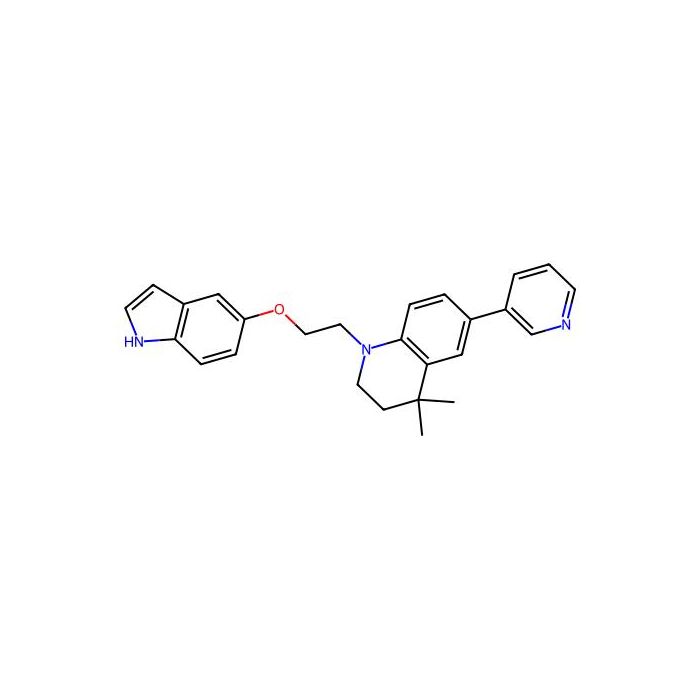
≥99% for sensitive chromatographic and analytical workflows requiring minimal baseline interference.
🌡
Storage & shipping
Store at -20°C Ships Ice chest + Ice pads Check lot-specific COA for exact specifications.
📋
Quality documents
SDS, COA, datasheet, and spec sheet available for download. Lot-specific COA accessible via lot number lookup.
📚
Literature proof
Cited in 0 peer-reviewed publications across chromatography, organic synthesis, and cross-coupling reactions.
Descripción general
STAT5-IN-2 is a STAT5 inhibitor,STAT5-IN-2 has potent antileukemic effect
In Vitro
STAT5-IN-2 has EC 50 values of 9 μM and 5 μM in K562 and KU812 cells, respectively. STAT5-IN-2 (100 nM-50 µM; 48 hours) has EC 50 values of 2.6 µM and 3.5 µM in KG1a and MV-4-11 cells, respectively. STAT5-IN-2 (10 µM; 48 hours) induces apoptosis in all cell lines (K562, KU812, KG1a and MV-4-11 cells). STAT5-IN-2 (10 µM; 24 hours) blocks phosphorylation of STAT5. MCE has not independently confirmed the accuracy of these methods. They are for reference only. Cell Viability AssayCell Line: KG1a and MV-4-11 cell lines Concentration: 100 nM, 10 µM, 20 µM, 30 µM, 40 µM, 50 µM Incubation Time: 48 hours Result: Inhibited cell growth in KG1a and MV-4-11 cell lines Apoptosis AnalysisCell Line: K562, KU812, KG1a and MV-4-11 cells Concentration: 10 µM Incubation Time: 48 hours Result: Significantly increased the number of apoptotic cells. Western Blot AnalysisCell Line: KG1a, MV-4-11 and KU812 cells Concentration: 10 µM Incubation Time: 24 hours Result: Inhibited phosphorylation of STAT5 compared to no influence on phosphorylation level of STAT3, Akt and Erk1/2.
Form:Solid
IC50& Target:STAT5 9 μM (EC 50 , in K562 cells) STAT5 5 μM (EC 50 , in KU812 cells )
Specifications
Especificaciones y pureza
≥99%
Mecanismos bioquímicos y fisiológicos
STAT5-IN-2 is a STAT5 inhibitor, extracted from reference 1, example 17f. STAT5-IN-2 has potent antileukemic effect.
Condiciones de almacenamiento de almacenamiento
Store at -20°C
Enviado en
Ice chest + Ice pads
Este producto requiere envío en cadena de frío. Los servicios terrestres y otros servicios económicos no están disponibles.
This compound belongs to the class of organic compounds known as hydroquinolines. These are derivatives of quinoline in which in which at least one double bond in the quinoline moiety are reduced by adding two hydrogen atoms.
External Descriptors
Not available
1. Djoumbou Feunang Y, Eisner R, Knox C, Chepelev L, Hastings J, Owen G, Fahy E, Steinbeck C, Subramanian S, Bolton E, Greiner R, and Wishart DS. ClassyFire: Automated Chemical Classification With A Comprehensive, Computable Taxonomy. Journal of Cheminformatics, 2016, 8:61.
Determine the necessary mass, volume, or concentration for preparing a solution.
Dilution Calculator
Determine the dilution needed to prepare a stock solution.
Reconstitution Calculator
Reseñas
Reseñas de cliente
Preguntas frecuentes
What is the purity of this product?
This product is supplied at ≥99% purity (chemical assay). Lot-specific values are stated on the Certificate of Analysis.
How should this product be stored?
Store at ?20 °C. Freezer storage is required to maintain the specified shelf life.
How is this product shipped?
This product ships in an insulated container with ice pads. Unpack on arrival and transfer it to the storage condition stated above.
What are the CAS number, molecular formula and molecular weight?
The CAS Number is 2111834-61-6, the molecular formula is C26H27N3O, and the molecular weight is 397.51 g/mol. InChIKey BELIZDRKUICBJC-UHFFFAOYSA-N.
What documentation is provided?
Available product documentation, including Certificates of Analysis (COA), Safety Data Sheets (SDS), and specification sheets, is shown in the product document area. Document availability and access follow the current site policy.
We use cookies to ensure the website functions properly and, where permitted, to improve your experience. You can manage your preferences at any time in Settings. Learn more in our Cookie Policy.
Shall we send you a message when we have discounts available?
Remind me later
Thank you! Please check your email inbox to confirm.
Products are supplied to verified businesses, institutions, and qualified professionals for research and development use only. Not for use in humans, animals, diagnosis, or therapy.