Determine the necessary mass, volume, or concentration for preparing a solution.
10mM in DMSO for sensitive chromatographic and analytical workflows requiring minimal baseline interference.
Store at -80°C Ships Dry ice packs + Cold packs Check lot-specific COA for exact specifications.
SDS, COA, datasheet, and spec sheet available for download. Lot-specific COA accessible via lot number lookup.
Cited in 8 peer-reviewed publications across chromatography, organic synthesis, and cross-coupling reactions.
Information
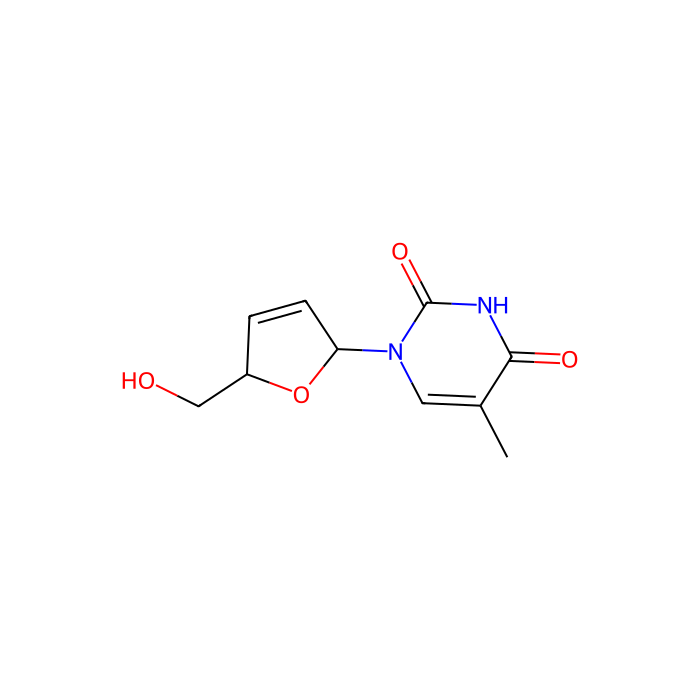
Stavudine (d4T) Stavudine (d4T, BMY-27857, Sanilvudine, NSC 163661) is a nucleoside analog reverse transcriptase inhibitor (NARTI) active against HIV.
In vitro
Stavudine alteres the lipid phenotype, decreasing the lipid content and expression of markers involved in lipid metabolism, namely C/EBPalpha, peroxisome proliferator-activated receptor gamma, adipocyte lipid binding protein 2, fatty acid synthase and acetyl-coenzyme A carboxylase. Stavudine drives 5-10% of 3T3-F442A cells towards apoptosis, and reduces the lipid content and survival of differentiated 3T3-L1 adipocytes. Stavudine increases mitochondrial mass by two to fourfold, and loweres the mitochondrial membrane potential (JC-1 stain). stavudine inhibits p24 antigen production by HIV-I in PBMC with EDsos ranging from 0.04 μM to 0.2 μM. Stavudine produces significant mitochondrial dysfunction with a 1.5-fold increase in cellular lactate to pyruvate ratios. Stavudine causes a dose-dependent decrease in mtDNA amplification and a correlative increase in abundance of markers of mitochondrial oxidative stress. Stavudine treatment elevates mitochondrial reactive oxygen species (ROS), enhances mitochondrial oxidative stress, and contributes mechanistically to NRTI-induced toxicity.
In vivo
Stavudine (500 mg/kg/day) results in lack of significant oxidative mtDNA lesions (as assessed by long polymerase chain reaction experiments), and normal blood lactate/pyruvate ratios in lean mice. Stavudine (500 mg/kg/day) can decrease hepatic and muscle mtDNA in lean mice and can also cause ketoacidosis during fasting without altering mtDNA. Stavudine (500 mg/kg/day) depletes WAT mtDNA only in obese mice.
Cell Data
cell lines:BT474, SKBR3, N87, SKOV3, MCF7, MDA468, Hs578T, Hs578Bst, A549, HT29, U87, SKMG3, HT1080, RPTEC, NDF, HMVEC, HMEC, HUVEC, and PBMC cells
Concentrations:
Incubation Time:
Powder Purity:≥99%
| Isómeros SMILES | CC1=CN(C(=O)NC1=O)[C@H]2C=C[C@H](O2)CO |
|---|---|
| WGK Alemania | 2 |
| RTECS | XP2075000 |
| Peso molecular | 224.21 |
| Reaxy-Rn | 618327 |
Comprehensive hazard, handling, storage, and regulatory compliance document.
Download SDS →Lot-specific quality data. Enter your lot number to retrieve the exact COA.
Look up COA →Full quality attributes and acceptance criteria for this grade.
View spec sheet →| Rotación específica [α] | [α]D -46° (C=0.69,H2O) |
|---|---|
| Punto de fusión (°C) | 166 °C(dec.) |
| 1. Peijun Chai, Xuhui Geng, Ruirui Zhu, Wenpu Wu, Xuesong Wang, Jinhua Li, Longwen Fu, Hongdan Wang, Wanhui Liu, Lingxin Chen, Zhihua Song. (2023) Fabrication and application of molecularly imprinted polymer doped carbon dots coated silica stationary phase. ANALYTICA CHIMICA ACTA, [PMID:37524474] [10.1016/j.aca.2023.341611] |
| 2. Junping Xue, Jingxiu Zhang, Cuichi Yu, Maryam Arabi, Jinhua Li, Guisheng Li, Gangqiang Yang, Lingxin Chen, Zhihua Song. (2023) Synthesis and evaluation of ginsenosides imprinted polymer-based chromatographic stationary phase. JOURNAL OF SEPARATION SCIENCE, 46 (10): (2200825). [PMID:36892410] [10.1002/jssc.202200825] |
| 3. Zhihua Song, Jinqiu Liu, Deyang Zhang, Yumeng Wang, Wen Lin, Yi Bi, Hongbo Wang, Maryam Arabi, Jinhua Li, Jiping Ma, Yan Wang, Lingxin Chen. (2022) Synthesis of C8F13-SiO2 stationary phase for chromatographic separation of highly polar compounds. MICROCHEMICAL JOURNAL, [PMID:] [10.1016/j.microc.2022.107670] |
| 4. Zhihua Song, Yanqin Song, Yinghao Wang, Jinqiu Liu, Yumeng Wang, Wen Lin, Yaqi Wang, Jinhua Li, Jiping Ma, Gangqiang Yang, Lingxin Chen. (2021) Chromatographic performance of zidovudine imprinted polymers coated silica stationary phases. TALANTA, [PMID:34890940] [10.1016/j.talanta.2021.123115] |
| 5. Lei Xu, Jing Lu, Weiqi Meng, Fengjuan Cui. (2021) Determination of the Nucleoside Reverse Transcriptase Inhibitors Lamivudine, Stavudine, and Didanosine in Human Urine by Micellar Electrokinetic Chromatography Using the Ionic Liquid-Based Cationic Surfactant 1-Tetradecyl-3-Methylimidazolium Bromide. ANALYTICAL LETTERS, [PMID:] [10.1080/00032719.2021.1904970] |
| 6. Haoran Wang, Tong Xu, Shuaishuai Xin, Guocheng Liu, Qinghua Yan, Dong Ma, Yanlong Sun, Chengzhi Zhou, Yanjun Xin, Ya-nan Zhang. (2025) Nucleoside structure promotes the degradation of antiviral drugs in simulated sunlight-activated periodate system. SEPARATION AND PURIFICATION TECHNOLOGY, [PMID:] [10.1016/j.seppur.2025.133922] |
| 7. Zijun Dong, Zhihao Han, Lulu Zhang, Xiaohui Sun, Chenyu Wang, Yifeng Yang. (2026) Fate and Ecological Risk Assessment of Antiviral Drugs in Multiprocess Wastewater Treatment Plants and Adjacent Watersheds: A Case Study in Shenzhen, China. ACS ES&T Water, [PMID:] [10.1021/acsestwater.5c01216] |
| 8. Zongyu Yan, Mian Wu, Haoran Wang, Tong Xu, Shuaishuai Xin, Qianwen Wang, Guocheng Liu, Qinghua Yan, Yanlong Sun, Chengzhi Zhou, Ya-nan Zhang, Yanjun Xin. (2026) Study on antiviral drugs degradation by UV/NH2Cl: Combination of experiments and quantum chemical calculation. Journal of Environmental Chemical Engineering, 14 (2): (121835). [PMID:] [10.1016/j.jece.2026.121835] |