GRADE & PURITYBioReagent?BioReagent grade — tested suitable for life-science and molecular-biology use. Use for cell culture, assays, and biochemical work needing biological compatibility.Ready-to-use?Ready-to-use — supplied pre-formulated at working concentration, no prep needed. Use to save time and reduce pipetting/dilution errors.Suitable for Immunohistochemistry(IHC)?IHC grade — validated for immunohistochemistry on tissue sections. Use to detect and localize antigens in fixed tissue.
BioReagent, ready-to-use, Suitable for Immunohistochemistry BioReagent,Ready-to-use,Suitable for Immunohistochemistry(IHC) for sensitive chromatographic and analytical workflows requiring minimal baseline interference.
🌡
Storage & shipping
Store at 2-8°C,Protected from light Ships Wet ice Check lot-specific COA for exact specifications.
📋
Quality documents
SDS, COA, datasheet, and spec sheet available for download. Lot-specific COA accessible via lot number lookup.
📚
Literature proof
Cited in 0 peer-reviewed publications across chromatography, organic synthesis, and cross-coupling reactions.
Descripción general
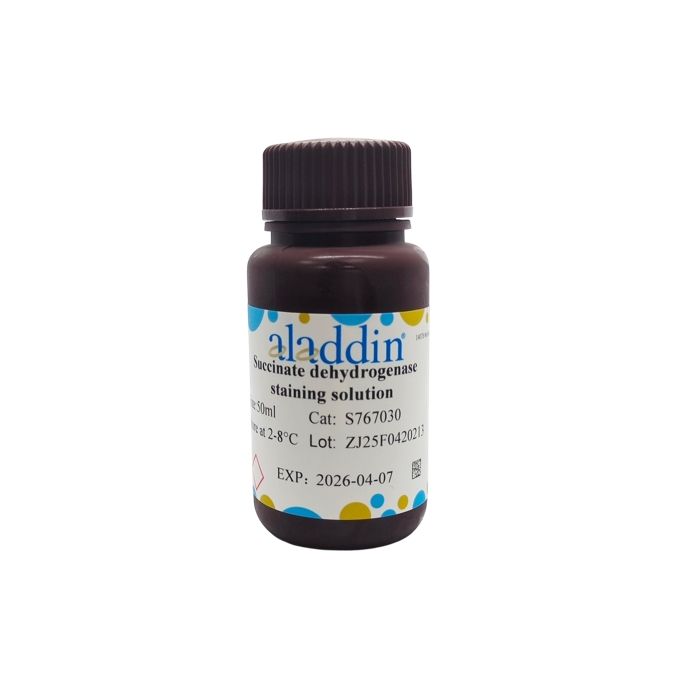
Succinate dehydrogenase (SDH) is located on the inner side of the mitochondrial ridge membrane and binds to the inner membrane of the mitochondria. SDH is the most membrane-binding enzyme among the three carboxylic acid cycles and is the hallmark enzyme of mitochondria. The active reaction site of SDH enzyme was blue-purple granules, located in cardiomyocytes and cell membranes, and the interstitium of cardiomyocytes was not colored. When the enzyme activity was high, the particles were dense and coarse, the enzyme activity of young animals was significantly higher than that of young and old animals, and the activity of SDH was significantly reduced when the myocardial cells were injured by ischemia or hypoxia. Operation process: 1 Sample handling 1.1 For paraffin sections: Dewaxing in xylene for 2×5min; Anhydrous ethanol 5 min, 90% ethanol 2 min, 70% ethanol 2 min; Rinse with PBS for 2 min. 1.2 For frozen sections: Rinse with PBS for 2 min. 2 succinate dehydrogenase stain solution 2.1 Dye succinate dehydrogenase solution in a wet box at 37°C for 2h; 2.2 Rinse slices with running water, 2×3~5min; 2.3 Use absorbent paper to absorb excess water on the section; 2.4 Dehydration with 100% ethanol for 3×1~3min; 2.5xylene transparent, 2 x 5min, sealed with resin. Dyeing result: The active reaction site of myocardial SDH enzyme was blue-purple granule, distributed in myocardial cells and cell membrane. Note: 1 A fluorescence microscope or laser confocal microscope that can observe blue fluorescence is required. 2 Prepare PBS, fixing solution and anti-fluorescence quenching sealing solution. 3 When using this kit for the first time, it is recommended to take 1 to 2 samples for pre-test. Warm reminder: For your own safety, please take good protection before using the reagent, such as wearing a lab coat, gloves, etc.
Specifications
Product Name
Succinate dehydrogenase staining solution
Sinónimos
Succinate dehydrogenase solution; SDH
Grado
BioReagent, Ready-to-use, Suitable for Immunohistochemistry(IHC)
Especificaciones y pureza
BioReagent, ready-to-use, Suitable for Immunohistochemistry
Tipo de molécula
Enzyme
Almacenamiento y envío
Condiciones de almacenamiento de almacenamiento
Store at 2-8°C,Protected from light
Enviado en
Wet ice
Estabilidad y almacenamiento
Store at 2-8℃ long term (12 months). Upon receipt, it is recommended to aliquot. Store in the dark.
Documentation
📋 Safety Data Sheet (SDS)
Comprehensive hazard, handling, storage, and regulatory compliance document.
Determine the necessary mass, volume, or concentration for preparing a solution.
Dilution Calculator
Determine the dilution needed to prepare a stock solution.
Reconstitution Calculator
Reseñas
Reseñas de cliente
Preguntas frecuentes
What does ready-to-use mean?
ready-to-use indicates that the material has been processed and tested for specialty industrial processing. Specifications focus on the impurities that affect performance in that application — for example, metal content for electronics, particle size for batteries, refractive index for optics, or moisture content for moisture-sensitive processes.
What does BioReagent mean?
BioReagent indicates that the product has been processed and tested for biological and biochemical applications. Specifications may include endotoxin limits, microbial controls, sterility, low DNase/RNase/protease activity, and verified biological activity where relevant.
How should this product be stored?
Store at 2–8 °C, protected from light. The material is light-sensitive — keep it in its original opaque or amber container.
How is this product shipped?
This product ships chilled on wet ice. Unpack on arrival and transfer it to the storage condition stated above.
What documentation is provided?
Available product documentation, including Certificates of Analysis (COA), Safety Data Sheets (SDS), and specification sheets, is shown in the product document area. Document availability and access follow the current site policy.
Need help choosing the grade?
Our grade selection guide covers purity, stabilizer status, and application suitability for all variants in our catalog.
We use cookies to ensure the website functions properly and, where permitted, to improve your experience. You can manage your preferences at any time in Settings. Learn more in our Cookie Policy.
Shall we send you a message when we have discounts available?
Remind me later
Thank you! Please check your email inbox to confirm.
Products are supplied to verified businesses, institutions, and qualified professionals for research and development use only. Not for use in humans, animals, diagnosis, or therapy.

 ZJ26F0434647