
Determine the necessary mass, volume, or concentration for preparing a solution.
| Activity Type | Activity Value -log(M) | Mechanism of Action | Activity Reference | Publications (PubMed IDs) |
|---|
Moligand™, 10mM in DMSO Moligand™ for sensitive chromatographic and analytical workflows requiring minimal baseline interference.
Store at -80°C Ships Dry ice packs + Cold packs Check lot-specific COA for exact specifications.
SDS, COA, datasheet, and spec sheet available for download. Lot-specific COA accessible via lot number lookup.
Cited in 0 peer-reviewed publications across chromatography, organic synthesis, and cross-coupling reactions.
Information
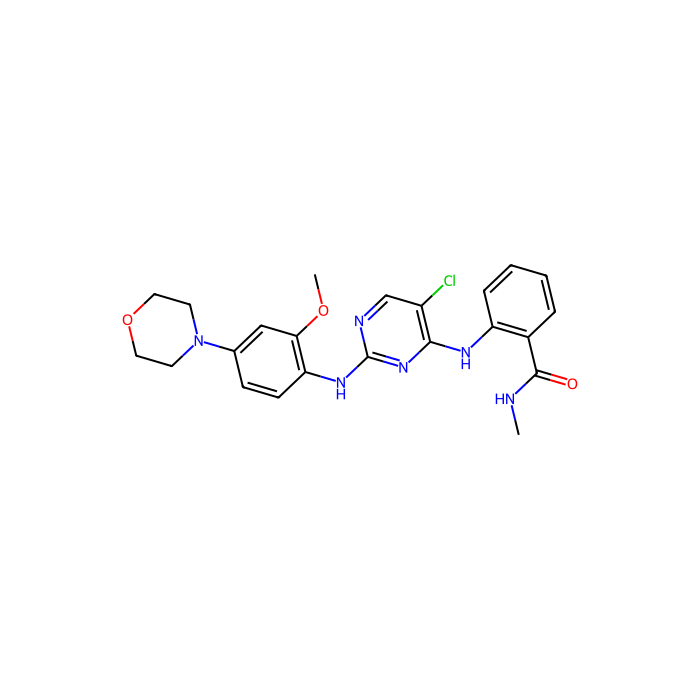
TAE226 (NVP-TAE226) TAE226 (NVP-TAE226) is a potent FAK inhibitor with IC50 of 5.5 nM and modestly potent to Pyk2, ~10- to 100-fold less potent against InsR, IGF-1R, ALK, and c-Met. TAE226 (NVP-TAE226) induces apoptosis .
In vitro
NVP-TAE226 (< 1 μM) inhibits extracellular matrix-induced autophosphorylation of FAK (Tyr397) in serum-starved U87 cells. NVP-TAE226 (< 1 μM) also inhibits IGF-I-induced phosphorylation of IGF-1R and activity of its downstream target genes such as MAPK and Akt in both U87 and U251 cells. NVP-TAE226 (<10 μM) retards tumor cell growth and attenuats G(2)-M cell cycle progression associated with a decrease in cyclin B1 and phosphorylated cdc2 (Tyr15) protein expression in both U87 and U251 cells. NVP-TAE226 (1 μM) inhibits tumor cell invasion by at least 50% compared with the control in an in vitro Matrigel invasion assay in glioma cell lines. NVP-TAE226 (1 μM) treatment of glioma cell lines containing wild-type p53 mainly exhibits G(2)-M arrest, whereas glioma cell lines bearing mutant p53 undergoes apoptosis, as evidence by detection of caspase-3/7 activation and poly(ADP-ribose) polymerase cleavage and by an Annexin V apoptosis assay. NVP-TAE226 (5 μM) inhibits phosphorylation of FAK in the human neuroblastoma cell line SK-N-AS. NVP-TAE226 (<10 μM) treatment of the human neuroblastoma cell line SK-N-AS leads to decrease in cellular viability, cell cycle arrest, and an increase in apoptosis. NVP-TAE226 (0.1 μM-10 μM) inhibits tube formation of HMEC1 cells.
In vivo
NVP-TAE226 (75 mg/kg) significantly increases the survival rate of mice bearing intracranial glioma xenografts. NVP-TAE226 (100 mg/kg, oral) exerts significant decrease in microvessel density in a human colon cancer model in SCID mice. NVP-TAE226 (100 mg/kg, oral) efficiently inhibits MIA PaCa-2 human pancreatic tumor growth without body weight loss in vivo model. NVP-TAE226 inhibits 4T1 murine breast tumor growth and metastasis to the lung in a dose-dependent manner in vivo model, associated with inhibition of FAK autophosphorylation at Y397 and Akt phosphorylation at Serine473.
Cell Data
cell lines:
Concentrations:10 μM
Incubation Time:5 days
Powder Purity:≥99%
| Isómeros SMILES | CNC(=O)C1=CC=CC=C1NC2=NC(=NC=C2Cl)NC3=C(C=C(C=C3)N4CCOCC4)OC |
|---|---|
| CAS alternativo | 761437-28-9 |
| PubChem CID | 9934347 |
| Términos de entrada MeSH | TAE226 |
| Peso molecular | 468.94 |
Comprehensive hazard, handling, storage, and regulatory compliance document.
Download SDS →Lot-specific quality data. Enter your lot number to retrieve the exact COA.
Look up COA →Full quality attributes and acceptance criteria for this grade.
View spec sheet →| Activity Type | Activity Value -log(M) | Mechanism of Action | Activity Reference | Publications (PubMed IDs) |
|---|
| Activity Type | Activity Value -log(M) | Mechanism of Action | Activity Reference | Publications (PubMed IDs) |
|---|
| Activity Type | Activity Value -log(M) | Mechanism of Action | Activity Reference | Publications (PubMed IDs) |
|---|
| Activity Type | Activity Value -log(M) | Mechanism of Action | Activity Reference | Publications (PubMed IDs) |
|---|
| Activity Type | Activity Value -log(M) | Mechanism of Action | Activity Reference | Publications (PubMed IDs) |
|---|
| Activity Type | Activity Value -log(M) | Mechanism of Action | Activity Reference | Publications (PubMed IDs) |
|---|
| Activity Type | Activity Value -log(M) | Mechanism of Action | Activity Reference | Publications (PubMed IDs) |
|---|
| Activity Type | Activity Value -log(M) | Mechanism of Action | Activity Reference | Publications (PubMed IDs) |
|---|
| Activity Type | Activity Value -log(M) | Mechanism of Action | Activity Reference | Publications (PubMed IDs) |
|---|
| Activity Type | Activity Value -log(M) | Mechanism of Action | Activity Reference | Publications (PubMed IDs) |
|---|
| Activity Type | Activity Value -log(M) | Mechanism of Action | Activity Reference | Publications (PubMed IDs) |
|---|
| Activity Type | Activity Value -log(M) | Mechanism of Action | Activity Reference | Publications (PubMed IDs) |
|---|
| Activity Type | Activity Value -log(M) | Mechanism of Action | Activity Reference | Publications (PubMed IDs) |
|---|
| Activity Type | Activity Value -log(M) | Mechanism of Action | Activity Reference | Publications (PubMed IDs) |
|---|
| Activity Type | Activity Value -log(M) | Mechanism of Action | Activity Reference | Publications (PubMed IDs) |
|---|
| Activity Type | Activity Value -log(M) | Mechanism of Action | Activity Reference | Publications (PubMed IDs) |
|---|
Our grade selection guide covers purity, stabilizer status, and application suitability for all variants in our catalog.
View Moligand™ grade guide →