≥99% for sensitive chromatographic and analytical workflows requiring minimal baseline interference.
🌡
Storage & shipping
Store at 2-8°C,Desiccated Ships Wet ice Check lot-specific COA for exact specifications.
📋
Quality documents
SDS, COA, datasheet, and spec sheet available for download. Lot-specific COA accessible via lot number lookup.
📚
Literature proof
Cited in 0 peer-reviewed publications across chromatography, organic synthesis, and cross-coupling reactions.
Descripción general
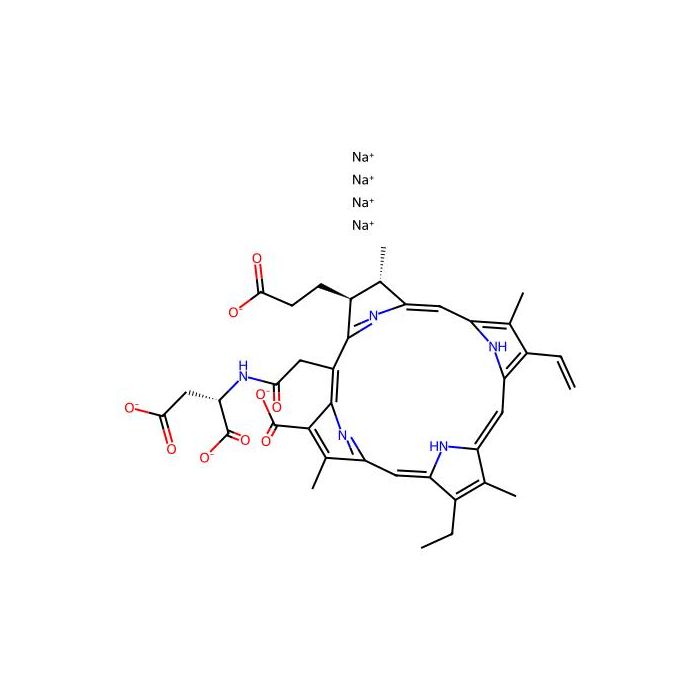
Talaporfin (ME2906) sodium is a chlorin based photosensitizer. Talaporfin sodium can be used for the research of various cancers by using photodynamic therapy (PDT).
In Vivo
Guidelines (Following is our recommended protocol. This protocol only provides a guideline, and should be modified according to your specific needs) . Labeling in vivo: 1. Use the rat brain tumor model produced by the inoculation of resuspended tumor cells into the frontal rat brain. Feed animals according to your normal protocol. 2. Intravenous injection of 5 mg/kg body weight talaporfin sodium, the concentration of the talaporfin sodium is 5 mg/1 ml 0.9% saline. 3. For the control group, intraperitoneal injection of 100 mg/kg body weight 5-ALA, the concentration of the 5-ALA is 20 mg/1 ml 0.9% saline. 4. Obtain the tissue samples corresponding to the tumor (or edema) brain tissue with 5 mm thickness. 5. The samples are well homogenized with 1 ml of 100% dimethyl sulfoxide (DMSO) and the 100 ul aliquots of the supernatant are put into each well of a 96-well plate. 6. Measure the relative fluorescence intensities of the samples by using a microplate readerin emission wavelength of 670 ±10 nm. The relative fluorescence intensities of the samples (a.u.) were normalized to the relative fluorescence intensities per 1 g-weight of the samples (a.u.). MCE has not independently confirmed the accuracy of these methods. They are for reference only. Animal Model: Rat brain tumor model Dosage: 5 mg/kg Administration: Intravenous injection Result: Showed high fluorescence intensity and retention in brain tumor differentiated from vasogenic edema.
Talaporfin (ME2906) sodium is a chlorin based photosensitizer . Talaporfin sodium can be used for the research of various cancers by using photodynamic therapy (PDT).
Condiciones de almacenamiento de almacenamiento
Store at 2-8°C, Desiccated
Enviado en
Wet ice
Este producto requiere envío en cadena de frío. Los servicios terrestres y otros servicios económicos no están disponibles.
Chlorin - Aspartic acid or derivatives - N-acyl-alpha-amino acid - N-acyl-alpha amino acid or derivatives - N-acyl-l-alpha-amino acid - Alpha-amino acid or derivatives - Tricarboxylic acid or derivatives - Pyrrole-3-carboxylic acid - Pyrrole-3-carboxylic acid or derivatives - Substituted pyrrole - Heteroaromatic compound - Pyrrole - Carboxamide group - Carboxylic acid salt - Secondary carboxylic acid amide - Organic alkali metal salt - Azacycle - Carboxylic acid - Carboxylic acid derivative - Organic sodium salt - Organooxygen compound - Organonitrogen compound - Hydrocarbon derivative - Organic oxide - Organic oxygen compound - Organic nitrogen compound - Carbonyl group - Organic salt - Organic zwitterion - Aromatic heteropolycyclic compound
Descripción
This compound belongs to the class of organic compounds known as chlorins. These are large heterocyclic aromatic ring systems consisting, at the core, of three pyrroles and one pyrroline coupled through four methine linkages.
External Descriptors
Not available
1. Djoumbou Feunang Y, Eisner R, Knox C, Chepelev L, Hastings J, Owen G, Fahy E, Steinbeck C, Subramanian S, Bolton E, Greiner R, and Wishart DS. ClassyFire: Automated Chemical Classification With A Comprehensive, Computable Taxonomy. Journal of Cheminformatics, 2016, 8:61.
We use cookies to ensure the website functions properly and, where permitted, to improve your experience. You can manage your preferences at any time in Settings. Learn more in our Cookie Policy.
Shall we send you a message when we have discounts available?
Remind me later
Thank you! Please check your email inbox to confirm.
Products are supplied to verified businesses, institutions, and qualified professionals for research and development use only. Not for use in humans, animals, diagnosis, or therapy.