
Determine the necessary mass, volume, or concentration for preparing a solution.
| Activity Type | Activity Value -log(M) | Mechanism of Action | Activity Reference | Publications (PubMed IDs) |
|---|
Moligand™, 10mM in DMSO Moligand™ for sensitive chromatographic and analytical workflows requiring minimal baseline interference.
Store at -80°C Ships Dry ice packs + Cold packs Check lot-specific COA for exact specifications.
SDS, COA, datasheet, and spec sheet available for download. Lot-specific COA accessible via lot number lookup.
Cited in 0 peer-reviewed publications across chromatography, organic synthesis, and cross-coupling reactions.
Information
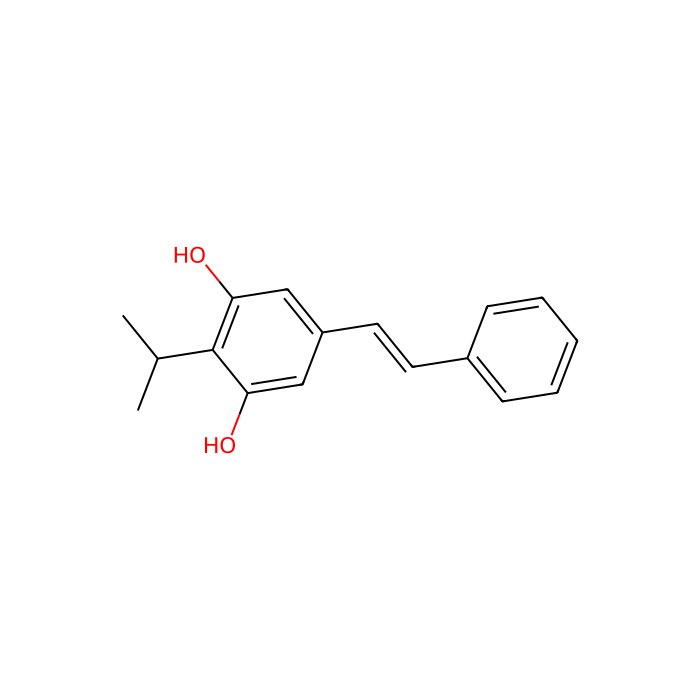
Tapinarof Tapinarof (GSK2894512, Benvitimod, WBI 1001, DHPS, DMVT 505) is a natural agonist of aryl hydrocarbon receptor (AhR) and induces nuclear translocation of AhR in immortalized keratinocytes (HaCaT) with EC50 of 0.16 nM. Tapinarof induces cellular apoptosis in CD4+ T cells in a dosedependent manner with IC50 of 5.2 μM.
Targets
AhR (in immortalized keratinocytes); apoptosis (in CD4+ T cells) 0.16 nM(EC50); 5.2 μM
In vitro
Tapinarof binds and activates AhR in multiple cell types, including cells of the target tissue –human skin. In addition, tapinarof moderates proinflammatory cytokine expression in stimulated peripheral blood CD4+ T cells and ex vivo human skin, and impacts barrier gene expression in primary human keratinocytes; both of these processes are likely to be downstream of AhR activation based on current evidence.
In vivo
The anti-inflammatory properties of tapinarof derive from AhR agonism is conclusively demonstrated using the mouse model of imiquimod-induced psoriasiform skin lesions. Topical treatment of AhR-sufficient mice with tapinarof leads to compound-driven reductions in erythema, epidermal thickening and tissue cytokine levels. In contrast, tapinarof has no impact on imiquimod-induced skin inflammation in AhR-deficient mice.
Cell Research(from reference)
Cell lines:HaCaT cells
Concentrations:0.01 pM - 1 μM
Incubation Time:30 min
| ALogP | 4.526 |
|---|---|
| Recuento HBD | 2 |
| Enlace rotable | 3 |
| Sonrisas canónicas | CC(C)C1=C(C=C(C=C1O)C=CC2=CC=CC=C2)O |
|---|---|
| IUPAC Name | 5-[(E)-2-phenylethenyl]-2-propan-2-ylbenzene-1,3-diol |
| InChIKey | ZISJNXNHJRQYJO-CMDGGOBGSA-N |
| INCHI | 1S/C17H18O2/c1-12(2)17-15(18)10-14(11-16(17)19)9-8-13-6-4-3-5-7-13/h3-12,18-19H,1-2H3/b9-8+ |
| Isómeros SMILES | CC(C)C1=C(C=C(C=C1O)/C=C/C2=CC=CC=C2)O |
| Peso molecular | 254.32 |
Comprehensive hazard, handling, storage, and regulatory compliance document.
Download SDS →Lot-specific quality data. Enter your lot number to retrieve the exact COA.
Look up COA →Full quality attributes and acceptance criteria for this grade.
View spec sheet →Taxonomy Tree
| Kingdom | Organic compounds |
|---|---|
| Superclass | Phenylpropanoids and polyketides |
| Clase | Stilbenes |
| Subclass | Not available |
| Intermediate Tree Nodes | Not available |
| Direct Parent | Stilbenes |
| Alternative Parents | Monocyclic monoterpenoids Aromatic monoterpenoids Phenylpropanes Cumenes Styrenes Resorcinols 1-hydroxy-4-unsubstituted benzenoids 1-hydroxy-2-unsubstituted benzenoids Organooxygen compounds Hydrocarbon derivatives |
| Molecular Framework | Aromatic homomonocyclic compounds |
| Substituents | Stilbene - P-cymene - Aromatic monoterpenoid - Monocyclic monoterpenoid - Monoterpenoid - Cumene - Phenylpropane - Resorcinol - Styrene - 1-hydroxy-4-unsubstituted benzenoid - Phenol - 1-hydroxy-2-unsubstituted benzenoid - Monocyclic benzene moiety - Benzenoid - Organooxygen compound - Hydrocarbon derivative - Organic oxygen compound - Aromatic homomonocyclic compound |
| Descripción | This compound belongs to the class of organic compounds known as stilbenes. These are organic compounds containing a 1,2-diphenylethylene moiety. Stilbenes (C6-C2-C6 ) are derived from the common phenylpropene (C6-C3) skeleton building block. The introduction of one or more hydroxyl groups to a phenyl ring lead to stilbenoids. |
| External Descriptors | Not available |
| Activity Type | Activity Value -log(M) | Mechanism of Action | Activity Reference | Publications (PubMed IDs) |
|---|
| Activity Type | Relation | Activity value | Units | Action Type | Journal | PubMed Id | doi | Assay Aladdin ID |
|---|
| Activity Type | Relation | Activity value | Units | Action Type | Journal | PubMed Id | doi | Assay Aladdin ID |
|---|
| Activity Type | Relation | Activity value | Units | Action Type | Journal | PubMed Id | doi | Assay Aladdin ID |
|---|
| Activity Type | Relation | Activity value | Units | Action Type | Journal | PubMed Id | doi | Assay Aladdin ID |
|---|
| Activity Type | Relation | Activity value | Units | Action Type | Journal | PubMed Id | doi | Assay Aladdin ID |
|---|
| Activity Type | Relation | Activity value | Units | Action Type | Journal | PubMed Id | doi | Assay Aladdin ID |
|---|
| Activity Type | Relation | Activity value | Units | Action Type | Journal | PubMed Id | doi | Assay Aladdin ID |
|---|
| Activity Type | Relation | Activity value | Units | Action Type | Journal | PubMed Id | doi | Assay Aladdin ID |
|---|
| Activity Type | Relation | Activity value | Units | Action Type | Journal | PubMed Id | doi | Assay Aladdin ID |
|---|
| Activity Type | Relation | Activity value | Units | Action Type | Journal | PubMed Id | doi | Assay Aladdin ID |
|---|
| Activity Type | Relation | Activity value | Units | Action Type | Journal | PubMed Id | doi | Assay Aladdin ID |
|---|
| DMSO (mg/ml) Solubilidad máxima | 51 |
|---|---|
| DMSO (mM) Solubilidad máxima | 200.534759358289 |
| Agua (mg/ml) Solubilidad máxima | <1 |
| Punto de fusión (°C) | 148 °C |
| Peso molecular | 254.320 g/mol |
| XLogP3 | 4.600 |
| Hydrogen Bond Donor Count | 2 |
| Hydrogen Bond Acceptor Count | 2 |
| Rotatable Bond Count | 3 |
| Exact Mass | 254.131 Da |
| Monoisotopic Mass | 254.131 Da |
| Topological Polar Surface Area | 40.500 Ų |
| Heavy Atom Count | 19 |
| Formal Charge | 0 |
| Complexity | 280.000 |
| Isotope Atom Count | 0 |
| Defined Atom Stereocenter Count | 0 |
| Undefined Atom Stereocenter Count | 0 |
| Defined Bond Stereocenter Count | 1 |
| Undefined Bond Stereocenter Count | 0 |
| The total count of all stereochemical bonds | 1 |
| Covalently-Bonded Unit Count | 1 |
Our grade selection guide covers purity, stabilizer status, and application suitability for all variants in our catalog.
View Moligand™ grade guide →