≥95%, mixture of isomers for sensitive chromatographic and analytical workflows requiring minimal baseline interference.
🌡
Storage & shipping
Store at 2-8°C,Argon charged Ships Wet ice Check lot-specific COA for exact specifications.
📋
Quality documents
SDS, COA, datasheet, and spec sheet available for download. Lot-specific COA accessible via lot number lookup.
📚
Literature proof
Cited in 34 peer-reviewed publications across chromatography, organic synthesis, and cross-coupling reactions.
Descripción general
Description
Tetradecafluorohexane in the gas phase reacts spontaneously with lithium amalgam, to give a solid and intimate mixture of lithium fluoride and elemental polymeric carbon with a small amount of superstoichiometric lithium.Tetradecafluorohexane may be used as a fluorocarbon organic solvent in the preparation of temperature-induced phase-separation solution.
This compound belongs to the class of organic compounds known as organofluorides. These are compounds containing a chemical bond between a carbon atom and a fluorine atom.
External Descriptors
fluoroalkane - fluorocarbon
1. Djoumbou Feunang Y, Eisner R, Knox C, Chepelev L, Hastings J, Owen G, Fahy E, Steinbeck C, Subramanian S, Bolton E, Greiner R, and Wishart DS. ClassyFire: Automated Chemical Classification With A Comprehensive, Computable Taxonomy. Journal of Cheminformatics, 2016, 8:61.
Determine the necessary mass, volume, or concentration for preparing a solution.
Dilution Calculator
Determine the dilution needed to prepare a stock solution.
Reconstitution Calculator
Reseñas
Reseñas de cliente
Application Protocols
No antibody/assay application protocols apply to this small-molecule solvent. For practical use, consider the following general handling procedures (literature/general):
Fluorous biphasic reaction setup: Combine organic phase and perfluorohexane in an appropriate ratio (e.g., 1:1 v/v as a starting point), add fluorous-tagged catalyst to the PFC phase, and stir under temperature control. After completion, cool, allow phases to separate, and recover catalyst-containing PFC phase.
Degassing/gas loading: To load O2, sparge the liquid with oxygen for 15–30 min under chilled conditions with a gas dispersion tube; cap under argon after loading to control headspace.
Recovery and reuse: Distill perfluorohexane through a short Vigreux column with a dry ice condenser to remove volatile impurities; collect the 56 °C fraction under inert atmosphere.
For validated, item-specific protocols or method suitability, consult the product CoA/SDS and perform pilot trials.
Biological Roles
This product is supplied strictly for research use only. No medical or clinical claims are made.
General biochemistry context (literature)
Biological activity: Perfluorohexane is chemically and biologically inert; it does not participate in metabolic pathways.
Gas transport: Exhibits high solubility for respiratory gases (O2, CO2, N2), which underpins its use in research on oxygen delivery systems, acoustic contrast agents, and microbubble formulations.
Cell and tissue interfacing: As an immiscible, dense overlay, PFCs can be used in vitro to modulate gas transfer to cell cultures without direct solvent mixing; the liquid serves as a physical barrier with high O2 permeability.
Imaging research: PFC microdroplets/bubbles are investigated as ultrasound and 19F-MRI tracers in preclinical settings; perfluorohexane’s volatility and density influence droplet stability and acoustic responses.
Note: These roles are provided as general literature context for perfluorocarbons and are not product performance claims.
Buffer Applications
Not typically applicable. Tetradecafluorohexane is a hydrophobic, fluorous liquid and is immiscible with aqueous buffers. For laboratory work involving buffers, use conventional aqueous buffer systems (e.g., PBS, Tris, HEPES). Where gas transfer modulation is desired, a perfluorocarbon overlay can be applied above an aqueous buffer phase to enhance oxygen availability without mixing.
Green Alternatives
Perfluorohexane provides exceptional inertness but raises environmental considerations due to persistence and high global warming potential (GWP). Selection should balance performance and sustainability.
Environmental profile (general)
Persistence: Very high; resistant to biodegradation and atmospheric breakdown.
GWP: High for perfluorocarbons; minimize emissions and implement closed-loop recovery.
Hydrofluoroethers (HFEs, e.g., HFE-7100): Lower GWP, somewhat organic-miscible, good volatility. Tradeoff: less chemically inert and may show mild solvency toward organics.
Hydrocarbon solvents (heptane, isopar solvents): Lower environmental persistence; flammable and chemically more reactive; unsuitable where nonflammability/inertness is critical.
Supercritical CO2: Green medium for extractions/processing; requires high-pressure equipment; limited compatibility for some reactions.
Comparison snapshot
PFCs: maximal inertness, nonflammable, biphasic with most media; environmental persistence high.
HFEs: intermediate inertness, better cleanup, lower GWP; may not replicate all fluorous partitioning effects.
Good practices
Use condensers, cold traps, and recovery systems to minimize atmospheric release.
Evaluate fluorous-tag loading to reduce solvent volumes or switch to solid-supported fluorous phases where feasible.
Pharmaceutical Uses
For research use only. No therapeutic claims.
General formulation/processing roles (literature context)
Emulsion component (R&D): Perfluorocarbons, including perfluorohexane, are used in research-stage emulsions for studying oxygen transport and imaging contrast; emulsification requires suitable surfactants and high-shear processing.
Aerosol/propellant research: Investigated as inert carrier phases or as part of propellant systems where nonflammability is valued.
Device/processing aid: As an inert, dense cleaning or displacement fluid for microfabrication or medical-device component processing where residue-free drying is essential.
Practical considerations
Regulatory monographs are uncommon for neat perfluorohexane; any use in regulated products would require thorough extractables/leachables and residual-solvent assessments.
Emulsions demand control of droplet size distribution, surfactant selection, and gas loading; stability is influenced by temperature relative to the ~56 °C boiling point.
Physical Properties
Only item-specific specifications listed on this page should be used for QC release. Values below are literature/computed references for professional use and method development.
Item-specific specs from Product Data
Appearance: Not specified for this item; refer to CoA/Spec Sheet.
Grade/Purity: Not specified for this item; refer to CoA/Spec Sheet.
Literature values (typical for tetradecafluorohexane; not item specifications)
State at RT: Colorless, dense liquid; essentially odorless
Boiling point: ~56 °C at 1 atm (literature)
Melting point: ~−90 to −95 °C (literature)
Density: ~1.68 g/mL at 20 °C (literature)
Refractive index (n20 D): ~1.252 (literature)
Vapor pressure: ~0.27–0.35 bar at 25 °C (literature)
Solubility: Practically insoluble in water; immiscible with most hydrocarbons and common organic solvents; miscible with perfluorinated/fluorous solvents and some hydrofluoroethers (literature)
Dielectric constant (ε, 20–25 °C): ~1.9 (literature; very low polarity)
LogP/logS: Not conventionally defined for perfluoroalkanes; exhibits strong fluorophilicity and poor solubility in both water and hydrocarbon media (general note)
Notes for practitioners
Extremely low surface energy and high gas solubility (notably O2, CO2) are characteristic of perfluorocarbons.
High chemical and thermal stability under neutral, non-reducing/non-oxidizing conditions.
Quality and Grades
Item-specific quality details
Grade/Purity: Not specified for this item; refer to CoA/Spec Sheet.
Stabilizers/Inhibitors: Not specified for this item; refer to CoA/Spec Sheet.
Guidance on grades for this compound class (general information for planning)
High-purity/low-nonvolatile grades are preferred for physical chemistry measurements, vapor-liquid equilibrium studies, and microfluidics, where trace nonfluorous residues impact interfacial properties.
Low-UV absorbance grades are advantageous for spectroscopic applications (UV/Vis cells filled with PFCs for optical referencing) and chromatographic interfacing.
Water content and dissolved-gas control: Although PFCs dissolve minimal water, dissolved gases can be substantial. For gas-transport or photochemical work, suppliers may offer gas-stripped or specified dissolved-oxygen content.
Practical notes
For reactions using fluorous biphasic catalysis or phase-vanishing methods, trace hydrocarbon or ionic contaminants can disrupt phase behavior. Review the CoA for nonvolatile residue, acidity/alkalinity, and GC assay when available.
This listing specifies storage under argon at 2–8 °C, indicating emphasis on maintaining headspace inertness and product cleanliness during storage.
Reaction and Applications
Applications leverage the unique phase behavior and inertness of perfluorohexane.
Fluorous-phase chemistry (literature/general)
Fluorous biphasic catalysis (FBC): Fluorinated ligands/catalysts dissolve in the PFC phase at reaction temperature, then partition back for recycling upon cooling. Common with Rh, Pd, and other transition-metal systems using perfluoroalkylated phosphines.
Phase-vanishing reactions: A fluorous layer separates reagent and substrate phases; diffusion-controlled delivery occurs through the PFC medium, facilitating controlled halogenations or oxidations.
Physical and analytical uses
Gas delivery/media: High O2 and CO2 solubility supports oxygenation studies, photochemistry requiring O2, and microbubble generation.
Ultrasonic/sonochemical medium: Distinct cavitation properties can alter radical generation profiles.
Density-based separations: As a non-miscible, dense underlayer for partitioning and rapid phase disengagement.
Practical tips
Use fluorinated stir bars/tubing or confirm compatibility; PFCs often wet PTFE well and poorly wet glass/steel.
Drying is typically unnecessary (very low water solubility), but degassing (freeze–pump–thaw or inert sparge) controls dissolved gases where needed.
For catalyst recycling, maintain clean interfaces; trace surfactants or organics can stabilize emulsions—minimize vigorous agitation when phase clarity is required.
Limitations
Poor solubility for non-fluorinated reactants; consider tagging strategies or co-solvents (HFEs) if some miscibility is required.
Reaction Conditions
Guidance below reflects literature practice for perfluorocarbon media and fluorous biphasic chemistry; adapt to your system via small-scale trials.
Fluorous biphasic catalysis (general)
Typical temperature: 40–90 °C (often near or modestly above room temperature; avoid exceeding the ~56 °C bp without reflux/pressure control).
Catalysts: Fluorous-tagged Pd, Rh, Ru complexes (e.g., perfluoroalkylated phosphine ligands). Catalyst recovery by phase separation on cooling.
Solvent pairing: Perfluorohexane with an organic phase (e.g., toluene, acetonitrile, alcohol) that remains immiscible.
Agitation: Gentle to moderate stirring to promote interfacial transfer while limiting emulsion formation.
Phase-vanishing halogenations/oxidations
Setup: Substrate in organic phase; reagent (e.g., Br2, NBS) on opposite side; fluorous interlayer controls diffusion.
Temperature: Ambient to 40 °C; monitor to avoid volatilization of perfluorohexane.
Gas–liquid photochemistry/sonochemistry
Rationale: High O2 solubility supports aerobic oxidations or singlet-oxygen generation when illuminated or sonicated.
Conditions: Use efficient gas sparging or pre-saturation; maintain condenser; consider quartzware for photochemistry.
Workup tips
Allow complete phase disengagement; separate fluorous underlayer with a bottom-drain separatory funnel.
Recover perfluorohexane by cold trapping or simple distillation; reuse after drying/filtration if purity is maintained.
Safety and Handling
Always consult the product SDS for authoritative, up-to-date safety information.
Item-specific hazard information
GHS classification/Pictograms/Signal word/H-statements: Not specified for this item; refer to SDS.
General safety characteristics of perfluorohexane (literature/industry practice)
Flammability: Generally considered nonflammable and non-explosive under ambient conditions.
Acute hazards: Inert, but high vapor concentrations can displace oxygen and pose an asphyxiation risk in confined spaces.
Thermal decomposition: At elevated temperatures (e.g., hot surfaces, open flames), may decompose to form toxic/irritant fluorinated byproducts (e.g., HF, perfluoroisobutylene). Avoid thermal abuse.
Chronic/environmental: Highly persistent and bioaccumulative potential is low but environmental persistence is high; minimize releases.
Incompatibilities and materials to avoid (general)
Strong Lewis acids at high temperature, alkali metals, reactive reducing metals; avoid contact with hot, reactive surfaces.
Recommended PPE and engineering controls
PPE: Chemical-resistant gloves (e.g., fluoroelastomer when splash risk), safety goggles, lab coat. Use in a well-ventilated area; local exhaust if vapor exposure possible.
Handling tips: Prevent aerosol formation. Use closed systems when feasible. Because of low surface tension, spills spread rapidly—use compatible absorbents designed for fluorinated liquids.
First-aid overview (general)
Inhalation: Move to fresh air. If symptoms of asphyxiation occur, seek medical attention.
Skin/eyes: Rinse with water if contacted. Seek medical advice if irritation persists.
Ingestion: Rinse mouth; do not induce vomiting; obtain medical attention.
Solvent Selection
Tetradecafluorohexane is a classic fluorous solvent: highly inert, very low polarity, and largely immiscible with both water and common organic solvents.
Miscibility: Immiscible with water and most hydrocarbons/ethers/esters; miscible with other perfluorocarbons and certain hydrofluoroethers. Forms distinct biphasic systems with many organic reaction media.
Choose for fluorous biphasic catalysis, phase-vanishing reactions, and gas–liquid mass transfer studies (high O2/CO2/N2 solubility).
Useful as an inert heat-transfer fluid or for ultrasound/sonochemistry where cavitation behavior in dense, low-surface-tension media is desired.
Not suitable for dissolving typical organic solutes; if solubility of organics is required, consider hydrocarbons, ethers, or chlorinated solvents instead.
Quick comparison (general)
vs. n-Hexane: PFC is nonflammable, denser, immiscible with hexane; hexane is better for dissolving nonpolar organics.
vs. Perfluorohexyl-substituted HFEs (e.g., HFE-7100): HFEs offer some organic miscibility and lower GWP but reduced chemical inertness compared to perfluoroalkanes.
Keep container tightly closed to prevent contamination. Although chemically inert, perfluorocarbons can absorb atmospheric gases and trace volatiles; inert headspace helps preserve consistency.
Store in compatible containers (PTFE-lined caps recommended). Avoid elastomers that may swell in fluorinated liquids.
If cold storage causes pressure changes, allow the container to equilibrate to room temperature before opening to minimize condensation and pressure differential.
Reconstitution
Not applicable; supplied as a neat liquid. If solidification occurs at very low temperatures, warm gently to ambient and mix to ensure homogeneity.
Stability
Chemically stable under neutral conditions. Avoid prolonged exposure to high heat or open flames to prevent thermal decomposition. For long-term reuse, consider distillation through clean, inert glassware to maintain purity.
Structure and Identity
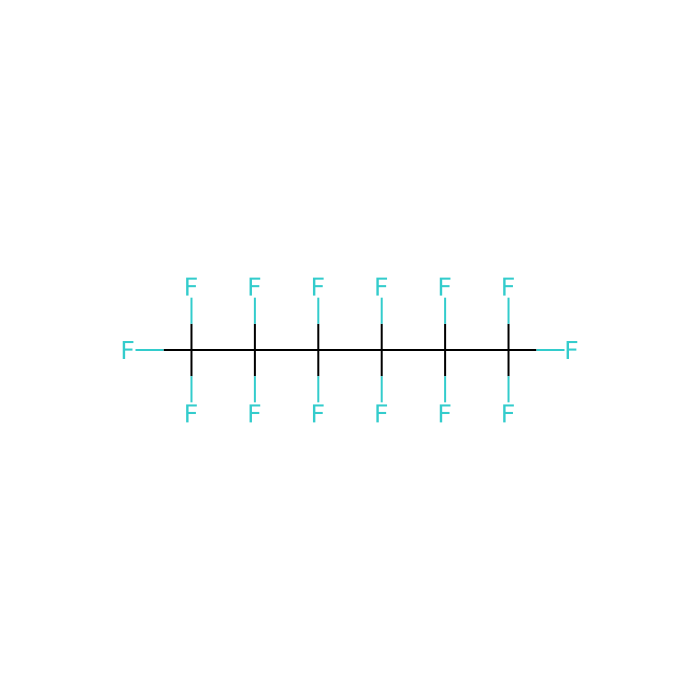
Brief overview: Tetradecafluorohexane (perfluorohexane) is a fully fluorinated linear alkane consisting of six carbon atoms with all hydrogens replaced by fluorine.
Item-specific identifiers (from Product Data)
SKU: T478344
CAS: 355-42-0
Product Name: Tetradecafluorohexane
InChIKey (as provided): 458591
Storage note: Store at 2–8 °C, argon charged; shipped on wet ice
Literature/computed identity details (for reference; not item-specific specs)
Synonym: Perfluorohexane; n-C6F14
Molecular formula (literature): C6F14
Molecular weight (literature): ~338.04 g/mol
SMILES (literature): FC(F)(F)C(F)(F)C(F)(F)C(F)(F)C(F)(F)C(F)(F)F (one of several equivalent representations)
Backbone: Linear, saturated C6 chain, completely fluorinated (a perfluoroalkane)
Functional groups: None beyond C–F bonds; no heteroatoms other than fluorine; no unsaturation or ring systems
Stereochemistry: Not applicable (no stereocenters in fully fluorinated n-alkane)
2D structure (descriptive): A straight-chain of six sp3 carbons, each bearing enough fluorine substituents to satisfy valency; terminal carbons are CF3 groups, internal carbons are CF2 units: CF3–(CF2)4–CF3.
Synthetic Utility
Perfluorohexane is not a reactive building block; its synthetic value arises from medium effects and separations.
Fluorous tagging and separations (literature/general)
Fluorous tags (perfluoroalkyl chains) appended to catalysts or reagents confer selective solubility in the PFC phase, enabling catalyst recycling and simplified product isolation.
Biphasic catalysis: Facilitates partition-controlled reactions; catalysts reside in the fluorous phase while substrates remain in an organic phase.
Operational roles
Inert diluent/heat sink: High heat capacity and non-reactivity make it a safe diluent for exothermic processes where miscibility is not required.
Phase-vanishing platform: Mediates diffusion-limited reagent delivery, sometimes improving selectivity in halogenations/oxidations.
Compatibility notes
Compatible with PTFE, FEP, PFA, many perfluorinated elastomers; verify with seals and tubing. Avoid highly reactive metals or Lewis acids at high temperature.
Minimal solvation of ions and polar reagents; consider co-solvent strategies (e.g., HFEs) if limited miscibility is acceptable.
Target Specificity
Not applicable to this product type. Tetradecafluorohexane is a small-molecule fluorous solvent and does not have antigen/epitope specificity, clone information, or species reactivity. Refer instead to the sections on Reaction & Applications and Synthetic Utility for relevant technical guidance.
We use cookies to ensure the website functions properly and, where permitted, to improve your experience. You can manage your preferences at any time in Settings. Learn more in our Cookie Policy.
Shall we send you a message when we have discounts available?
Remind me later
Thank you! Please check your email inbox to confirm.
Products are supplied to verified businesses, institutions, and qualified professionals for research and development use only. Not for use in humans, animals, diagnosis, or therapy.

 H2318426