GRADE & PURITYMoligand™?Moligand™ — Aladdin's line of ligands and bioactive small molecules. Use for receptor, pathway, and binding studies needing defined small-molecule tools.10mM in DMSO
Moligand™, 10mM in DMSO Moligand™ for sensitive chromatographic and analytical workflows requiring minimal baseline interference.
🌡
Storage & shipping
Store at -80°C Ships Dry ice packs + Cold packs Check lot-specific COA for exact specifications.
📋
Quality documents
SDS, COA, datasheet, and spec sheet available for download. Lot-specific COA accessible via lot number lookup.
📚
Literature proof
Cited in 0 peer-reviewed publications across chromatography, organic synthesis, and cross-coupling reactions.
Descripción general
Information
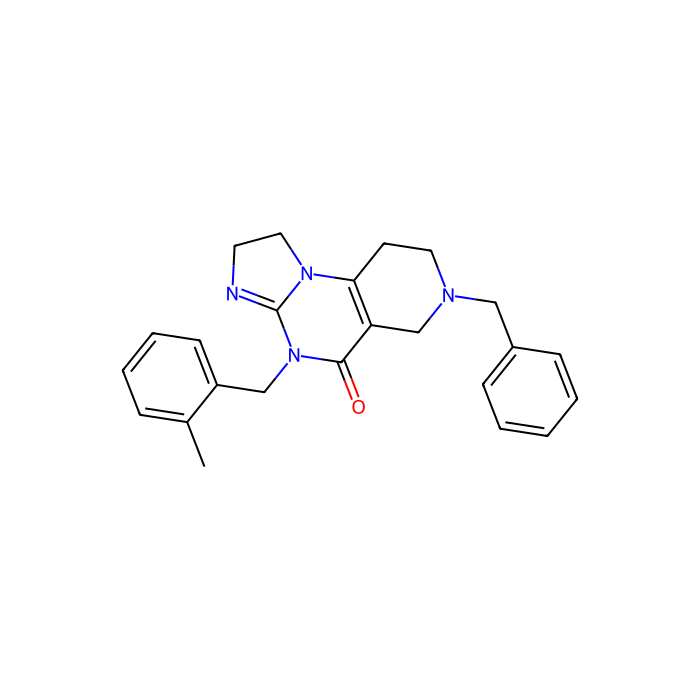
TIC10 (ONC201) TIC10 (ONC201) inactivates Akt and ERK to induce TNF-related apoptosis-inducing ligand (TRAIL) through Foxo3a, possesses superior drug properties: delivery across the blood-brain barrier, superior stability and improved pharmacokinetics. Phase 1/2.
Targets
Akt ; ERK
In vitro
TIC10 causes a dose-dependent increase in TRAIL mRNA and induces TRAIL protein localization on the cell surface of several cancer cell lines in a p53-independent manner. TIC10 has broad-spectrum activity against multiple malignancies in vitro and induces an increase in sub-G1 DNA content suggestive of cell death in TRAIL-sensitive HCT116 p53−/− cells, but does not alter the cell cycle profiles of normal fibroblasts at equivalent doses. TIC10 decreases the clonogenic survival of cancer cell lines and spares normal fibroblasts. TIC10 increases the percentage of sub-G1 DNA in cancer cells in a p53-independent and Bax-dependent manner, as previously reported for TRAIL-mediated apoptosis. TIC10-induced TRAIL up-regulation is Foxo3a-dependent, which also up-regulates TRAIL death receptor DR5 among other targets, potentially allowing for sensitization of some TRAIL-resistant tumor cells. TIC10 inactivates kinases Akt and extracellular signal–regulated kinase (ERK), leading to the translocation of Foxo3a into the nucleus, where it binds to the TRAIL promoter to up-regulate gene transcription. TIC10 is an efficacious antitumor therapeutic agent that acts on tumor cells and their microenvironment to enhance the concentrations of the endogenous tumor suppressor TRAIL.
In vivo
TIC10 and TRAIL treatment causes tumor regression in the HCT116 p53−/− xenograft to a comparable extent when both are administered as multiple doses. TIC10 also induces regression of MDA-MB-231 human triple-negative breast cancer xenografts, whereas TRAIL-treated tumors progressed. In DLD-1 colon cancer xenografts, TIC10 induces tumor stasis at 1 week after treatment, whereas TRAIL-treated tumors progresses after a single dose. A single dose of TIC10 also induces a sustained regression of the SW480 xenograft and is equally effective when delivered by intraperitoneal or oral route, suggesting favorable oral bioavailability for TIC10. TIC10 causes tumor-specific cell death by TRAIL-mediated direct and bystander effects. TIC10 is an effective antitumor agent against orthotopic human glioblastoma multiforme tumors.
TIC10 (ONC201) inactivates Akt and ERK to induce TNF-related apoptosis-inducing ligand (TRAIL) through Foxo3a, possesses superior drug properties: delivery across the blood-brain barrier, superior stability and improved pharmacokinetics. Phase 1/2.
Condiciones de almacenamiento de almacenamiento
Store at -80°C
Enviado en
Dry ice packs + Cold packs
Este producto requiere envío en cadena de frío. Los servicios terrestres y otros servicios económicos no están disponibles.
This compound belongs to the class of organic compounds known as imidazopyrimidines. These are organic polycyclic compounds containing an imidazole ring fused to a pyrimidine ring. Imidazole is 5-membered ring consisting of three carbon atoms, and two nitrogen centers at the 1- and 3-positions. Pyrimidine is a 6-membered ring consisting of four carbon atoms and two nitrogen centers at the 1- and 3- ring positions.
External Descriptors
Not available
1. Djoumbou Feunang Y, Eisner R, Knox C, Chepelev L, Hastings J, Owen G, Fahy E, Steinbeck C, Subramanian S, Bolton E, Greiner R, and Wishart DS. ClassyFire: Automated Chemical Classification With A Comprehensive, Computable Taxonomy. Journal of Cheminformatics, 2016, 8:61.
We use cookies to ensure the website functions properly and, where permitted, to improve your experience. You can manage your preferences at any time in Settings. Learn more in our Cookie Policy.
Shall we send you a message when we have discounts available?
Remind me later
Thank you! Please check your email inbox to confirm.
Products are supplied to verified businesses, institutions, and qualified professionals for research and development use only. Not for use in humans, animals, diagnosis, or therapy.