
Determine the necessary mass, volume, or concentration for preparing a solution.
| Activity Type | Activity Value -log(M) | Mechanism of Action | Activity Reference | Publications (PubMed IDs) |
|---|
≥96% for sensitive chromatographic and analytical workflows requiring minimal baseline interference.
Protected from light,Store at -80°C Ships Dry ice packs + Cold packs Check lot-specific COA for exact specifications.
SDS, COA, datasheet, and spec sheet available for download. Lot-specific COA accessible via lot number lookup.
Cited in 0 peer-reviewed publications across chromatography, organic synthesis, and cross-coupling reactions.
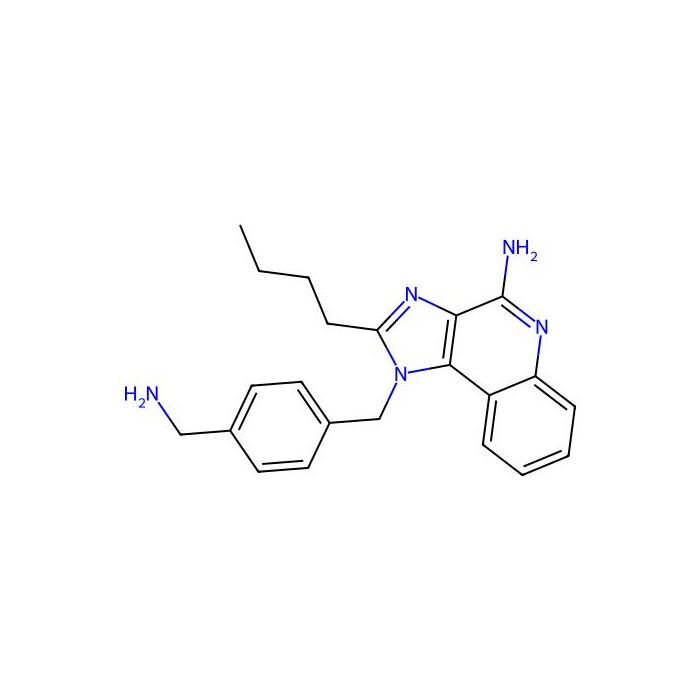
TLR7/8 agonist 1 is a toll-like receptor ( TLR7 )/ TLR8 dual-agonistic imidazoquinoline.
In Vitro
TLR7/8 agonist 1 (Compound 5d) shows prominent immunostimulatory activities. TLR7/8 agonist 1 serves as a convenient precursor for the covalent attachment of fluorophores without significant loss of activity.TLR7/8 agonist 1 retains TLR7-agonistic activity with an EC 50 of 20 nM. TLR7/8 agonist 1 is covalently coupled directly to commercially-available fluorescein isothiocyanate and rhodamine B isothiocyanate. TLR7/8 agonist 1 (Compound 1) shows substantially different agonistic potencies in human TLR7 (50 nM) and TLR8 (55 nM) primary screens. MCE has not independently confirmed the accuracy of these methods. They are for reference only.
Cell Assay
Fresh human peripheral blood mononuclear cells ( hPBMC ) are isolated from human blood obtained by venipuncture with informed consent and as per institutional guidelines on Ficoll–Hypaque gradients. Aliquots of PBMCs (10 5 cells in 100 μL/well) are stimulated for 12 h with graded concentrations of test compounds (e.g., TLR7/8 agonist 1; 0.1, 1, 10, and 100 μg/mL ). Supernatants are isolated by centrifugation and are assayed in duplicates using analyte-specific multiplexed cytokine/chemokine bead array assays. MCE has not independently confirmed the accuracy of these methods. They are for reference only.
Form:Solid
IC50& Target:TLR7 TLR8
| Sonrisas canónicas | CCCCC1=NC2=C(N1CC3=CC=C(C=C3)CN)C4=CC=CC=C4N=C2N |
|---|---|
| IUPAC Name | 1-[[4-(aminomethyl)phenyl]methyl]-2-butylimidazo[4,5-c]quinolin-4-amine |
| InChIKey | SDSKFWHQCNBICO-UHFFFAOYSA-N |
| INCHI | 1S/C22H25N5/c1-2-3-8-19-26-20-21(17-6-4-5-7-18(17)25-22(20)24)27(19)14-16-11-9-15(13-23)10-12-16/h4-7,9-12H,2-3,8,13-14,23H2,1H3,(H2,24,25) |
| Isómeros SMILES | CCCCC1=NC2=C(N1CC3=CC=C(C=C3)CN)C4=CC=CC=C4N=C2N |
| PubChem CID | 52945312 |
| Peso molecular | 359.5 |
Comprehensive hazard, handling, storage, and regulatory compliance document.
Download SDS →Lot-specific quality data. Enter your lot number to retrieve the exact COA.
Look up COA →Full quality attributes and acceptance criteria for this grade.
View spec sheet →Taxonomy Tree
| Kingdom | Organic compounds |
|---|---|
| Superclass | Organoheterocyclic compounds |
| Clase | Quinolines and derivatives |
| Subclass | Imidazoquinolines |
| Intermediate Tree Nodes | Not available |
| Direct Parent | Imidazoquinolines |
| Alternative Parents | Aminoquinolines and derivatives Imidazo-[4,5-c]pyridines Phenylmethylamines Benzylamines Aralkylamines Aminopyridines and derivatives N-substituted imidazoles Imidolactams Heteroaromatic compounds Azacyclic compounds Monoalkylamines Hydrocarbon derivatives |
| Molecular Framework | Aromatic heteropolycyclic compounds |
| Substituents | Imidazoquinoline - Aminoquinoline - Imidazopyridine - Imidazo-[4,5-c]pyridine - Benzylamine - Phenylmethylamine - Aminopyridine - Aralkylamine - Imidolactam - Benzenoid - Pyridine - N-substituted imidazole - Monocyclic benzene moiety - Heteroaromatic compound - Azole - Imidazole - Azacycle - Primary amine - Amine - Hydrocarbon derivative - Primary aliphatic amine - Organic nitrogen compound - Organonitrogen compound - Aromatic heteropolycyclic compound |
| Descripción | This compound belongs to the class of organic compounds known as imidazoquinolines. These are aromatic heterocyclic compounds containing an imidazole ring fused to a quinoline ring system. In some configurations, the imidazole ring shares a nitrogen atom with the quinoline moiety. |
| External Descriptors | Not available |
| Activity Type | Activity Value -log(M) | Mechanism of Action | Activity Reference | Publications (PubMed IDs) |
|---|
| Activity Type | Activity Value -log(M) | Mechanism of Action | Activity Reference | Publications (PubMed IDs) |
|---|
| Activity Type | Relation | Activity value | Units | Action Type | Journal | PubMed Id | doi | Assay Aladdin ID |
|---|
| Activity Type | Relation | Activity value | Units | Action Type | Journal | PubMed Id | doi | Assay Aladdin ID |
|---|
| Activity Type | Relation | Activity value | Units | Action Type | Journal | PubMed Id | doi | Assay Aladdin ID |
|---|
| Peso molecular | 359.500 g/mol |
|---|---|
| XLogP3 | 3.500 |
| Hydrogen Bond Donor Count | 2 |
| Hydrogen Bond Acceptor Count | 4 |
| Rotatable Bond Count | 6 |
| Exact Mass | 359.211 Da |
| Monoisotopic Mass | 359.211 Da |
| Topological Polar Surface Area | 82.800 Ų |
| Heavy Atom Count | 27 |
| Formal Charge | 0 |
| Complexity | 464.000 |
| Isotope Atom Count | 0 |
| Defined Atom Stereocenter Count | 0 |
| Undefined Atom Stereocenter Count | 0 |
| Defined Bond Stereocenter Count | 0 |
| Undefined Bond Stereocenter Count | 0 |
| The total count of all stereochemical bonds | 0 |
| Covalently-Bonded Unit Count | 1 |