
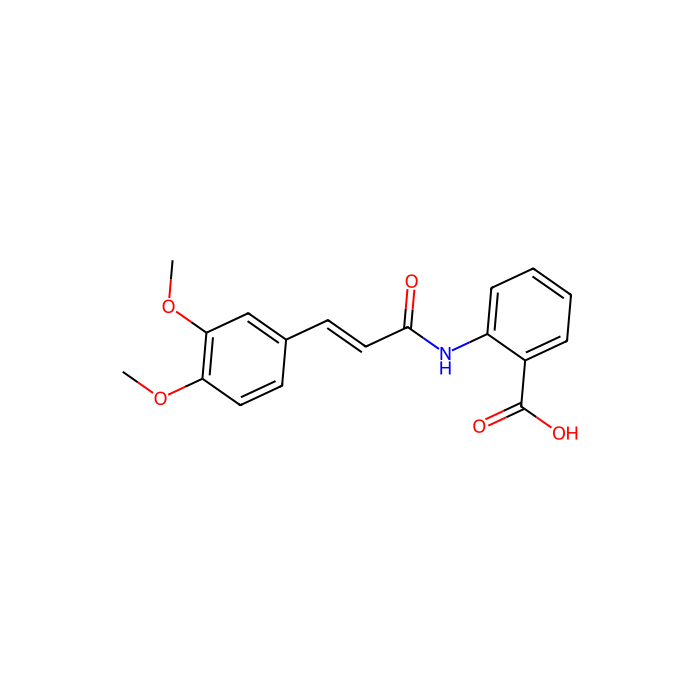
Determine the necessary mass, volume, or concentration for preparing a solution.
| Activity Type | Activity Value -log(M) | Mechanism of Action | Activity Reference | Publications (PubMed IDs) |
|---|
10mM in DMSO for sensitive chromatographic and analytical workflows requiring minimal baseline interference.
Store at -80°C Ships Dry ice packs + Cold packs Check lot-specific COA for exact specifications.
SDS, COA, datasheet, and spec sheet available for download. Lot-specific COA accessible via lot number lookup.
Cited in 2 peer-reviewed publications across chromatography, organic synthesis, and cross-coupling reactions.
Information
Tranilast (SB 252218, MK-341, Rizaben, MK 341, Tranpro) is anantiallergicdrug by inhibiting lipid mediator and cytokine release from inflammatory cells, used for the treatment of allergic disorders such as asthma, allergic rhinitis and atopic dermatitis.
In vitro
Tranilast is an anti-allergic drug inhibiting the release of substances such as histamine and prostaglandins from mast cells, which suppresses collagen synthesis of fibroblasts derived from keloid tissues. Tranilast (3-300 mM) suppresses the collagen synthesis of fibroblasts from keloid and hypertrophic scar tissue but not healthy skin fibroblasts. Tranilast (30-300 mM) inhibits the release of transforming growth factor (TGF)-beta 1 from keloid fibroblasts, which enhances the collagen synthesis of keloid fibroblasts. Tranilast improves keloids and hypertrophic scars which originate from the abnormal proliferation and excessive collagen accumulation of fibroblasts. Tranilast inhibits the release of TGF-beta 1, IL-1 beta and PGE2 from the human monocytes-macrophages. Tranilast inhibits the proliferation stimulated with fetal bovine serum (FBS), TGF-beta 1 and platelet-derived growth factor-BB (PDGF-BB) as well as PDGF-BB-induced migration. Tranilast exhibits inhibitory effects on spontaneous collagen synthesis and TGF-beta 1-induced collagen and glycosaminoglycan synthesis.
In vivo
Tranilast results in a 58% reduction in TGF-beta1-induced 3[H]-hydroxyproline incorporation in the diabetic heart of rats. Tranilast attenuates cardiac fibrosis by 37% in association with reduction in phospho-Smad2 in the diabetic heart of rats. Tranilast treatment completely prevents the increase in chymaselike activity, reduces the chymase mRNA levels by 43%, and decreases the carotid intima/media ratio by 63% in the carotid artery of dogs.
Cell Data
cell lines:MOLM-13 and RS4;11 cells
Concentrations:
Incubation Time:
Powder Purity:≥99%
| Isómeros SMILES | COC1=C(C=C(C=C1)/C=C/C(=O)NC2=CC=CC=C2C(=O)O)OC |
|---|---|
| WGK Alemania | 3 |
| RTECS | DG8731000 |
| CAS alternativo | 70806-55-2 |
| Peso molecular | 327.33 |
| Reaxy-Rn | 3987703 |
| Reaxys-RN_link_address | https://www.reaxys.com/reaxys/secured/hopinto.do?context=S&query=IDE.XRN=3987703&ln= |
Comprehensive hazard, handling, storage, and regulatory compliance document.
Download SDS →Lot-specific quality data. Enter your lot number to retrieve the exact COA.
Look up COA →Full quality attributes and acceptance criteria for this grade.
View spec sheet →| Activity Type | Activity Value -log(M) | Mechanism of Action | Activity Reference | Publications (PubMed IDs) |
|---|
| Punto de fusión (°C) | 166.2-168.2 °C |
|---|
| 1. Qian ZhiZhi, Wang QianYi, Qiu ZhaoShun, Li DanYang, Zhang ChenCheng, Xiong XiYu, Zheng ZiHui, Ruan QinLi, Guo YiChen, Guo Jun. (2022) Protein nanoparticle-induced osmotic pressure gradients modify pulmonary edema through hyperpermeability in acute respiratory distress syndrome. JOURNAL OF NANOBIOTECHNOLOGY, 20 (1): (1-21). [PMID:35794575] [10.1186/s12951-022-01519-1] |
| 2. Kai-chao Wen, Zheng-an Li, Ji-heng Liu, Chuan Zhang, Feng Zhang, Feng-qian Li. (2024) Preparation and characterization of PLGA nano-drug delivery system co-loaded with tranilast/gallium phytate for stent coating. JOURNAL OF DRUG DELIVERY SCIENCE AND TECHNOLOGY, [PMID:] [10.1016/j.jddst.2024.105812] |