Determine the necessary mass, volume, or concentration for preparing a solution.
Taxonomy Tree
| Kingdom | Organic compounds |
|---|---|
| Superclass | Hydrocarbons |
| Clase | Saturated hydrocarbons |
| Subclass | Cycloalkanes |
| Intermediate Tree Nodes | Not available |
| Direct Parent | Cycloalkanes |
| Alternative Parents | Not available |
| Molecular Framework | Aliphatic homomonocyclic compounds |
| Substituents | Cycloalkane - Aliphatic homomonocyclic compound |
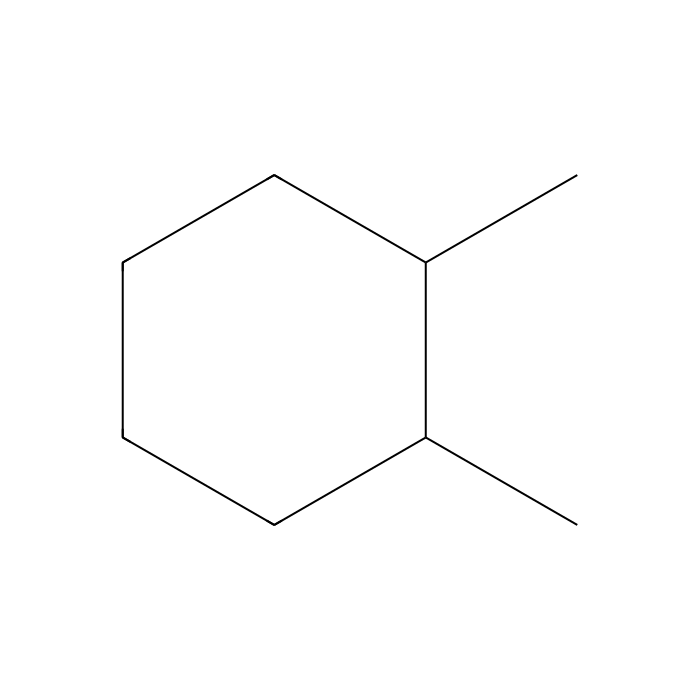
| Descripción | This compound belongs to the class of organic compounds known as cycloalkanes. These are saturated monocyclic hydrocarbons (with or without side chains). |
| External Descriptors | Hydrocarbons |
| Índice de refracción | 1.43 |
|---|---|
| Punto de inflamación (°F) | 7°C(lit.) |
| Punto de inflamación (°C) | 7°C(lit.) |
| Punto de ebullición (°C) | 124 °C |
| Peso molecular | 112.21 |
| XLogP3 | 3.800 |
| Hydrogen Bond Donor Count | 0 |
| Hydrogen Bond Acceptor Count | 0 |
| Rotatable Bond Count | 0 |
| Exact Mass | 112.125 Da |
| Monoisotopic Mass | 112.125 Da |
| Topological Polar Surface Area | 0.000 Ų |
| Heavy Atom Count | 8 |
| Formal Charge | 0 |
| Complexity | 56.400 |
| Isotope Atom Count | 0 |
| Defined Atom Stereocenter Count | 2 |
| Undefined Atom Stereocenter Count | 0 |
| Defined Bond Stereocenter Count | 0 |
| Undefined Bond Stereocenter Count | 0 |
| The total count of all stereochemical bonds | 0 |
| Covalently-Bonded Unit Count | 1 |
H225:Highly Flammable liquid and vapor
H304:May be fatal if swallowed and enters airways
H336:May cause drowsiness or dizziness
P210:Keep away from heat, hot surface, sparks, open flames and other ignition sources. - No smoking.
P233:Keep container tightly closed.
P240:Ground/bond container and receiving equipment.
P241:Use explosion-proof [electrical/ventilating/lighting/.../] equipment.
P242:Use only non-sparking tools.
P243:Take precautionary measures against static discharge.
P261:Avoid breathing dust/fume/gas/mist/vapors/spray.
P271:Use only outdoors or in a well-ventilated area.
P280:Wear protective gloves/protective clothing/eye protection/face protection.
P331:Do NOT induce vomiting.
P303+P361+P353:IF ON SKIN (or hair): Take off Immediately all contaminated clothing. Rinse SKIN with water [or shower].
P304+P340:IF INHALED: Remove person to fresh air and keep comfortable for breathing.
P370+P378:In case of fire: Use ... to extinguish.
P405:Store locked up.
P403+P233:Store in a well-ventilated place. Keep container tightly closed.
P403+P235:Store in a well-ventilated place. Keep cool.
P501:Dispose of contents/container to an approved waste disposal plant.
P301+P316:IF SWALLOWED: Get emergency medical help immediately.
P319:Get medical help if you feel unwell.
No item-specific, validated application protocols are provided for this SKU. Typical laboratory uses are method- and goal-dependent (e.g., GC retention indexing, conformational NMR studies, mechanistic probes).
General suggestions (adapt to your SOPs):
For any regulated workflow, incorporate appropriate system suitability checks and reference materials.
Item-specific biological data: Not specified for this item; this product is supplied strictly for research use only.
General/contextual information (literature):
For any work intersecting with biological matrices, ensure proper containment due to volatility, avoid emulsions that complicate separation, and confirm that no surfactants or residual polar contaminants confound results.
Not typically applicable. trans-1,2-Dimethylcyclohexane is a nonpolar hydrocarbon with negligible aqueous solubility and no acid/base functionality; it does not serve as a buffer component.
Practical note: If your workflow involves aqueous buffers alongside this compound (e.g., biphasic reactions, partition studies), pre-equilibrate phases to minimize volume changes, and use vigorous phase separation techniques (centrifugation or salting-out) to ensure clean partitioning.
As a non-functionalized hydrocarbon, trans-1,2-dimethylcyclohexane is typically used as a substrate/standard rather than as a process solvent. Green chemistry considerations therefore focus on source, minimization, and end-of-life rather than substitution.
Opportunities (general guidance):
Comparison snapshot (literature/general):
Waste management:
Note: Selection should balance performance, availability of recycling, and process safety.
Item-specific pharmacopeial status or excipient role: Not specified for this item; refer to CoA/Spec Sheet.
General context (non-clinical; manufacturing/formulation science):
Regulatory note: There are no therapeutic claims or indications associated with this material. Use is restricted to research and development activities in controlled laboratory settings.
Item-specific specifications (BP, MP, density, etc.): Not specified for this item; refer to CoA/Spec Sheet.
Literature and general reference values for trans-1,2-dimethylcyclohexane (for informational planning only; verify against primary sources for critical work):
Note: Reported constants often do not distinguish isomeric purity (cis vs trans). For exact values of this item, consult the Aladdin CoA/Spec Sheet.
Guidance on quality dimensions relevant to this material (general best practice for hydrocarbon isomers):
Documentation and traceability:
Representative research uses and reactivity considerations for trans-1,2-dimethylcyclohexane (literature/practice-based):
Practical tips:
General literature guidance for representative transformations involving 1,2-dimethylcyclohexane; adapt and optimize for your specific setup and scale:
Radical halogenation (unselective benchmark):
Autoxidation (mechanistic studies):
Catalytic dehydrogenation/hydrogenation (model studies):
NMR conformational analysis:
These are literature-style, illustrative conditions and not product specifications. Always conduct small-scale trials and consult primary references.
Item-specific GHS details (signal word, hazard statements, pictograms, classification): Not specified for this item; refer to the product SDS for authoritative safety information.
General safety guidance for saturated aliphatic hydrocarbons such as trans-1,2-dimethylcyclohexane (literature/practice-based):
Always consult the SDS for this specific SKU prior to use.
This product is not typically used as a laboratory solvent. It is a nonpolar hydrocarbon substrate/standard. If employing it as a medium or diluent, consider the following general characteristics (literature/general):
When to choose vs alternatives (if used as an environment for reactivity/measurement):
Note: For extractions, kinetics, or spectroscopic studies requiring nonpolar media, validate solubility and background absorbance empirically under your exact conditions.
Always refer to the CoA and SDS accompanying your lot for any additional handling or stability notes specific to that batch.
trans-1,2-Dimethylcyclohexane is a saturated, aliphatic cycloalkane bearing two vicinal methyl substituents in a trans relationship.
While lacking functional groups, trans-1,2-dimethylcyclohexane has utility as a model substrate and starting point in hydrocarbon functionalization studies (literature/general):
Because transformations often lack directing groups, expect low chemoselectivity without sophisticated catalysts or radical traps; design experiments accordingly and plan rigorous analytical separation (GC, preparative GC, or careful distillation).
Not applicable. This product is a small-molecule hydrocarbon and is not an antibody, probe, or targeted biological reagent. No target specificity information is provided for this item.