This compound belongs to the class of organic compounds known as cinnamic acids. These are organic aromatic compounds containing a benzene and a carboxylic acid group forming 3-phenylprop-2-enoic acid.
External Descriptors
Not available
1. Djoumbou Feunang Y, Eisner R, Knox C, Chepelev L, Hastings J, Owen G, Fahy E, Steinbeck C, Subramanian S, Bolton E, Greiner R, and Wishart DS. ClassyFire: Automated Chemical Classification With A Comprehensive, Computable Taxonomy. Journal of Cheminformatics, 2016, 8:61.
Determine the necessary mass, volume, or concentration for preparing a solution.
Dilution Calculator
Determine the dilution needed to prepare a stock solution.
Reconstitution Calculator
Reseñas
Reseñas de cliente
Application Protocols
No assay or bioanalytical application protocols are provided for this SKU. Typical laboratory uses are in organic synthesis and materials/photochemistry research.
General handling suggestions (non-protocol):
Prepare stock solutions in dry DMSO or DMF (e.g., 10–100 mM), filter (0.2 µm PTFE) if needed, and store aliquots protected from light.
For purification, use silica gel chromatography with gradients of hexanes/EtOAc or toluene/EtOAc; add 0.1–1% acetic acid to mobile phase if tailing occurs due to acid–silica interactions.
For any bioassay use, establish your own dilution schemes, controls, and detection settings. Research use only.
Biological Roles
No biological testing data are provided for this SKU. The following are general, literature-based considerations for cinnamic-acid derivatives and electron-rich anisole analogs; they are not product-specific claims.
Phenylpropanoid context: Cinnamic acid is a central intermediate in the phenylpropanoid pathway in plants. Methoxy substitutions (as in anisyl derivatives) mirror O-methylation steps commonly catalyzed by O-methyltransferases in planta.
Physicochemical attributes: Two methoxy groups increase hydrophobicity and electron density, which can influence membrane association and photophysics relative to hydroxycinnamic acids (e.g., ferulates, caffeates).
Acid–base behavior: At physiological pH, the carboxylate is largely ionized; transport and partitioning depend strongly on pH (logD shifts) and presence of transporters in biological systems (general concept).
Photochemical behavior: Conjugated cinnamates display pronounced UV absorption and can undergo E/Z photoisomerization; methoxy substitution modulates absorption maxima and quantum yields (literature observations).
Research use only: Any biological activity, metabolism, or toxicology assessments must be determined experimentally for your intended system. Do not extrapolate pharmacological effects from structural analogy without data.
Buffer Applications
This compound is not a conventional buffer component. As a weak carboxylic acid, it can ionize around acidic pH, but its hydrophobic aromatic core and limited aqueous solubility make it unsuitable as a primary buffering agent.
Practical note: If introduced into aqueous systems (e.g., assays), prepare concentrated stocks in DMSO or DMF and dilute into pre-made buffers (phosphate, HEPES, Tris) while monitoring for precipitation.
pH control: Use established buffer systems with appropriate capacity in the pH 6–8 range (e.g., PBS, HEPES). Adjust pH only after dissolving the compound in a miscible co-solvent if necessary.
For pH-sensitive experiments, titrate solutions to the desired pH after dissolution and verify solubility at working concentrations.
Green Alternatives
While the compound itself is a substrate, greener choices can be made in its processing, transformations, and purification.
Greener solvent choices (general guidance):
Replace chlorinated solvents (CH2Cl2, chloroform) with greener ethers/esters where feasible:
Ethyl acetate or 2-MeTHF for extractions and Steglich-type couplings (check solubility of reagents; 2-MeTHF offers lower peroxide tendency than THF and a better environmental profile than DCM).
Alcohols (EtOH, MeOH from renewable sources) for Fischer esterifications.
Reaction media:
Use MeCN alternatives (if avoidance desired) like propylene carbonate or Cyrene for some coupling/activation chemistries (verify reagent compatibility).
Employ water/EtOH biphasic systems for phase-transfer-promoted reactions (where applicable).
Reagent alternatives and strategies:
Couplings: swap DCC (urea waste) with EDC·HCl (water-soluble urea byproduct) or T3P (CO2/isopropanol byproducts). Enzymatic esterifications (lipase-catalyzed in green solvents) are possible for cinnamates.
Catalysis: use catalytic acid (p-toluenesulfonic acid) instead of stoichiometric mineral acids for Fischer esterification; drive equilibrium by azeotropic removal of water (Dean–Stark) in bio-derived solvents (e.g., isopropyl acetate).
Trade-offs:
2-MeTHF/EtOAc may reduce rate or solubility versus DCM; temperature/time adjustments may be needed.
Water-rich systems can hydrolyze activated intermediates; control pH and dosing carefully.
Document solvent selection and waste minimization in your process safety review.
Pharmaceutical Uses
No pharmacopeial status, excipient role, or formulation grade is specified for this item; refer to the CoA/Spec Sheet. The following are general, non-clinical context notes for research/manufacturing chemistry involving cinnamate motifs.
Role in process chemistry: Cinnamic-acid derivatives are common synthetic intermediates for producing cinnamate esters and amides used in materials, cosmetics, and as reference compounds in analytical methods.
Solubility enhancement via salt formation (temporary) is feasible but may be reversed upon neutralization; permanent enhancement often relies on ester pro-moieties (for research chemicals) or co-solvent systems.
Solid-state: many cinnamates crystallize well; polymorphism and E/Z isomer content can influence melting range and processability (establish via DSC/PXRD if relevant to your work).
Analytical standards: Conjugated aromatic acids provide strong UV signals, making them convenient for HPLC method development and detector calibration (research use).
Note: No therapeutic or clinical claims are made. This product is sold strictly for research use only.
Physical Properties
Item-specific specifications are not provided in the Product Data. The following notes are general/literature-oriented and should not be treated as specifications for this SKU.
Appearance: Not specified for this item; refer to CoA/Spec Sheet. (Typically a crystalline solid for related cinnamic acids; literature)
Melting point: Not specified for this item; refer to CoA/Spec Sheet. (cinnamic acid derivatives often melt in the 150–230 °C range; literature)
Boiling point: Not applicable (decomposes before boiling at atmospheric pressure for many aromatic acids; literature)
Density: Not specified for this item; refer to CoA/Spec Sheet.
Solubility (qualitative, literature):
Water: low to very low at neutral pH due to hydrophobic ring and limited ionization; increases in basic media by carboxylate formation.
Organic: soluble in polar organics (MeOH, EtOH, acetone, DMF, DMSO, EtOAc); moderate in less polar solvents (THF, CH2Cl2); poor in alkanes.
pKa (carboxylic acid, literature typical): ~4–5 for substituted cinnamic acids; electron-donating methoxy groups can slightly increase pKa versus unsubstituted.
LogP (literature expectation): moderately lipophilic in neutral form due to aryl and two methoxy groups; ionization markedly reduces logD at basic pH.
UV–vis (literature qualitative): strong π→π* absorption in near-UV due to extended conjugation; bathochromic shift versus benzoic acids.
For exact numerical values applicable to this lot, consult the CoA/Spec Sheet.
Quality and Grades
Grade/Purity: Not specified for this item; refer to CoA/Spec Sheet.
Appearance: Not specified for this item; refer to CoA/Spec Sheet.
Interpretation and implications (general guidance):
In absence of an explicit grade (e.g., “AR,” “HPLC,” “ACS”), treat as a research-grade reagent. Critical analytical applications (e.g., quantitative reference standards, photophysical measurements) should verify suitability via CoA and in-house QC.
UV-sensitive work: cinnamate chromophores absorb strongly in the near-UV; if using in photochemical or spectrophotometric contexts, low-UV-impurity grades (e.g., HPLC grade for solvents or recrystallized solids) are beneficial.
Stabilizers: None are listed. Carboxylic acids of this class generally do not require stabilizers; however, prolonged exposure to strong light/heat can lead to slow discoloration/polymerization in some cinnamates. Use light-protective storage for photochemical consistency when needed.
Identity/purity confirmation (recommended QC):
1H/13C NMR (E-geometry evident from coupling constant of vinyl protons, typically J ≈ 15–16 Hz; literature).
HPLC/UPLC purity profile at multiple wavelengths (e.g., 220–320 nm).
HRMS for molecular ion confirmation.
Melting point (if crystalline) as a quick check against literature.
For lot-specific specifications (assay, residual solvents, metal content, water), consult the CoA/Spec Sheet.
Reaction and Applications
Cinnamic-acid derivatives are versatile conjugated building blocks. The 2,4-dimethoxy substitution adds electron-rich character and handles for further diversification.
Representative applications (literature/general):
Esterification to cinnamate esters: Fischer (cat. H2SO4 in MeOH/EtOH, reflux) or Steglich (DCC/DMAP, CH2Cl2) to furnish UV-absorbing esters useful as monomers, probes, or materials precursors.
Amide coupling: EDC·HCl/HOBt, HATU, or T3P in DMF/MeCN to install cinnamamide motifs for library synthesis and photophysical studies. Electron-rich aryl increases conjugation and can tune fluorescence/UV behavior.
Selective hydrogenation: Pd/C (H2, 1–5 bar) reduces the C=C to give 3-(2,4-dimethoxyphenyl)propionic acid; harsher conditions (Raney Ni, elevated T/P) may further reduce the carboxyl to alcohols (stepwise sequences).
Demethylation: BBr3 (DCM, −78 to 0 °C) or AlCl3/thiolates to unmask catechol-type hydroxycinnamic acids (2,4-dihydroxy analog), enabling subsequent etherification or metal-chelation studies.
Photochemistry: E-cinnamates undergo E/Z isomerization or [2+2] cycloadditions in solid state or films; methoxy substitution modulates triplet yields (application-dependent).
Conjugate addition (activated systems): the α,β-unsaturated acid can be engaged as a Michael acceptor when activated (e.g., as acid chloride, mixed anhydride, or under base-promoted conditions), enabling C–C or C–X bond formation.
Practical notes:
Drying: if water-sensitive couplings are planned, azeotrope with toluene or dry under vacuum at mild temperature.
Protect carboxyl group as ester for cross-coupling on an aryl halide if further aryl diversification is desired (introduce halogen on ring first by separate routes).
Reaction Conditions
General, literature-based conditions for common transformations of 2,4-dimethoxycinnamic acid (non-specific to this SKU):
Fischer esterification: ROH (5–20 equiv), catalytic H2SO4 or p-TsOH, reflux (MeOH ~65 °C; EtOH ~78 °C) for 2–16 h; remove water (Dean–Stark in toluene/isopropyl acetate for higher alcohols). Typical isolated yields: 70–95% depending on R and workup.
Steglich esterification: alcohol (1.2–2.0 equiv), DCC (1.1–1.3 equiv), DMAP (5–10 mol%), CH2Cl2 or EtOAc, 0 °C to rt, 2–18 h. Filter dicyclohexylurea; 70–95% yields common.
Amide coupling: amine (1.1–1.5 equiv), EDC·HCl (1.2–1.5 equiv) + HOBt or Oxyma, DIPEA (2–3 equiv), DMF/MeCN, 0 °C to rt (or 40 °C for hindered partners), 2–12 h. Typical yields: 60–90%.
Acid chloride formation: SOCl2 (3–5 equiv), catalytic DMF, reflux 1–3 h; evaporate and use in situ. Alternative: (COCl)2 (1.5–2.0 equiv), catalytic DMF, 0 °C to rt.
Catalytic hydrogenation (C=C): 5–10 wt% Pd/C (5–10 mol% Pd relative), H2 1–5 bar, EtOH/EtOAc/AcOEt, rt to 50 °C, 2–8 h; saturates alkene to give 3-arylpropionic acid.
Demethylation (to dihydroxycinnamic acid): BBr3 (2–4 equiv per OMe), anhydrous CH2Cl2, −78 °C to 0 °C, 1–4 h, then aqueous quench; protect carboxyl (as Me ester) if needed to avoid side reactions. Alternative: AlCl3/thiol systems at refluxing toluene.
Photochemistry: UV irradiation (e.g., 300–365 nm) in solid state/films or solution; monitor E/Z and [2+2] outcomes; inert atmosphere and optical filters recommended.
Optimize stoichiometry, temperature, and solvent based on substrate solubility and desired selectivity. Conduct small-scale trials before scale-up.
Safety and Handling
Hazard classification details are not provided in the Product Data for this SKU.
GHS classification, signal word, hazard statements, pictograms: Not specified for this item; refer to SDS for authoritative information.
General laboratory safety guidance for aromatic carboxylic acids (non-specific):
Likely hazards: may cause irritation to skin, eyes, and respiratory tract; dust can be irritating. Avoid inhalation and contact.
PPE: lab coat, safety glasses or goggles, appropriate chemical-resistant gloves (e.g., nitrile), and use within a fume hood to control dust/aerosols.
Handling: avoid dust formation; use clean, dry tools. The compound is organic and combustible; keep away from ignition sources. Prevent contact with strong oxidizers. Carboxylic acids can react with strong bases (neutralization) and with acid chlorides/anhydrides (acyl exchange) — avoid incompatible storage.
First aid (general):
Inhalation: move to fresh air; seek medical attention if symptoms persist.
Skin contact: wash with soap and water; remove contaminated clothing.
Eye contact: rinse cautiously with water for several minutes; remove contact lenses if present; seek medical attention if irritation continues.
Ingestion: rinse mouth; seek medical advice.
Spill response: avoid raising dust; collect mechanically; dispose of according to local regulations.
Always consult the SDS for this product before use. Research use only.
Solvent Selection
This is an aromatic carboxylic acid with moderate lipophilicity in its neutral form and ionizable functionality.
Anionic form (carboxylate): highly polar and water-soluble in basic aqueous media (pH > pKa).
Miscibility/useful solvents (practical guidance):
Stock solutions for screening: DMSO (10–100 mM) or DMF; dilute into assay buffers with care to avoid precipitation upon neutralization.
Preparative work: EtOAc, MeOH, EtOH, acetone, or THF for extractions/recrystallizations; dichloromethane for workups when water immiscibility is advantageous.
Poor choices: aliphatic hydrocarbons (hexanes, heptane) — insufficient polarity for the neutral acid.
Selection tips:
For esterifications/amidations: dry to anhydrous grade; choose solvents that solubilize both coupling reagents and the acid (DCM, DMF, MeCN, or toluene depending on system).
For chromatographic purification: normal-phase silica using gradients of hexanes/EtOAc or toluene/EtOAc; for ionic forms, pre-neutralize to the acid to avoid tailing.
Comparison (contextual):
Versus more hydrophobic cinnamates: better solubility in polar organics due to two methoxy groups.
Versus hydroxycinnamic acids: less hydrogen-bond donation; may be more soluble in less polar media.
Always confirm solvent compatibility with your reaction conditions and downstream analytics.
Storage and Reconstitution
Storage conditions (per Product Data): Room temperature. Store tightly closed in a dry place. Protect from moisture and excessive light to preserve E-isomer composition and color.
Shipped in: Normal.
Reconstitution:
For solution stocks: dissolve in anhydrous DMSO or DMF to desired concentration (e.g., 10–100 mM). For alcoholic solutions (MeOH, EtOH), ensure water content is controlled if using for moisture-sensitive reactions.
Filter through a 0.2 µm PTFE syringe filter for analytical work to remove particulates.
If aqueous use is required, dissolve in minimal DMSO/DMF, then dilute into buffer with vigorous mixing; adjust pH if precipitation occurs (basic pH increases solubility via carboxylate formation). Avoid exceeding 1–2% v/v DMSO in biological media unless validated.
Stability:
Solid state: generally stable at ambient conditions; avoid prolonged exposure to strong light/heat. Keep desiccated to prevent clumping/hygroscopic uptake.
Solution: prepare fresh when possible. DMSO/DMF stocks are typically stable for days to weeks at 2–8 °C in the dark; freeze aliquots at −20 °C for longer-term storage to minimize repeated freeze–thaw.
For lot-specific stability/shelf-life details, consult the CoA/Spec Sheet. Research use only.
Structure and Identity
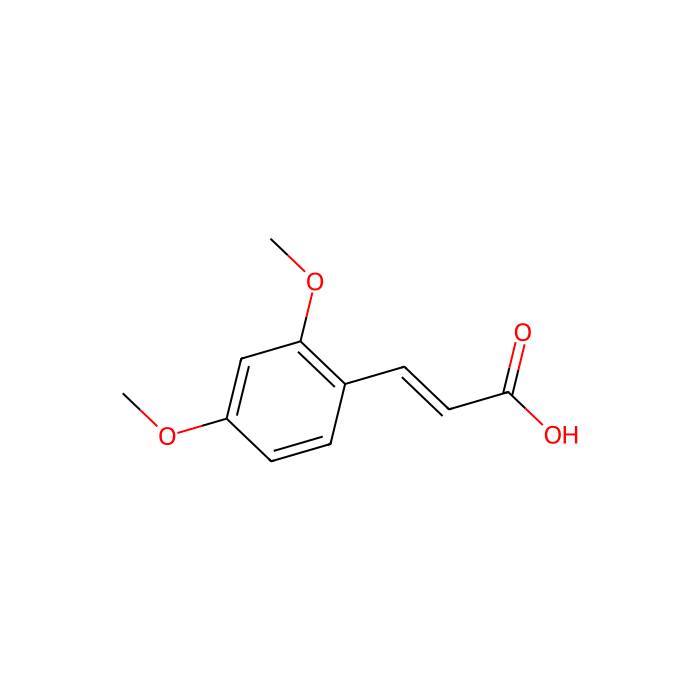
A substituted cinnamic acid bearing two methoxy groups on the aromatic ring in the 2- and 4-positions and an E (trans) styrenyl double bond.
SKU: I167827
Product name: trans-2,4-Dimethoxycinnamic acid
CAS: 16909-09-4 (literature)
PubChem CID: 734009 (literature)
InChIKey: Not specified for this item; refer to CoA/Spec Sheet.
SMILES: Not specified for this item; refer to CoA/Spec Sheet.
Molecular formula: Not specified for this item; refer to CoA/Spec Sheet. (literature commonly reports C11H12O4 for the E-isomer)
Molecular weight: Not specified for this item; refer to CoA/Spec Sheet. (literature estimate for C11H12O4 ≈ 208.21 g/mol)
Structural features (general description):
Aromatic ring (benzene) substituted at the 2- (ortho) and 4- (para) positions with methoxy groups (–OCH3), imparting electron donation and resonance activation to the ring.
Cinnamic acid motif: styrenyl double bond (–CH=CH–) conjugated with the ring and terminating in a carboxylic acid (–CO2H).
Geometry: specified as trans (E) across the C=C, maximizing conjugation and planarity across aryl–alkene–carboxylate.
Functional groups: carboxylic acid (acidic, H-bond donor/acceptor), two anisole-type methoxy ethers (weak H-bond acceptors), conjugated alkene (Michael acceptor under specific activation).
Synthetic Utility
Functional handles and reactivity summary (literature/general):
Carboxylic acid:
Coupling to esters (Fischer; Steglich with DCC/DMAP; EDC/DMAP; T3P) and amides (EDC/HATU/HBTU) to generate libraries of cinnamates/cinnamamides.
Activation as acid chloride (SOCl2, oxalyl chloride, Ghosez’s reagent) enabling Friedel–Crafts acylation (with care) or formation of mixed anhydrides for subsequent transformations.
Conjugated alkene (α,β-unsaturated system):
Michael-type additions when rendered more electrophilic (as acyl derivatives); conjugate reductions (Stryker’s reagent, Pd-catalyzed transfer hydrogenation) to access saturated analogs.
Photocycloadditions and E/Z isomerization useful in materials/photopatterning studies.
Methoxy substituents:
Directing and activating for electrophilic aromatic substitutions at remaining positions (e.g., mild formylation, halogenation on the ring in suitably protected forms).
Demethylation (BBr3, BCl3/TBAI, AlCl3/thiols) to phenolic derivatives, unlocking further etherification/esterification chemistry and metal-binding motifs.
Retrosynthetic value:
Serves as a convergent synthon: aryl core from 2,4-dimethoxybenzaldehyde via Knoevenagel/Perkin/HWE with acetate equivalents; downstream diversification at carboxyl or alkene level allows rapid SAR-type library generation.
Target Specificity
Not applicable. This product is a small-molecule chemical and not an antibody, protein, or bioassay reagent. No target specificity data are provided or expected for this SKU.
Preguntas frecuentes
How is this product shipped?
This product ships under standard ambient conditions. No temperature-controlled packaging is required.
What is the purity of this product?
This product is supplied at ≥95% purity (chemical assay). Lot-specific values are stated on the Certificate of Analysis.
How should this product be stored?
Store at room temperature.
What are the CAS number, molecular formula and molecular weight?
The CAS Number is 16909-09-4, the molecular formula is C11H12O4, and the molecular weight is 208.21 g/mol. InChIKey YIKHDPHTFYWYJV-GQCTYLIASA-N.
What documentation is provided?
Available product documentation, including Certificates of Analysis (COA), Safety Data Sheets (SDS), and specification sheets, is shown in the product document area. Document availability and access follow the current site policy.
Utilizamos cookies para garantizar el correcto funcionamiento del sitio web y, cuando esté permitido, para mejorar su experiencia. Puede gestionar sus preferencias en cualquier momento en Configuración. Más información en nuestra Política de Cookies.
¿Quieres que te enviemos un mensaje cuando tengamos descuentos disponibles?
Recordármelo más tarde
¡Gracias! Por favor, revisa tu bandeja de entrada de correo electrónico para confirmar.
Products are supplied to verified businesses, institutions, and qualified professionals for research and development use only. Not for use in humans, animals, diagnosis, or therapy.

 D2315724