Determine the necessary mass, volume, or concentration for preparing a solution.
TRFS-green - ≥97% , CAS No.1513848-14-0
Disponible para pedir
GRADE & PURITY ≥97%
Storage
Store at -20°C
Shipped In
Ice chest + Ice pads

≥97% for sensitive chromatographic and analytical workflows requiring minimal baseline interference.
Store at -20°C Ships Ice chest + Ice pads Check lot-specific COA for exact specifications.
SDS, COA, datasheet, and spec sheet available for download. Lot-specific COA accessible via lot number lookup.
Cited in 0 peer-reviewed publications across chromatography, organic synthesis, and cross-coupling reactions.
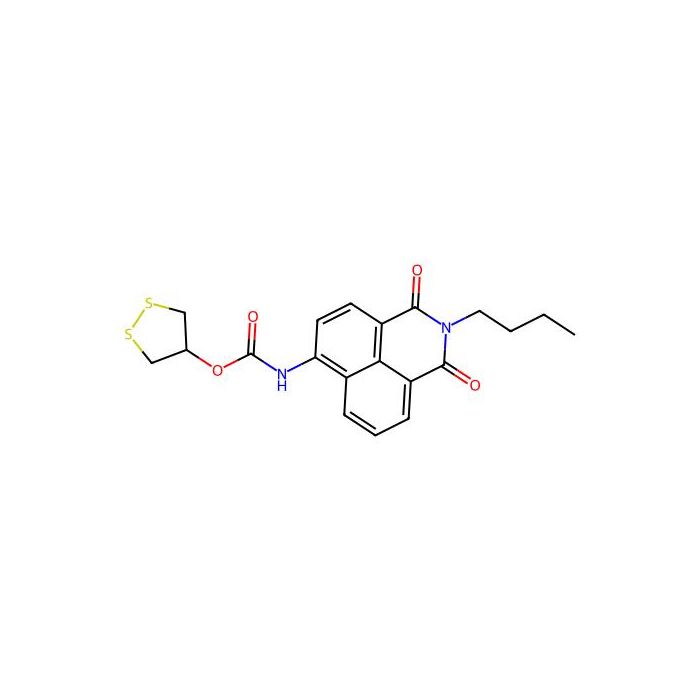
TRFS-green is a highly selective off−on fluorescent probe for imaging selenoprotein thioredoxin reductase (TrxR) in living cells. TRFS-green has the maximum absorbance at around 373 nm. After it is activated by TrxR , the maximum absorbance shifts to around 440 nm.
In Vitro
TRFS-green displays a green fluorescence off−on change induced by TrxR-mediated disulfide cleavage and subsequent intramolecular cyclization to liberate the masked naphthalimide fluorophore. TRFS-green gives a signal at ~480 nm when excited at 377 nm. Pretreatment of living cells with TrxR inhibitors in a dose-dependent manner can inhibit the fluorescence signal of TRFS-green in living cells, thereby facilitating the development of living cell-based screening assays for TrxR inhibitors. TRFS-green shows no response to GSH or Cys, the predominant thiols in cells, or the endogenous reducing agents, such as vitamin C and NADPH. Measure TrxR activity in crude cell extracts: Incubate cell lysates with TRFS-green for an appropriate time (usually 1-2 hours), and measure fluorescence intensity by fluorimeter (Em= 540 nm, Ex=440 nm). It is also possible to monitor the time-dependent increase in fluorescence (Em=540 nm, Ex=440 nm) over a given period of time. Cells treated with TRFS-green (10 μM; 2-4 h) can be observed through the green fluorescent channel of the microscope. Note: In order to obtain a clear fluorescence image, it is recommended to wash the cells with PBS or fresh medium immediately before taking pictures to remove residual TRFS-green. TRFS-green is the first fluorescent probe of TrxR with a green emission. However, the response rate of TRFS-green to the enzyme is slow, and it takes more than 2 h to reach the maximal fluorescence signal even using tris(2-carboxyethyl)phosphine (TCEP) as a reducing agent. MCE has not independently confirmed the accuracy of these methods. They are for reference only.
Form:Solid
Comprehensive hazard, handling, storage, and regulatory compliance document.
Download SDS →Lot-specific quality data. Enter your lot number to retrieve the exact COA.
Look up COA →Full quality attributes and acceptance criteria for this grade.
View spec sheet →Taxonomy Tree
| Kingdom | Organic compounds |
|---|---|
| Superclass | Organoheterocyclic compounds |
| Clase | Isoquinolines and derivatives |
| Subclass | Isoquinolones and derivatives |
| Intermediate Tree Nodes | Not available |
| Direct Parent | Isoquinolones and derivatives |
| Alternative Parents | Naphthalenes N-substituted carboxylic acid imides Carbamate esters 1,2-dithiolanes Organic disulfides Azacyclic compounds Organonitrogen compounds Organic oxides Hydrocarbon derivatives Carbonyl compounds |
| Molecular Framework | Aromatic heteropolycyclic compounds |
| Substituents | Isoquinolone - Naphthalene - Carboxylic acid imide, n-substituted - Benzenoid - Carboxylic acid imide - Dithiolane - Carbamic acid ester - 1,2-dithiolane - Organic disulfide - Carboxylic acid derivative - Azacycle - Organooxygen compound - Organonitrogen compound - Organic oxide - Organic oxygen compound - Organic nitrogen compound - Carbonyl group - Hydrocarbon derivative - Aromatic heteropolycyclic compound |
| Descripción | This compound belongs to the class of organic compounds known as isoquinolones and derivatives. These are aromatic polycyclic compounds containing a ketone bearing isoquinoline moiety. |
| External Descriptors | Not available |
| Solubilidad | DMSO : 25 mg/mL (60.02 mM; Need ultrasonic) |
|---|