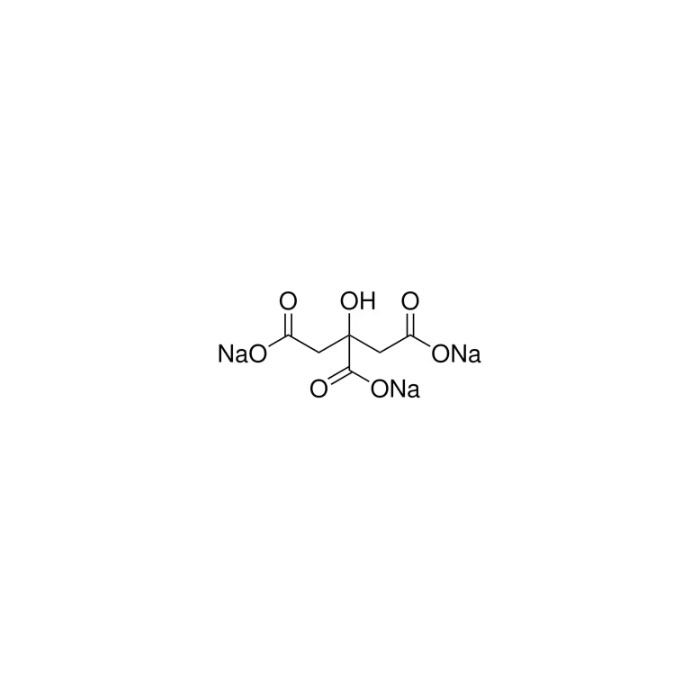
tri-Sodium citrate - Anhydrous Grade, USP, PharmPure™ , CAS No.68-04-2

CAS: 68-04-2 Cat. No.: T774745 Fórmula: C6H5O7Na3 Peso molecular: 258.07 Número EC: 200-675-3
Disponible para pedir
CALIDAD & PUREZA Anhydrous Grade ? Anhydrous grade — water removed and packaged dry for moisture-sensitive chemistry. Use in reactions where even trace water would interfere or quench. PharmPure™ ? PharmPure™ — Aladdin's line of biopharmaceutical raw and starting materials. Use for pharma manufacturing inputs needing high purity and documentation. USP ? United States Pharmacopeia grade — meets USP monograph specs for pharmaceutical use. Use for drug manufacturing, QC, and applications requiring US compendial compliance.
Synonyms
tri-Sodium citrate
Storage
Room temperature,Argon charged,Desiccated
Shipped In
Normal
★
Talla
USA
Alemania (EU)*
Precio
Cantidad
100g
T774745-GMP-100g
Fabricado bajo pedido · 8–12 semanas
33,90US$
500g
T774745-GMP-500g
Fabricado bajo pedido · 8–12 semanas
135,90US$
Enter a quantity for the sizes you want to add.
🧪
Por qué esta calidad

Anhydrous Grade, USP, PharmPure™ Anhydrous Grade,PharmPure™,USP para flujos de trabajo cromatográficos y analíticos sensibles que requieren una interferencia mínima de la línea base.

🌡

Almacenamiento y envío

Room temperature,Argon charged,Desiccated Envío Normal. Consulte el COA específico del lote para conocer las especificaciones exactas.

📋

Documentos de calidad

SDS, COA, ficha técnica y hoja de especificaciones disponibles para descargar. COA específico del lote accesible mediante búsqueda por número de lote.

📚

Prueba documental

Citado en 2092 publicaciones revisadas por pares sobre cromatografía, síntesis orgánica y reacciones de acoplamiento cruzado.

Descripción general

tri-Sodium citrate anhydrous is typically used as a citrate buffer system component for biomolecule downstream chromatography steps or final liquid formulation.

Especificaciones

Sinónimos
tri-Sodium citrate
Especificaciones y pureza
Anhydrous Grade, USP, PharmPure™
Condiciones de almacenamiento de almacenamiento
Room temperature,Argon charged,Desiccated
Enviado en
Normal
Grado
Anhydrous Grade, PharmPure™, USP
Nombres e identificadores
PH
7.5-9.0 (20 °C, 10 g/L in H2O)
Sonrisas canónicas
C(C(=O)[O-])C(CC(=O)[O-])(C(=O)[O-])O.[Na+].[Na+].[Na+]
IUPAC Name
trisodium;2-hydroxypropane-1,2,3-tricarboxylate
InChIKey
HRXKRNGNAMMEHJ-UHFFFAOYSA-K
INCHI
1S/C6H8O7.3Na/c7-3(8)1-6(13,5(11)12)2-4(9)10;;;/h13H,1-2H2,(H,7,8)(H,9,10)(H,11,12);;;/q;3*+1/p-3
Isómeros SMILES
C(C(=O)[O-])C(CC(=O)[O-])(C(=O)[O-])O.[Na+].[Na+].[Na+]
Peso molecular
258.07
Reaxy-Rn
3920956
Reaxys-RN_link_address
https://www.reaxys.com/reaxys/secured/hopinto.do?context=S&query=IDE.XRN=3920956&ln=

Documentación

📋 Hoja de datos de seguridad (SDS)

Documento completo sobre peligros, manipulación, almacenamiento y cumplimiento normativo.

<<<<<<< HEAD Descargar SDS → ======= Descargar SDS → >>>>>>> release248-p3

✅ Certificado de análisis (COA)

Datos de calidad específicos del lote. Introduzca su número de lote para obtener el COA exacto.

Buscar COA →

📊 Ficha técnica

Resumen de referencia rápida de las especificaciones y aplicaciones del producto.

Ver ficha técnica →

🔬 Hoja de especificaciones

Atributos de calidad completos y criterios de aceptación para esta calidad.

Ver hoja de especificaciones →

Datos avanzados

Taxonomic Classification

Taxonomy Tree

KingdomOrganic compounds
SuperclassOrganic acids and derivatives
ClaseCarboxylic acids and derivatives
SubclassTricarboxylic acids and derivatives
Intermediate Tree Nodes Not available
Direct ParentTricarboxylic acids and derivatives
Alternative Parents Tertiary alcohols  Carboxylic acid salts  Carboxylic acids  Organic sodium salts  Organic oxides  Hydrocarbon derivatives  Carbonyl compounds  
Molecular FrameworkAliphatic acyclic compounds
Substituents Tricarboxylic acid or derivatives - Tertiary alcohol - Carboxylic acid salt - Organic alkali metal salt - Carboxylic acid - Organic oxygen compound - Organic oxide - Hydrocarbon derivative - Organic sodium salt - Organic salt - Organooxygen compound - Carbonyl group - Alcohol - Aliphatic acyclic compound
DescripciónThis compound belongs to the class of organic compounds known as tricarboxylic acids and derivatives. These are carboxylic acids containing exactly three carboxyl groups.
External Descriptors organic sodium salt
Estructura 3D
Modelo de Estructura Química Interactiva


Certificados (CoA, COO, BSE/TSE y tabla de análisis)
C of A & Other Certificates(BSE/TSE, COO):
Analytical Chart:

Find and download the COA for your product by matching the lot number on the packaging.

3 results found

Lot NumberCertificate TypeFechaArticulo
GMH2604129GMH2604129Certificate of AnalysisAug 06, 2026 T774745
GMC2610320GMC2610320Certificate of AnalysisDec 26, 2025 T774745
GML2523674GML2523674Certificate of AnalysisDec 26, 2025 T774745
Propiedades químicas y físicas
Solubilidad425 g/L
SensibilidadMoisture sensitive
Punto de fusión (°C)150 °C (decomposition)
Peso molecular258.070 g/mol
XLogP3
Hydrogen Bond Donor Count1
Hydrogen Bond Acceptor Count7
Rotatable Bond Count2
Exact Mass257.973 Da
Monoisotopic Mass257.973 Da
Topological Polar Surface Area141.000 Ų
Heavy Atom Count16
Formal Charge0
Complexity211.000
Isotope Atom Count0
Defined Atom Stereocenter Count0
Undefined Atom Stereocenter Count0
Defined Bond Stereocenter Count0
Undefined Bond Stereocenter Count0
The total count of all stereochemical bonds0
Covalently-Bonded Unit Count4
Preguntas frecuentes y artículos
GMP
From Spec to Bench: Understanding and Using USP Grade Reagents
The Guide to Anhydrous Grade for Reagents
Differences Among Antibodies for WB/FC/IP/ChIP/IF/IHC
Structural–Functional Characteristics, Production Technologies, and Application Progress of Thrombin
Practical Guide to Sodium Carboxymethyl Cellulose (CMC-Na): Thickening/Stabilizing Mechanisms, Key Controls for Solution Preparation, and Selection Navigation (including Table 1 and Tables A–C)
Systematic Anticoagulant Selection Strategy
Chymosin: A Review of Molecular Features, Coagulation Kinetics, and Activity Evaluation
Hemicellulases: A Review of Substrate Specificity, Catalytic Systems, and Research and Industrial Applications
Why LABSA (Sulfonic Acid) Is Commonly Used in Household Cleaning Formulations: Neutralization Mechanism, Detergency Action, and Formulation Application Points
From Structure to Performance: Conditioning, Film-Forming, Thickening, and Chelating Applications of Functional Ingredients in Personal Care and Home Care
Application of Fatty Acid Methyl Ester Sulfonate (MES) in Household Detergent and Cleaning Formulations: Detergency, Hard-Water Tolerance, and Selection Criteria
Differences, Mechanisms of Action, and Selection of Sodium Metasilicate and Sodium Tripolyphosphate in Detergent and Cleaning Formulations
The Role, Selection, and Validation of Chelating Agents in Daily Chemical Formulations
Differences, Functions, and Selection Guidelines for Sodium Hydroxide Flakes, Granules, Liquid Caustic Soda, and Caustic Soda in Household and Personal Care Product Manufacturing: The Functional and Application Logic of Sodium Hydroxide
Why Daily Chemical Formulations Need Alkaline Ingredients: From pH Adjustment and Saponification to Detergency Boosting and Selection Logic
Xiao Fang Bai, Da Fang Bai, PnB and DPnB: Mechanisms and Selection of Butyl Glycol Ethers in Hard-Surface Cleaning Formulations
Why Limonene Can Soften Greasy Soils Yet Is Difficult to Dissolve in Water: Understanding the Cleaning Mechanism and Formulation Applications of Naturally Derived Solvents from Molecular Structure
Degreasing Agents from a Molecular-Structure Perspective: How AEO, APG, and Related Surfactants Can Replace Nonylphenol Ethoxylates (NPE)
How Can Sodium Tripolyphosphate (STPP) Be Replaced? From Detergency Mechanisms to Formulation Choices for Low-Phosphorus/Phosphorus-Free Builder Systems
Interfacial Mechanism and Formulation Applications of AEO-9 (Fatty Alcohol Polyoxyethylene Ether): An Analysis of Emulsification, Wetting, Oil Soil Removal, and Co-Formulation Compatibility
More Than a pH Adjuster: Mechanisms, Selection Logic, and Alternative Acid Source Analysis of Citric Acid in Home-Care Cleaning
Structural Characteristics, Low-Temperature Flowability, and Home-Care Cleaning Applications of Palm-Derived Isomeric Alcohol Polyoxyethylene Ether PLE-S9
Performance Sources and Formulation Applications of Enzyme-Based Ingredients in Daily Chemical Products: Fermentation Transformation, Enzymatic Reactions, and Application Principles
Dispersants, Anti-Redeposition Agents, and Scale-Control Materials in Household Cleaning Formulations: Mechanisms of Action, Selection Logic, and Representative Products
Mechanism of Kojic Acid in Reducing Hyperpigmentation: From Tyrosinase Inhibition to Melanin Production Regulation
Antioxidant Mechanisms of Ferulic Acid in Skincare, Vitamin C/E Synergy, and Stable Delivery Applications
Potential Mechanisms of Succinic Acid in Acne Care: From Dicarboxylic Acid–Base Equilibria to Metabolic Antagonism Among Skin Microorganisms
Citations of This Product
Calculadoras de soluciones
Reseñas

Reseñas de cliente

¿Necesita ayuda para elegir la calidad?

Nuestra guía de selección de calidades cubre la pureza, el estado del estabilizador y la idoneidad de la aplicación para todas las variantes de nuestro catálogo.

Ver la guía de calidades Anhydrous Grade → Ver la guía de calidades PharmPure™ → Ver la guía de calidades USP →

¿Quieres que te enviemos un mensaje cuando tengamos descuentos disponibles?

Recordármelo más tarde

¡Gracias! Por favor, revisa tu bandeja de entrada de correo electrónico para confirmar.

¡Vaya! Las notificaciones están desactivadas.