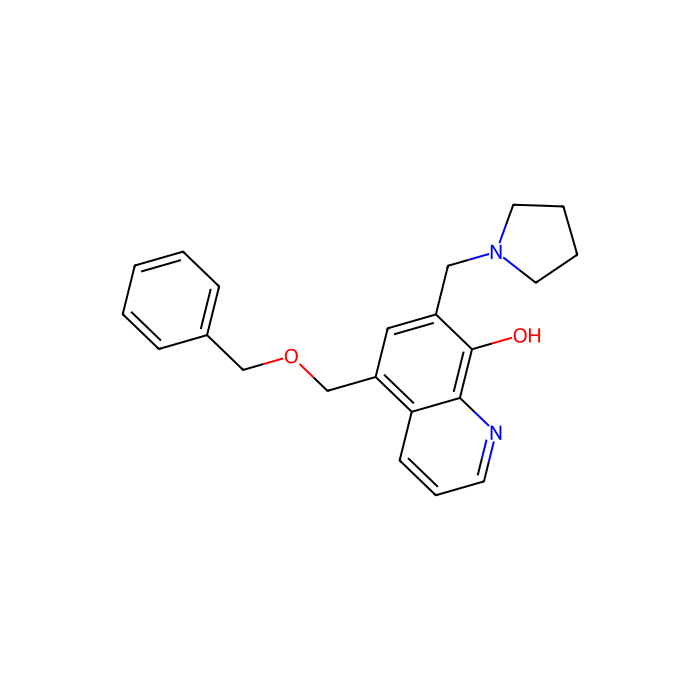
IAP inhibitor (IC50values from 0.7 - 3.4μM); inhibits cell growth in multiple cancer cell lines and in a melanoma xenograft modelin vivo. Also suppresses X-linked inhibitor of apoptosis protein (XIAP) and survivin levels. Inhibits the growth of P-glycopro
Condiciones de almacenamiento de almacenamiento
Store at -20°C
Enviado en
Ice chest + Ice pads
Este producto requiere envío en cadena de frío. Los servicios terrestres y otros servicios económicos no están disponibles.
This compound belongs to the class of organic compounds known as 8-hydroxyquinolines. These are compounds containing a quinoline moiety, which carries a hydroxy group at the 8-position. Quinoline consists of a benzene ring fused to a pyrimidine ring to form benzo[b]azabenzene.
External Descriptors
Not available
1. Djoumbou Feunang Y, Eisner R, Knox C, Chepelev L, Hastings J, Owen G, Fahy E, Steinbeck C, Subramanian S, Bolton E, Greiner R, and Wishart DS. ClassyFire: Automated Chemical Classification With A Comprehensive, Computable Taxonomy. Journal of Cheminformatics, 2016, 8:61.
Solvent:DMSO, Max Conc. mg/mL: 34.84, Max Conc. mM: 100
Peso molecular
348.400 g/mol
XLogP3
3.300
Hydrogen Bond Donor Count
1
Hydrogen Bond Acceptor Count
4
Rotatable Bond Count
6
Exact Mass
348.184 Da
Monoisotopic Mass
348.184 Da
Topological Polar Surface Area
45.600 Ų
Heavy Atom Count
26
Formal Charge
0
Complexity
420.000
Isotope Atom Count
0
Defined Atom Stereocenter Count
0
Undefined Atom Stereocenter Count
0
Defined Bond Stereocenter Count
0
Undefined Bond Stereocenter Count
0
The total count of all stereochemical bonds
0
Covalently-Bonded Unit Count
1
Calculadoras de soluciones
Molarity Calculator
Determine the necessary mass, volume, or concentration for preparing a solution.
Dilution Calculator
Determine the dilution needed to prepare a stock solution.
Reconstitution Calculator
Reseñas
Reseñas de cliente
Application Protocols
No vendor-validated protocols are provided for this item. The following is general guidance for handling small-molecule screening compounds; adapt to your assay and treat as non-binding, research-only guidance.
General small-molecule dosing (biochemical assay)
Prepare a 10 mM stock in anhydrous DMSO. If insoluble, reduce to 1–5 mM and/or gently warm and sonicate. Filter if necessary using a low-binding 0.2 µm PTFE filter.
Perform serial dilutions in DMSO to create a range (e.g., 10-point 3-fold). Transfer to assay buffer to achieve final DMSO ≤0.5% v/v.
Include vehicle-only controls at matching DMSO levels and positive/negative controls as appropriate.
Cell-based assays (general)
Verify tolerability of the final DMSO concentration for your cell line/model. Pre-screen for cytotoxicity of vehicle and matrix effects.
Consider adsorption and light sensitivity; use low-binding plates and protect from light if needed.
Documentation
Record lot, stock concentration, preparation date, diluent, and storage. Monitor for precipitation or color change; discard if visible degradation occurs.
Item-specific, tested applications and recommended dilutions: Not specified for this item; refer to CoA/Spec Sheet.
Biological Roles
Item-specific biological target(s), pathways, or modes of action for UC 112 are not provided in the Product Data.
Target specificity and mechanism: Not specified for this item; consult primary literature using CAS 383392-66-3 and PubChem CID 3426979 for peer-reviewed reports of biological activity, if any.
Use context: In compound libraries, such molecules are commonly employed as tool compounds or for hit/lead discovery. Users should independently confirm identity, purity, and activity under their assay conditions.
Experimental considerations (general): Verify that the vehicle (e.g., DMSO) does not exceed the tolerance of the model system. Include orthogonal assays to confirm on-target effects and to identify nuisance behaviors (aggregation, redox cycling, covalent reactivity, fluorescence interference).
Documentation: Record full experimental conditions (cosolvent %, plate type, incubation times, cell density or enzyme concentration) to ensure reproducibility and facilitate cross-study comparison.
No medical or clinical claims are made; for research use only.
Buffer Applications
This product is not a buffer reagent. However, when dosing small molecules into buffered systems for assays, the buffer composition can strongly influence apparent activity and solubility.
General guidance
Common assay buffers: HEPES, PBS, Tris, or MOPS adjusted to the optimal pH for the biological target. Maintain consistent ionic strength and include small amounts of non-ionic surfactant (e.g., 0.01–0.05% Tween 20) if precipitation or adsorption to plastics is observed.
DMSO carryover: Keep final DMSO at ≤0.5% v/v for most biochemical assays and ≤0.2–0.5% v/v for cell-based assays, unless justified otherwise. Always include vehicle controls.
Adsorption: Hydrophobic compounds may bind to polypropylene; precondition plasticware with assay buffer containing protein or surfactant where compatible.
Light sensitivity: If the compound is light-sensitive (unknown here), protect plates/tubes with foil or amber plastic during incubation.
Item-specific buffer compatibility: Not specified for this item; refer to CoA/Spec Sheet and pilot tests.
Green Alternatives
Because item-specific structure and solvent compatibility are not provided, the following guidance focuses on greener handling of small-molecule screening stocks rather than replacing the compound itself.
Greener solvent practices (general)
Prefer ethanol or water/ethanol cosolvent systems where compatible with solubility and assay biology. Pilot assess precipitation and assay interference vs. DMSO.
Minimize DMSO concentration in working assays; validate functionality at the lowest feasible percentage (e.g., 0.1–0.2% v/v).
Use micro-aliquoting (low-dead-volume tubes/plates) to reduce freeze–thaw waste and extend usable life, lowering overall solvent usage.
Comparison table (general)
DMSO: excellent solvency; common in screening; higher environmental and biological burden; hygroscopic and high boiling point complicates removal.
Ethanol: renewable feedstock, lower toxicity; may not dissolve very hydrophobic compounds; volatile and flammable.
PEG400/water: useful for some hydrophobes; viscous; assay-dependent compatibility.
Operational improvements
Implement plate sealing with low-permeation films to reduce DMSO evaporation and concentration drift.
Consider automation with acoustic dispensing to minimize solvent volumes and plastic waste.
Pharmaceutical Uses
No pharmacopeial status, excipient role, or formulation-specific information is provided for this item. This product is sold strictly for research use only.
General context
Screening and discovery: Such compounds are typically used in early-stage discovery research, assay development, or as reference comparators in non-clinical studies.
If formulation studies are conducted for research, standard preformulation assessments (solubility across pH, chemical stability in aqueous media, light/oxidative stability) should be performed. Clearly label all findings as research-only and non-clinical.
Item-specific pharmaceutical information: Not specified for this item; refer to CoA/Spec Sheet and primary literature.
Physical Properties
Item-specific physico-chemical specifications were not provided in the Product Data.
Appearance: Not specified for this item; refer to CoA/Spec Sheet.
Melting point: Not specified for this item; refer to CoA/Spec Sheet.
Boiling point: Not specified for this item; refer to CoA/Spec Sheet.
Density: Not specified for this item; refer to CoA/Spec Sheet.
Solubility: Not specified for this item; refer to CoA/Spec Sheet.
LogP, pKa, refractive index: Not specified for this item; refer to CoA/Spec Sheet.
General characterization guidance (literature/computed)
For small-molecule screening compounds, initial dissolution is commonly attempted in anhydrous DMSO at 10–50 mM; aqueous compatibility is then evaluated by serial dilution into assay buffer while monitoring for precipitation.
If the structure is retrieved via the provided CAS/CID, computed properties (cLogP, TPSA, HBD/HBA counts) from cheminformatics tools can inform expected solubility and permeability. Clearly label such values as calculated/literature and do not treat them as product specifications.
When preparing solutions, note and record any visible turbidity or oiling out during dilution; document final cosolvent percentage used in assays.
Quality and Grades
Grade/Purity: Not specified for this item; refer to CoA/Spec Sheet for assay purity, residual solvent profile, and analytical data.
How to interpret typical documentation (general guidance)
Analytical characterization for screening compounds commonly includes LC–MS purity (area % at a defined UV wavelength), 1H NMR identity, and, where relevant, HRMS. Some vendors provide HPLC chromatograms across multiple wavelengths to assess UV cleanliness for bioassays and plate-based readouts.
If stabilizers, salt forms, or polymorph information apply, they should appear on the CoA. Absence of such notes generally implies a neat free base/neutral form, but verify against documentation before use.
For assay-critical work (biochemical or cellular), consider performing in-house verification: orthogonal LC–MS purity check, NMR spot check, and a quick solubility/precipitation screen in the intended assay buffer at working concentrations.
Lot-to-lot considerations
Record lot number and replicate key pilot data when changing lots. If solubility is marginal, minor differences in form (hydrate/solvate) may affect handling; confirm against CoA notes.
Reaction and Applications
This product is categorized under a small-molecule/compound library and is generally used as a reference or screening compound rather than as a synthetic reagent.
Research use: For in vitro research and assay development only (per Research Use Note). No medical or clinical use is implied.
Typical applications (general): biochemical target screening, phenotypic screening, mechanistic probes in cell-free assays, and control experiments in method development. Specific mechanisms/targets are not provided for this item; consult literature via CAS 383392-66-3 or CID 3426979 for peer-reviewed application reports.
Practical tips: prepare a DMSO master stock, verify solubility at working concentrations, include vehicle controls matched to the final DMSO percentage, and monitor precipitation by light scattering or visual inspection during assay setup.
Documentation: record batch/lot, stock concentration, preparation date, diluent, and storage conditions on all aliquots. Archive any vendor-supplied analytical data alongside in-house verification results.
Not typically applicable
Named synthetic reactions, catalysts, or reagent roles are not typically relevant for library screening compounds unless the user intends to derivatize the scaffold; in that case, consult structural data first.
Reaction Conditions
Not typically applicable. UC 112 is provided as a screening/library compound and not as a reagent for chemical synthesis. No item-specific reaction conditions are provided.
General advice (only if user intends chemical transformations)
Solvents and temperatures should be selected based on the actual structure and functional groups retrieved via CAS 383392-66-3 or CID 3426979.
Begin with small-scale scouting experiments and monitor by LC–MS to assess stability and conversion. Protect from moisture/oxygen/light as indicated by functional group sensitivity.
For most users, see the sections on Solvent Selection and Storage & Reconstitution, which are the most relevant for handling in biological assays.
Safety and Handling
Hazard communication specific to this item was not provided. Always consult the product SDS for authoritative information.
GHS classification, pictograms, signal word, and H-statements: Not specified for this item; refer to SDS.
General lab PPE: lab coat, safety glasses, and appropriate chemically resistant gloves (e.g., nitrile). Work in a chemical fume hood to avoid inhalation exposure to dust/aerosols or solvent vapors.
Storage: Store at -20°C (per Product Data). Maintain desiccation and protect from light if the compound is light- or moisture-sensitive (verify via SDS/CoA). Keep container tightly closed.
Handling: Allow container to equilibrate to room temperature before opening to minimize moisture condensation. When making DMSO stocks, avoid repeated freeze–thaw cycles; aliquot as needed.
Incompatibilities: Without structure, specific incompatibilities cannot be stated; as a precaution avoid strong oxidizers and acids/bases until compatibility is confirmed from SDS.
First aid (general): In case of skin/eye contact, rinse with water for at least 15 minutes. If inhaled, move to fresh air. If swallowed, rinse mouth and seek medical advice. Provide SDS to medical personnel.
Waste: Dispose according to institutional chemical waste procedures; classify based on actual solvent/assay matrix used.
Solvent Selection
Item-specific solubility data are not provided. The following is general best practice for small-molecule screening compounds.
Primary dissolution: Start with anhydrous DMSO (analytical/anhydrous grade). Typical master stocks: 10 mM to 50 mM. If limited solubility is observed, gentle warming (≤40°C) and brief sonication can help; avoid prolonged heating.
Aqueous use: Dilute DMSO stocks into assay buffers with vigorous mixing to final DMSO ≤0.1–0.5% (biochemical) or ≤0.1–0.5% (cellular) unless assay tolerance allows higher; confirm tolerance empirically.
Alternative solvents (general): DMF or ethanol can be considered for primary dissolution if DMSO fails, followed by dilution into buffer with surfactant (e.g., 0.01–0.05% Tween 20) where compatible.
Polarity profile: Not specified for this item; consult literature properties (cLogP, TPSA) via the provided CAS/CID to predict solvent compatibility.
Comparison (general)
DMSO: highest success rate for initial dissolution; hygroscopic, can affect biological readouts at >1% v/v.
Ethanol: greener and volatile; lower solvating power for very lipophilic compounds; higher cell toxicity above ~1–2%.
DMF: strong solvent; less preferred biologically; use sparingly and ensure compatibility.
Storage and Reconstitution
Storage (as supplied): Store at -20°C (per Product Data). Keep tightly closed, preferably under inert atmosphere or with desiccant if moisture-sensitive. Protect from light if indicated by SDS/CoA.
Shipping: Shipped in an ice chest with ice pads (per Product Data). Inspect upon receipt; if warmed, re-equilibrate to -20°C promptly.
Reconstitution: Item-specific solvent is not provided. General practice for small molecules is to dissolve in anhydrous DMSO to prepare a concentrated stock (e.g., 10–50 mM), then aliquot and store at -20°C to avoid repeated freeze–thaw.
Working solutions: Prepare fresh on the day of use. Avoid prolonged storage in aqueous buffers unless stability is established. Document final cosolvent percentage.
Stability: Not specified for this item; refer to CoA/Spec Sheet. If no data are available, perform a small stability pilot (freeze–thaw tolerance, short-term bench stability, and light exposure) using LC–MS.
Research use: For research use only. Not for human or veterinary use.
Structure and Identity
Overview for SKU U288560 (UC 112). The structural identity details for this catalog item are limited in the provided Product Data; consult the CoA/Spec Sheet and primary literature for definitive structural information.
CAS: 383392-66-3 (as provided)
PubChem CID: 3426979 (as provided)
InChIKey: 208546 (as provided)
SMILES: Not specified for this item; refer to CoA/Spec Sheet.
Molecular formula: Not specified for this item; refer to CoA/Spec Sheet.
Molecular weight: Not specified for this item; refer to CoA/Spec Sheet.
Structural features
Item-specific functional groups, ring systems, and stereochemistry: Not specified for this item; refer to CoA/Spec Sheet.
General guidance (literature)
The CAS and CID listed can be used to retrieve the exact 2D/3D structure, functional groups, and stereochemical descriptors from public databases (e.g., PubChem) and to verify identity against analytical data (1H/13C NMR, HRMS, LC–MS).
For internal documentation, include: compound code (UC 112), CAS, CID, batch/lot, and any analytical spectra received with the shipment to ensure traceable identity.
Synthetic Utility
This item is offered as a small-molecule screening compound rather than a synthetic reagent or building block.
Functional group reactivity, protecting group strategies, and named reaction participation cannot be detailed without structural information. If derivatization or SAR exploration is intended, obtain the full structure via the provided CAS/CID and plan routes accordingly.
For synthetic modifications (general): verify compound stability to common conditions (acid/base, oxidation/reduction) and confirm that the purchased lot is the desired form (free base, salt, or specific polymorph) before attempting transformations.
Item-specific synthetic roles: Not specified for this item; refer to CoA/Spec Sheet.
Target Specificity
Target, pathway, and species selectivity information are not provided for this item.
Item-specific target(s): Not specified for this item; refer to CoA/Spec Sheet and peer-reviewed literature based on CAS 383392-66-3 or CID 3426979.
Cross-reactivity, off-targets, and potency metrics (IC50, Ki, EC50): Not specified for this item; must be derived from independent studies and are not product specifications.
For research use only; no medical or diagnostic claims are made.
Preguntas frecuentes
What is the purity of this product, and how is it determined?
This product is supplied at ≥98% purity, determined by HPLC. Lot-specific values are stated on the Certificate of Analysis.
How should this product be stored?
Store at ?20 °C. Freezer storage is required to maintain the specified shelf life.
How is this product shipped?
This product ships in an insulated container with ice pads. Unpack on arrival and transfer it to the storage condition stated above.
What are the CAS number, molecular formula and molecular weight?
The CAS Number is 383392-66-3, the molecular formula is C??H??N?O?, and the molecular weight is 348.44 g/mol. InChIKey LTGLGIQQZXSLLF-UHFFFAOYSA-N.
What documentation is provided?
Available product documentation, including Certificates of Analysis (COA), Safety Data Sheets (SDS), and specification sheets, is shown in the product document area. Document availability and access follow the current site policy.
Utilizamos cookies para garantizar el correcto funcionamiento del sitio web y, cuando esté permitido, para mejorar su experiencia. Puede gestionar sus preferencias en cualquier momento en Configuración. Más información en nuestra Política de Cookies.
¿Quieres que te enviemos un mensaje cuando tengamos descuentos disponibles?
Recordármelo más tarde
¡Gracias! Por favor, revisa tu bandeja de entrada de correo electrónico para confirmar.
Products are supplied to verified businesses, institutions, and qualified professionals for research and development use only. Not for use in humans, animals, diagnosis, or therapy.

 C2625077