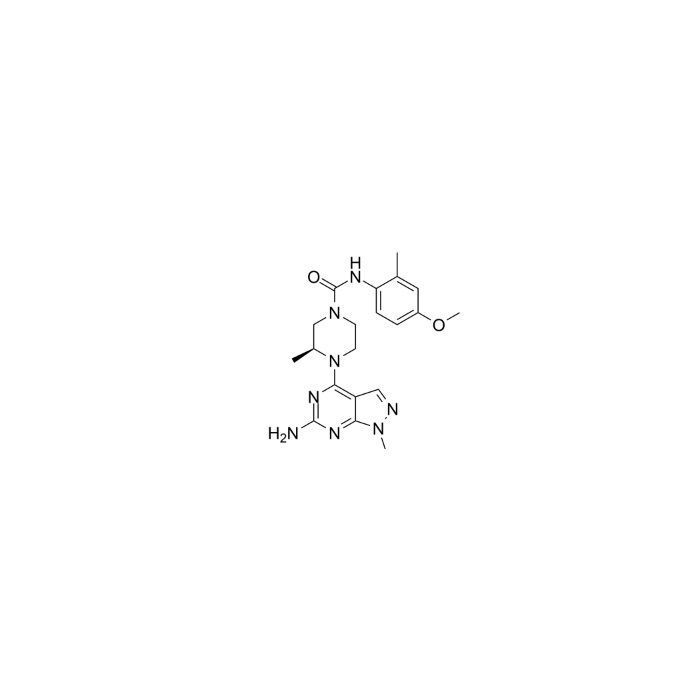
 I2604743
Determine the necessary mass, volume, or concentration for preparing a solution.
| Activity Type | Activity Value -log(M) | Mechanism of Action | Activity Reference | Publications (PubMed IDs) |
|---|

Moligand™,≥98% Moligand™ para flujos de trabajo cromatográficos y analíticos sensibles que requieren una interferencia mínima de la línea base.
Protected from light,Store at -20°C,Argon charged Envío Ice chest + Ice pads. Consulte el COA específico del lote para conocer las especificaciones exactas.
SDS, COA, ficha técnica y hoja de especificaciones disponibles para descargar. COA específico del lote accesible mediante búsqueda por número de lote.
Citado en 0 publicaciones revisadas por pares sobre cromatografía, síntesis orgánica y reacciones de acoplamiento cruzado.
Documento completo sobre peligros, manipulación, almacenamiento y cumplimiento normativo.
<<<<<<< HEAD Descargar SDS → ======= Descargar SDS → >>>>>>> release248-p3Datos de calidad específicos del lote. Introduzca su número de lote para obtener el COA exacto.
Buscar COA →Resumen de referencia rápida de las especificaciones y aplicaciones del producto.
Ver ficha técnica →Atributos de calidad completos y criterios de aceptación para esta calidad.
Ver hoja de especificaciones →Taxonomy Tree
| Kingdom | Organic compounds |
|---|---|
| Superclass | Organoheterocyclic compounds |
| Clase | Diazinanes |
| Subclass | Piperazines |
| Intermediate Tree Nodes | Not available |
| Direct Parent | N-arylpiperazines |
| Alternative Parents | N-phenylureas Methoxyanilines Pyrazolo[3,4-d]pyrimidines Piperazine carboxamides Anisoles Dialkylarylamines Methoxybenzenes Phenoxy compounds Toluenes Alkyl aryl ethers Aminopyrimidines and derivatives Imidolactams Heteroaromatic compounds Pyrazoles Ureas Azacyclic compounds Hydrocarbon derivatives Carbonyl compounds Organic oxides Primary amines |
| Molecular Framework | Aromatic heteropolycyclic compounds |
| Substituents | N-arylpiperazine - N-phenylurea - Pyrazolo[3,4-d]pyrimidine - Piperazine-1-carboxamide - Methoxyaniline - Pyrazolopyrimidine - Phenoxy compound - Anisole - Phenol ether - Methoxybenzene - Dialkylarylamine - Alkyl aryl ether - Aminopyrimidine - Toluene - Monocyclic benzene moiety - Imidolactam - Pyrimidine - Benzenoid - Pyrazole - Heteroaromatic compound - Azole - Urea - Azacycle - Ether - Primary amine - Organooxygen compound - Organonitrogen compound - Hydrocarbon derivative - Carbonyl group - Organic nitrogen compound - Amine - Organic oxygen compound - Organic oxide - Aromatic heteropolycyclic compound |
| Descripción | This compound belongs to the class of organic compounds known as n-arylpiperazines. These are organic compounds containing a piperazine ring where the nitrogen ring atom carries an aryl group. |
| External Descriptors | Not available |
| Activity Type | Activity Value -log(M) | Mechanism of Action | Activity Reference | Publications (PubMed IDs) |
|---|
| Activity Type | Relation | Activity value | Units | Action Type | Journal | PubMed Id | doi | Assay Aladdin ID |
|---|
| Activity Type | Relation | Activity value | Units | Action Type | Journal | PubMed Id | doi | Assay Aladdin ID |
|---|
| Activity Type | Relation | Activity value | Units | Action Type | Journal | PubMed Id | doi | Assay Aladdin ID |
|---|
| Activity Type | Relation | Activity value | Units | Action Type | Journal | PubMed Id | doi | Assay Aladdin ID |
|---|
| Activity Type | Relation | Activity value | Units | Action Type | Journal | PubMed Id | doi | Assay Aladdin ID |
|---|
| Activity Type | Relation | Activity value | Units | Action Type | Journal | PubMed Id | doi | Assay Aladdin ID |
|---|
| Activity Type | Relation | Activity value | Units | Action Type | Journal | PubMed Id | doi | Assay Aladdin ID |
|---|
| Activity Type | Relation | Activity value | Units | Action Type | Journal | PubMed Id | doi | Assay Aladdin ID |
|---|
| Solubilidad | Solubility (25°C) In vitro DMSO: 82 mg/mL (199.77 mM); Water: Insoluble; Ethanol: Insoluble; |
|---|---|
| Sensibilidad | air sensitive |
| Peso molecular | 410.500 g/mol |
| XLogP3 | 1.700 |
| Hydrogen Bond Donor Count | 2 |
| Hydrogen Bond Acceptor Count | 7 |
| Rotatable Bond Count | 3 |
| Exact Mass | 410.218 Da |
| Monoisotopic Mass | 410.218 Da |
| Topological Polar Surface Area | 114.000 Ų |
| Heavy Atom Count | 30 |
| Formal Charge | 0 |
| Complexity | 609.000 |
| Isotope Atom Count | 0 |
| Defined Atom Stereocenter Count | 1 |
| Undefined Atom Stereocenter Count | 0 |
| Defined Bond Stereocenter Count | 0 |
| Undefined Bond Stereocenter Count | 0 |
| The total count of all stereochemical bonds | 0 |
| Covalently-Bonded Unit Count | 1 |
No tested applications or recommended protocols are provided for this item.
General assay handling protocol (non-item-specific example for small molecules):
For any specific protocol (WB, IF, IHC, FC, enzymatic assays, binding assays), consult internal SOPs and adapt based on your target biology. No item-specific conditions are provided here.
No biological function, target, or pathway annotation is provided for UCB9608 in the Product Data. As supplied, it is a research-use-only small molecule intended for screening and discovery.
General considerations for small-molecule library members:
Assay design tips (general):
For any claim of biological activity, rely on your internal data, peer-reviewed literature tied to the exact CAS/CID, and the lot-specific CoA. No biological roles are specified for this item.
This product is a discrete small-molecule library member and is not a buffering agent. Accordingly, it has no standard role in preparing biochemical buffers.
Practical notes for assay buffers (general):
For buffer recipes, pH ranges, and ionic strengths, refer to standard buffering systems (PBS, HEPES, Tris, MOPS) relevant to your assay; none are specific to this item.
As UCB9608 is a discrete small-molecule library member rather than a commodity solvent or reagent, “green substitution” typically pertains to its handling solvents and workflows rather than replacement of the compound itself.
Greener handling considerations (general guidance):
Illustrative solvent comparison (general, not item-specific):
Because compound-specific environmental fate and hazard data are not provided, users should follow institutional green-chemistry policies and consult the SDS for disposal and hazard classification.
No excipient or manufacturing role is provided for this item. UCB9608 is supplied for research use only and is not intended for clinical, diagnostic, or therapeutic applications.
Context for discovery workflows (general):
Item-specific notes:
Only item-specific facts from Product Data are listed; no physicochemical constants were provided for this compound.
Practical considerations (general guidance for library compounds):
Note: Where precise physical constants are required for experimental design (e.g., extinction coefficients, solubility limits), consult the lot-specific CoA/Spec Sheet or contact technical support with the CAS and SKU.
What Moligand-grade typically implies (general information):
Relevance of provided handling/packaging:
Best practices for quality verification (user-side):
All item-specific numerical specifications (purity %, residuals, water content, UV cutoff, etc.) are Not specified for this item; refer to CoA/Spec Sheet.
This product is presented as a Moligand small-molecule library member intended for research and screening rather than as a synthetic reagent. Consequently, classical synthetic “reaction applications” (e.g., as a base, catalyst, coupling partner) are not typically applicable without structural disclosure.
Potential research applications (general, non-item-specific):
Practical tips for assay deployment:
Because no mode-of-action or target annotation is provided, end users should perform their own in-house profiling (biochemical, cellular, off-target panels) to contextualize activity. For any synthetic transformations using this compound as a substrate or intermediate, consult the structure and apply standard condition scouting; no item-specific reactivity can be inferred here.
Typical reaction conditions are not applicable here because UCB9608 is offered as a research screening small molecule, not as a reagent or catalyst. No item-specific data on reactivity, catalytic use, or transformation conditions are provided.
If you intend to subject UCB9608 to chemical transformations:
No general yields, temperatures, or catalysts can be responsibly recommended without structural information. Defer to primary literature for the exact CAS/CID once confirmed.
Hazard data are not provided in the Product Data for this item; always consult the SDS for the authoritative, up-to-date safety profile.
General laboratory precautions for small-molecule research reagents:
Note: This product is for research use only. No assessment for food, drug, cosmetic, or household use is implied.
Given the absence of disclosed structure/solubility data, the following guidance reflects common practice for small-molecule screening compounds rather than item-specific specifications.
When to choose alternatives:
Note: No item-specific solvent or solubility data were provided; verify empirically and consult the CoA/Spec Sheet.
Item-specific storage/handling from Product Data:
Recommended practices (general, aligned with item-specific guidance):
Note: This product is for research use only. Dispose of any unused material and waste according to institutional and regulatory requirements.
Brief overview: UCB9608 is listed as a small-molecule library member under the Moligand grade. Item-specific structural identifiers are largely not provided in the product data.
Structural features (general note):
2D structure description (general):
Identity confirmation practices (general guidance):
Because the structure and functional groups of UCB9608 are not provided in the Product Data, specific synthetic transformations, reactivity patterns, and named-reaction participation cannot be detailed for this item.
General guidance if using as a synthetic intermediate (user-determined):
Analytical control:
Without the structural disclosure, no further synthetic utility claims can be made. Please consult the CoA/Spec Sheet or request structural information before planning synthetic chemistry involving this compound.
No target, pathway, enzyme, receptor, or organism specificity is provided for UCB9608 in the Product Data.
Users should establish target engagement using appropriate biochemical/biophysical assays (e.g., ITC, SPR, DSF, CETSA) and confirm functional effects in cellular models with orthogonal methods. No claims of specificity can be made from the current data.
Nuestra guía de selección de calidades cubre la pureza, el estado del estabilizador y la idoneidad de la aplicación para todas las variantes de nuestro catálogo.
Ver la guía de calidades Moligand™ →