
Determine the necessary mass, volume, or concentration for preparing a solution.
| Activity Type | Relation | Activity value | Units | Action Type | Journal | PubMed Id | doi | Assay Aladdin ID |
|---|
Moligand™,≥98% Moligand™ for sensitive chromatographic and analytical workflows requiring minimal baseline interference.
Store at -20°C,Argon charged Ships Ice chest + Ice pads Check lot-specific COA for exact specifications.
SDS, COA, datasheet, and spec sheet available for download. Lot-specific COA accessible via lot number lookup.
Cited in 0 peer-reviewed publications across chromatography, organic synthesis, and cross-coupling reactions.
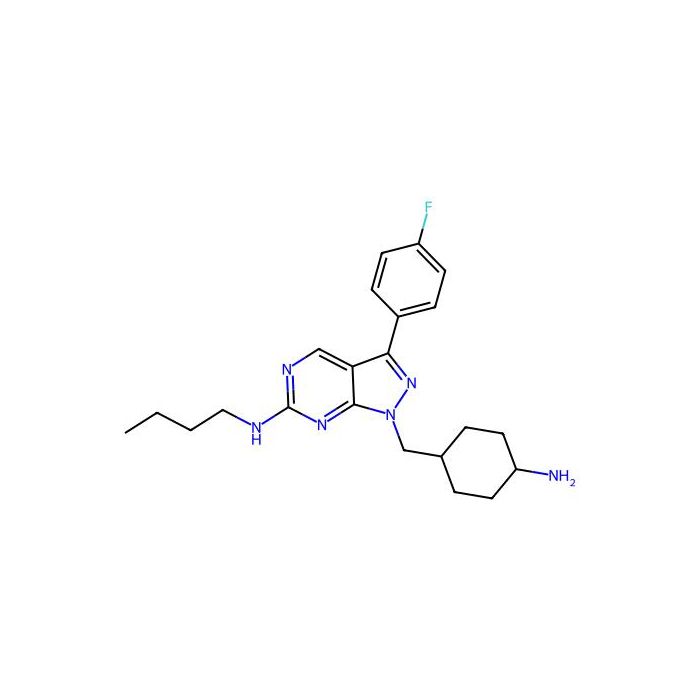
UNC569 is a potent, reversible, ATP-competitive and orally active Mer kinase inhibitor with an IC 50 of 2.9 nM and a K i of 4.3 nM. UNC569 also inhibits Axl and Tyro3 with IC 50 s of 37 nM and 48 nM, respectively. UNC569 can be used for acute lymphoblastic leukemia (ALL) and atypical teratoid/rhabdoid tumors research
In Vitro
UNC569 (24 hours) induces apoptosis in ALL cell lines, and increases the levels of cleaved Caspase 3 and cleaved PARP. UNC569 (1 µM; 1.5 hours) treatment effectively inhibit the activation of Mer and downstream signaling, including the PI3K/AKT and MAPK/ERK pathways. UNC569 (1 hour) inhibits Mer phosphorylation levels with IC50 values of 141 nM and 193 nM in human B-ALL (acute lymphoblastic leukemia) 697 and Jurkat cell lines, respectively . MCE has not independently confirmed the accuracy of these methods. They are for reference only. Apoptosis AnalysisCell Line: 697 and Jurkat cells Concentration: 0.4 µM, 0.8 µM, 1 µM, 1.2 µM, 1.4 µM, 1.6 µM, 1.8 µM, 2 µM Incubation Time: 24 hours Result: Induced apoptosis in ALL cell lines. Western Blot AnalysisCell Line: 697 and Jurkat cells Concentration: 1 µM Incubation Time: 1.5 hours Result: Inhibited Mer activation and downstream signaling through ERK1/2 and AKT.
In Vivo
The in vivo pharmacokinetic properties of UNC569 (3 mg/kg) are also assessed in mice via both intravenous (IV) and oral (PO) administration. UNC569 has low systemic clearance (19.5 mL/min/kg), high volume of distribution (V ss of 5.83 L/kg), and good oral bioavailability (57%) . Leukemic zebrafish are treated continuously for 2 weeks by immersion in 4 µM UNC569. the result shows that UNC569 induces more than 50% reduction in tumor burden compared with vehicle- and mock-treated fish. MCE has not independently confirmed the accuracy of these methods. They are for reference only.
Form:Solid
IC50& Target:IC50: 2.9 nM (Mer), 37 nM (Axl), 48 nM (Tyro3), Ki: 4.3 nM (Mer)
| Sonrisas canónicas | CCCCNC1=NC=C2C(=NN(C2=N1)CC3CCC(CC3)N)C4=CC=C(C=C4)F |
|---|---|
| IUPAC Name | 1-[(4-aminocyclohexyl)methyl]-N-butyl-3-(4-fluorophenyl)pyrazolo[3,4-d]pyrimidin-6-amine |
| InChIKey | OGEBRHQLRGFBNV-UHFFFAOYSA-N |
| INCHI | 1S/C22H29FN6/c1-2-3-12-25-22-26-13-19-20(16-6-8-17(23)9-7-16)28-29(21(19)27-22)14-15-4-10-18(24)11-5-15/h6-9,13,15,18H,2-5,10-12,14,24H2,1H3,(H,25,26,27) |
| Isómeros SMILES | CCCCNC1=NC=C2C(=NN(C2=N1)CC3CCC(CC3)N)C4=CC=C(C=C4)F |
| PubChem CID | 53355503 |
| Términos de entrada MeSH | UNC569 |
| Peso molecular | 396.50 |
Comprehensive hazard, handling, storage, and regulatory compliance document.
Download SDS →Lot-specific quality data. Enter your lot number to retrieve the exact COA.
Look up COA →Full quality attributes and acceptance criteria for this grade.
View spec sheet →Taxonomy Tree
| Kingdom | Organic compounds |
|---|---|
| Superclass | Organoheterocyclic compounds |
| Clase | Azoles |
| Subclass | Pyrazoles |
| Intermediate Tree Nodes | Not available |
| Direct Parent | Phenylpyrazoles |
| Alternative Parents | Pyrazolo[3,4-d]pyrimidines Fluorobenzenes Cyclohexylamines Aminopyrimidines and derivatives Aryl fluorides Heteroaromatic compounds Azacyclic compounds Organofluorides Monoalkylamines Hydrocarbon derivatives |
| Molecular Framework | Aromatic heteropolycyclic compounds |
| Substituents | Phenylpyrazole - Pyrazolo[3,4-d]pyrimidine - Pyrazolopyrimidine - Aminopyrimidine - Cyclohexylamine - Fluorobenzene - Halobenzene - Aryl fluoride - Aryl halide - Monocyclic benzene moiety - Benzenoid - Pyrimidine - Heteroaromatic compound - Azacycle - Organohalogen compound - Primary aliphatic amine - Hydrocarbon derivative - Organofluoride - Organonitrogen compound - Amine - Primary amine - Organic nitrogen compound - Aromatic heteropolycyclic compound |
| Descripción | This compound belongs to the class of organic compounds known as phenylpyrazoles. These are compounds containing a phenylpyrazole skeleton, which consists of a pyrazole bound to a phenyl group. |
| External Descriptors | Not available |
| Activity Type | Relation | Activity value | Units | Action Type | Journal | PubMed Id | doi | Assay Aladdin ID |
|---|
| Activity Type | Relation | Activity value | Units | Action Type | Journal | PubMed Id | doi | Assay Aladdin ID |
|---|
| Activity Type | Relation | Activity value | Units | Action Type | Journal | PubMed Id | doi | Assay Aladdin ID |
|---|
| Activity Type | Relation | Activity value | Units | Action Type | Journal | PubMed Id | doi | Assay Aladdin ID |
|---|
| Activity Type | Relation | Activity value | Units | Action Type | Journal | PubMed Id | doi | Assay Aladdin ID |
|---|
| Activity Type | Relation | Activity value | Units | Action Type | Journal | PubMed Id | doi | Assay Aladdin ID |
|---|
| Solubilidad | DMSO : 31.25 mg/mL (78.81 mM; Need ultrasonic) |
|---|---|
| Sensibilidad | light sensitive |
| Peso molecular | 396.500 g/mol |
| XLogP3 | 4.000 |
| Hydrogen Bond Donor Count | 2 |
| Hydrogen Bond Acceptor Count | 6 |
| Rotatable Bond Count | 7 |
| Exact Mass | 396.244 Da |
| Monoisotopic Mass | 396.244 Da |
| Topological Polar Surface Area | 81.700 Ų |
| Heavy Atom Count | 29 |
| Formal Charge | 0 |
| Complexity | 492.000 |
| Isotope Atom Count | 0 |
| Defined Atom Stereocenter Count | 0 |
| Undefined Atom Stereocenter Count | 0 |
| Defined Bond Stereocenter Count | 0 |
| Undefined Bond Stereocenter Count | 0 |
| The total count of all stereochemical bonds | 0 |
| Covalently-Bonded Unit Count | 1 |
Our grade selection guide covers purity, stabilizer status, and application suitability for all variants in our catalog.
View Moligand™ grade guide →