Determine the necessary mass, volume, or concentration for preparing a solution.
Dilution Calculator
Determine the dilution needed to prepare a stock solution.
Reconstitution Calculator
Reseñas
Reseñas de cliente
Application Protocols
No tested application protocols are specified for this item. Typical research uses (general guidance):
Stock preparation
Dissolve in sterile water or buffer to desired molarity; or prepare concentrated DMSO stocks (e.g., 100–500 mM) and dilute into assay media.
Filter-sterilize (0.22 μm) if sterility is required. Prepare single-use aliquots.
Biochemical assays
Use UV absorbance near 260–262 nm for quantification; confirm extinction coefficient for your conditions.
Synthesis
Follow literature protocols in the Reaction Conditions and Synthetic Utility sections.
For any validated, product-specific protocols or recommended dilutions, refer to the CoA/Spec Sheet.
Biological Roles
Literature overview of uridine biology (no medical claims):
Fundamental role
Uridine is a canonical ribonucleoside of RNA; incorporation occurs as UMP within polynucleotide chains.
Metabolic pathways
Salvage: Uridine is phosphorylated by uridine–cytidine kinases to UMP, then to UDP and UTP. UTP serves as a substrate for RNA polymerases and for sugar activation.
Glycobiology: UDP-sugars (e.g., UDP-glucose, UDP-galactose, UDP-N-acetylhexosamines) derive from UTP and drive glycosyltransferase reactions underpinning glycoconjugate assembly.
Nucleotide interconversion: UTP participates in CTP synthesis via CTP synthetase; UMP ⇄ dUMP connects to thymidylate biosynthesis.
UV absorbance typical of pyrimidines (λmax ~260–262 nm) allows spectrophotometric tracking of reactions and quantification (literature).
These biological roles are provided for context in research planning. Use in any biological system should follow appropriate approvals and safety protocols. This product is supplied strictly for laboratory research use only.
Buffer Applications
Uridine is not a buffering agent and does not constitute a standard buffer system. However, practical notes for using uridine in buffered solutions:
Dissolution: Dissolve in neutral aqueous buffers (e.g., PBS, HEPES, Tris at pH ~7–7.5). Gentle warming and vortexing/sonication aid dissolution.
pH considerations: Extreme pH can promote degradation (acid/base-catalyzed glycosidic cleavage). Maintain near-neutral pH for stability.
Sterility: For cell-related work, filter-sterilize solutions (0.22 μm) after dissolution and prepare single-use aliquots to minimize contamination.
For actual buffer capacity or recipes, refer to dedicated buffer systems (e.g., phosphate, HEPES), not uridine.
Green Alternatives
While uridine itself is the substrate, greener choices can be made for solvents and reagents used around it.
Greener solvent choices (literature/general)
Replace DMF/DMAc/NMP with water/ethanol mixtures where feasible (e.g., enzymatic transformations, crystallizations).
For certain protections/couplings, 2-MeTHF or CPME may substitute for dichloromethane/THF, subject to solubility and reactivity.
Process-intensification options
Biocatalytic transglycosylation and kinase-mediated phosphorylation often proceed in aqueous media at ambient temperature, reducing solvent and energy use.
Trade-offs
Green solvents can lower substrate solubility, lengthening reaction times. Phase-transfer strategies or minimal co-solvent DMSO may be needed.
Comparison (general guidance; not item-specific specs)
Conventional: DMF, pyridine, CH2Cl2; high solubility and established protocols, but higher EHS burden.
Greener: water/EtOH, 2-MeTHF, enzymatic methods; improved EHS profile, but may require method reoptimization and enzyme sourcing.
Recommendation: For analytical/sample preparation, prioritize aqueous buffers. For synthesis, screen greener solvent systems early, especially for protection/deprotection and crystallization steps.
Pharmaceutical Uses
No therapeutic or clinical claims are made for this product. The following relate to formulation/manufacturing contexts in general literature:
Possible roles (general)
Process reagent or component in fermentation/cell culture media where nucleosides are supplemented for metabolic studies.
Analytical reference standard in QC methods monitoring pyrimidine nucleosides or nucleotide-related impurities.
Compendial status
Some nucleosides appear in pharmacopeial monographs or reference materials; item-specific pharmacopeial compliance is Not specified for this item; refer to CoA/Spec Sheet.
Formulation notes
Highly hydrophilic; best handled in aqueous vehicles or as DMSO concentrates diluted into water-based systems.
Avoid extreme pH to limit degradation.
Any use in manufacturing or clinical settings requires appropriate regulatory qualification and is outside the scope of this research-use-only product.
Physical Properties
Only literature/general physicochemical information is provided here; these are NOT item-specific specifications.
Phase/appearance: Typically a white to off-white crystalline solid (literature). Item-specific appearance: Not specified for this item; refer to CoA/Spec Sheet.
Melting point: ~165–170 °C, reported to darken/decompose on further heating (literature).
Boiling point: Not applicable; decomposes before boiling (literature).
Molecular weight: ~244.20 g/mol (literature for uridine base form).
Solubility (literature)
Water: good aqueous solubility; readily soluble in hot water and common biological buffers. Exact value varies with temperature and ionic strength.
Alcohols: sparingly soluble in ethanol/methanol; enhanced solubility in aqueous alcohols.
DMSO: soluble; frequently used to prepare concentrated stock solutions for biochemical work.
Practically insoluble in nonpolar solvents (e.g., diethyl ether, hexanes).
pKa (literature): the acidic imide N3 has pKa in the ~9–10 range; the ribose hydroxyls are non-ionizing under neutral conditions.
Optical rotation: nucleoside solutions can exhibit modest levorotation depending on solvent/concentration; item-specific value not provided.
Refractive index/density: Not typically reported for solids of this class.
Notes: Values above are typical literature ranges for uridine and should be used as guidance only. For lot-specific specifications, consult the CoA/Specification Sheet.
Quality and Grades
Grade/purity: Not specified for this item; refer to CoA/Spec Sheet for assay, residual solvents, and related nucleoside impurities.
What “research use only” implies
Material is intended for laboratory R&D, method development, reference use, or synthesis. It is not manufactured for human or veterinary use, diagnostics, or therapeutic applications.
Typical quality considerations for uridine (general)
Identity: confirmed by 1H/13C NMR, MS, and chromatographic purity (HPLC/UPLC). UV spectrum with λmax near ~262 nm is common for pyrimidine nucleosides (literature), but do not treat as a spec.
Related substances: may include cytidine/uridine isomers, 2′,3′-isouridine, or uracil; controlled by gradient HPLC.
Water content: Karl Fischer often reported for hygroscopic solids; Not specified for this item.
Bioburden/endotoxin: If relevant to your workflow, request additional testing documentation.
Stabilizers/additives: None indicated for this listing; Not specified for this item.
Documentation
For precise acceptance criteria, refer to the product’s CoA/Specification Sheet. Lot-specific data supersede any general/literature values.
Reaction and Applications
This nucleoside is used broadly in biochemistry and synthetic chemistry.
Biochemical applications (general)
Substrate and precursor in pyrimidine salvage pathways: phosphorylation to UMP/UDP/UTP by uridine kinases (literature).
Supplement in enzymology and metabolism studies involving UDP-sugars and glycoconjugate biosynthesis.
Synthetic/chemical applications (literature)
Protecting-group manipulations: selective protection of 5′-OH (e.g., DMT), or 2′,3′-diols (e.g., acetonide, silyl such as TBDMS/TBS) to control reactivity.
5-Position functionalization on uracil (electrophilic substitution via halogenation at C5 followed by cross-coupling) to access modified uridines.
Phosphorylations: formation of 5′-monophosphate/di-/triphosphates (e.g., Ludwig–Eckstein method) for nucleotide synthesis.
Glycosylation/transglycosylation: enzymatic or Vorbrüggen-type approaches when constructing nucleoside analogs.
Practical tips
Use anhydrous polar aprotic solvents (DMF/DMAc/NMP) for silylations and acylations; include molecular sieves.
Monitor reactions by HPLC or TLC using mixed eluents (e.g., CH2Cl2/MeOH with NH3 modifier) due to strong adsorption and polarity.
For C5 cross-couplings, prefunctionalize to 5-iodo- or 5-bromo-uridine to enable Suzuki/Sonogashira under mild conditions.
Reaction Conditions
General literature guidance for common uridine transformations (for planning purposes; optimize for your system):
5′-O-DMT protection
Reagents: 4,4′-dimethoxytrityl chloride (DMT-Cl), pyridine or CH2Cl2/pyridine, catalytic DMAP.
Conditions: 0–25 °C, 1–4 h; monitor by TLC/HPLC. Quench with MeOH; workup to remove trityl cation.
2′,3′-O-acetonide formation
Reagents: 2,2-dimethoxypropane, catalytic acid (e.g., p-TsOH) in acetone or MeCN.
Conditions: ambient to 40 °C; remove acid promptly to avoid glycosidic cleavage.
Silylation (TBDMS/TBS)
Reagents: TBDMS-Cl (or TBS-Cl), imidazole in dry DMF.
Conditions: RT to 60 °C, several hours; molecular sieves recommended. Selectivity tuned via stoichiometry/temperature.
5-Position halogenation
Reagents: NBS/NIS or Br2/I2 under controlled conditions in DMF/AcOH.
Conditions: 0–25 °C; protect ribose hydroxyls to prevent side reactions.
Phosphorylation (5′-monophosphate)
Reagents: POCl3 in trimethyl phosphate (TMP) or phosphoramidite routes.
Conditions: 0–5 °C to RT; careful quench; subsequent neutralization and ion-exchange purification.
Conditions: anhydrous polar aprotic solvents; low temperature initiation then warm to RT; ion-exchange (DEAE) purification.
Analytical control: Use HPLC with UV at ~260–262 nm for monitoring (literature). Adjust eluents with volatile buffers (e.g., ammonium acetate) for MS compatibility.
Safety and Handling
Item-specific GHS details were not provided. Always consult the product SDS for authoritative safety information and local compliance.
GHS/Classification (item-specific): Not specified for this item; refer to SDS.
General hazards (literature/typical for nucleosides)
Low acute toxicity is generally reported for ribonucleosides; however, avoid inhalation/ingestion and contact with eyes/skin.
Dust may irritate respiratory tract and eyes.
Recommended PPE and engineering controls
Wear lab coat, safety glasses, and appropriate gloves (e.g., nitrile). Handle powders in a fume hood or ventilated enclosure to avoid dust exposure.
Use clean, dry tools to prevent contamination of material intended for biochemical assays.
Handling practices
Hygroscopicity: nucleosides can absorb moisture; minimize exposure to ambient humidity and cap containers promptly.
Prepare aqueous/DMSO stocks with sterile, filtered solvents if using in cell-free or cell-based workflows.
Incompatibilities
Strong oxidizers and strong acids/bases may cause degradation (ring opening or glycosidic bond cleavage under harsh conditions).
First-aid (general)
Inhalation: move to fresh air; seek medical attention if symptoms persist.
Skin/eyes: rinse with water for several minutes; remove contaminated clothing; obtain medical advice if irritation continues.
Ingestion: rinse mouth; do not induce vomiting; seek medical advice.
Storage risk controls
Follow storage guidance below (−80 °C for this item). Avoid repeated freeze–thaw and moisture ingress.
Solvent Selection
Uridine is a highly polar, hydrogen-bonding nucleoside. Solvent choice depends on the application (biochemical assay vs. chemical derivatization).
Aqueous/biological contexts
Water, PBS, Tris, HEPES: preferred for biochemical and cell-based assays. Warm slightly and vortex/sonicate to speed dissolution. Filter-sterilize through 0.22 μm when sterility is required.
Aqueous alcohols (water–methanol/ethanol): improve wetting/solubility for stock preparation but consider effects on biological systems.
Organic media for synthesis
DMSO, DMF, DMAc, NMP: dissolve uridine for derivatization and coupling chemistry; dry (molecular sieves) to protect moisture-sensitive reagents.
Pyridine or CH2Cl2/pyridine: commonly used for protecting group chemistry (e.g., DMT, acylations) in nucleoside synthesis.
Miscibility/polarity (literature/general)
Insufficient solubility in nonpolar solvents (hexanes, ethers); use as antisolvents for crystallization.
When to choose alternatives
For greener processing, consider water/ethanol or 2-MeTHF in steps where solubility and reaction compatibility allow.
Practical tips
pH can affect stability (acid/base-catalyzed glycosidic cleavage at extremes). Maintain near-neutral pH for storage/handling.
For high-concentration stocks, DMSO is often the most practical solvent; dilute into aqueous media just prior to use.
Storage and Reconstitution
Storage conditions (item-specific)
Store at −80 °C.
Shipped on dry ice packs + cold packs to maintain low temperature during transit.
Handling after receipt
Allow container to equilibrate to room temperature in a desiccator before opening to minimize moisture condensation.
Minimize time at ambient conditions; promptly recap under dry air or nitrogen if possible.
Reconstitution (general guidance)
Aqueous: Dissolve in sterile water or buffer (neutral pH). Gentle warming and vortexing/sonication aid dissolution.
Organic: For high-concentration stocks, dissolve in DMSO; dilute into aqueous media immediately before use.
Sterile work: Filter-sterilize solutions (0.22 μm) and prepare aliquots for single use.
Storage of solutions
Short term (days to a week): 2–8 °C, protected from light.
Long term: aliquot and store at −20 to −80 °C; avoid repeated freeze–thaw cycles.
Stability is pH- and temperature-dependent; extreme pH accelerates degradation.
Specifications
Appearance, purity, water content, and other lot-specific parameters: Not specified for this item; refer to CoA/Spec Sheet.
Always follow your institution’s SOPs and consult the SDS for detailed storage and handling precautions.
Structure and Identity
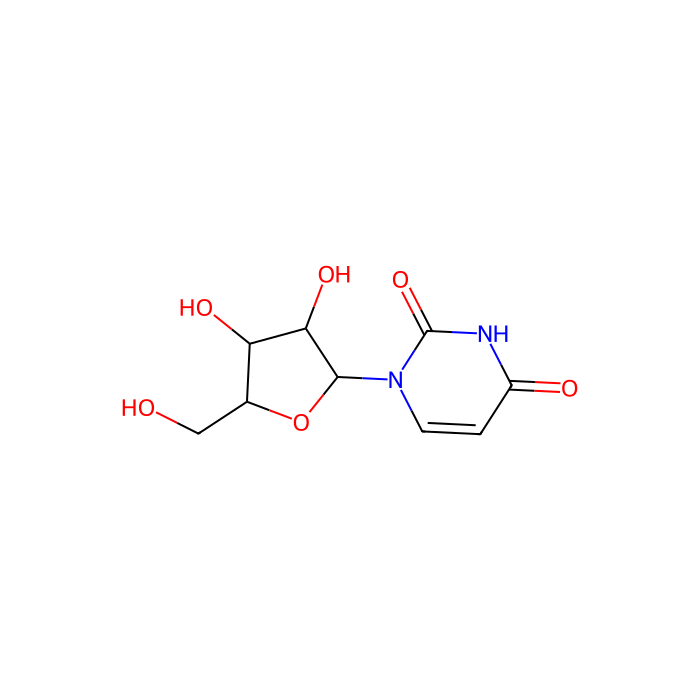
Research-grade uridine is a canonical ribonucleoside composed of the nucleobase uracil linked β-glycosidically at N1 to D-ribofuranose.
Item-specific identifiers
Product Name: Uridine (SKU: U408901)
CAS: 58-96-8
PubChem CID: 6029
Category Path: 全部 / 可售 / 小分子和化合物库
Research Use: For research use only
Structural features (general/literature)
Core scaffold: pyrimidin-2,4-dione (uracil) fused via N1–C1′ β-glycosidic bond to a D-ribofuranose ring.
Functional groups: two amide-like carbonyls on uracil (2- and 4-positions), one endocyclic imide NH (N3), multiple secondary alcohols (2′, 3′) and a primary alcohol (5′) on ribose.
Stereochemistry: β-D-ribofuranose with defined stereocenters at 1′, 2′, 3′, 4′ (all typical for ribonucleosides).
Formula and identifiers
Molecular formula (literature): C9H12N2O6
Molecular weight (literature): ~244.20 g/mol
SMILES (literature): a commonly reported canonical form is C1=CN(C(=O)NC1=O)[C@H]2OC@HC@@H[C@H]2O
InChIKey: Not specified for this item; refer to CoA/Spec Sheet.
2D structure in words: a five-membered ribofuranose ring bearing hydroxyls at C2′, C3′, and a CH2OH at C5′, with the anomeric C1′ connected to the N1 of a six-membered pyrimidine ring bearing two carbonyls (uracil).
Synthetic Utility
Uridine is a versatile chiral building block for nucleoside/nucleotide chemistry.
Functional group handles
Ribose hydroxyls (5′-primary; 2′/3′-secondary) enable selective protection (e.g., DMT at 5′; acetonide or silyl at 2′,3′) and subsequent derivatization.
Uracil ring C5 amenable to electrophilic halogenation; N3 acidity allows controlled N3-alkylation under specific conditions (literature).
Key transformations (literature)
5′-Phosphorylations to mono-, di-, and triphosphates (Ludwig–Eckstein) for enzymology.
Cross-coupling on 5-halo-uridines (Suzuki, Sonogashira, Stille) to access modified RNA probes.
Selective silylation (TBDMS/TBS) for downstream activation at unprotected sites.
Formation of 5′-azido or alkyne derivatives enabling click chemistry conjugations.
Retrosynthetic value
Serves as a platform to access a wide array of 5-substituted uridines, 2′-modified analogs, and prodrugs via protection–functionalization–deprotection sequences.
Practicalities
Strong adsorption on silica; use polar eluents with basic modifiers (Et3N, NH3) for chromatographic separation.
Moisture control is important for reagents (e.g., phosphitylation, silylation) but the substrate itself tolerates brief exposure to ambient conditions.
Target Specificity
Not applicable to small-molecule uridine. This product is not an antibody, enzyme, or affinity reagent with a defined biological “target specificity.” For biochemical context, see the Biological Roles section.
Preguntas frecuentes
How should this product be stored?
Store at ?80 °C. Ultra-low temperature storage is required to maintain the specified shelf life.
How is this product shipped?
This product ships frozen with dry ice and cold packs. Unpack on arrival and transfer it to the storage condition stated above; handle dry ice with insulated gloves in a ventilated area.
What are the CAS number, molecular formula and molecular weight?
The CAS Number is 58-96-8, the molecular formula is C9H12N2O6, and the molecular weight is 244.20 g/mol.
What documentation is provided?
Available product documentation, including Certificates of Analysis (COA), Safety Data Sheets (SDS), and specification sheets, is shown in the product document area. Document availability and access follow the current site policy.
Utilizamos cookies para garantizar el correcto funcionamiento del sitio web y, cuando esté permitido, para mejorar su experiencia. Puede gestionar sus preferencias en cualquier momento en Configuración. Más información en nuestra Política de Cookies.
¿Quieres que te enviemos un mensaje cuando tengamos descuentos disponibles?
Recordármelo más tarde
¡Gracias! Por favor, revisa tu bandeja de entrada de correo electrónico para confirmar.
Products are supplied to verified businesses, institutions, and qualified professionals for research and development use only. Not for use in humans, animals, diagnosis, or therapy.