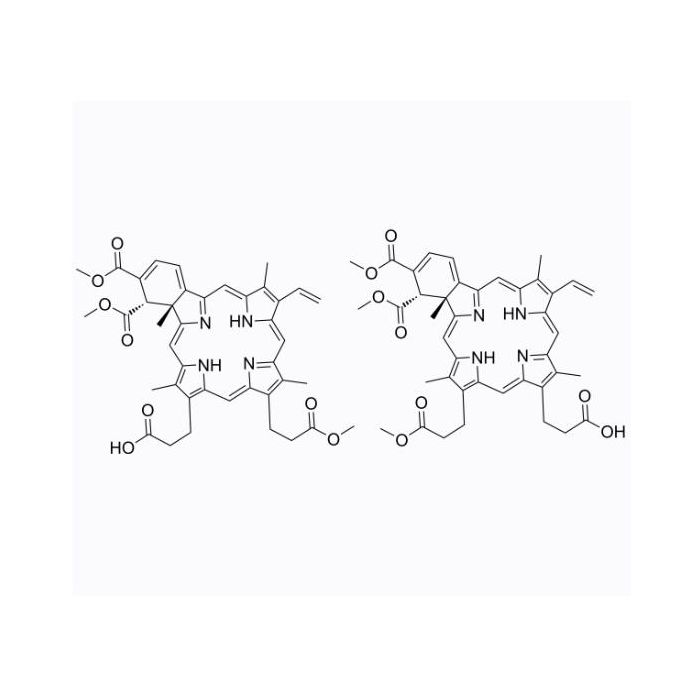
Verteporfin (CL 318952) - 10mM in DMSO , CAS No.129497-78-5

CAS: 129497-78-5 Cat. No.: V408385 Peso molecular: 718.79 Número EC: 893-418-5
Disponible para pedir
GRADE & PURITY 10mM in DMSO
Synonyms
Visudyne | (4R,​4aS)​-​rel-18-​ethenyl-​4,​4a-​dihydro-​3,​4-​bis(methoxycarbonyl)​-​4a,​8,​14,​19-​tetramethyl-24H,​26H-​Benzo[b]​porphine-​9,​13-​dipropanoic acid monomethyl ester
Storage
Store at -80°C
Shipped In
Dry ice packs + Cold packs
 ·  off list, applied to all prices below.
Size
Estado
Price
Qty
1ml
V408385-1ml
2
177,90US$
Enter a quantity for the sizes you want to add.
🧪

Why this grade

10mM in DMSO for sensitive chromatographic and analytical workflows requiring minimal baseline interference.

🌡

Storage & shipping

Store at -80°C Ships Dry ice packs + Cold packs Check lot-specific COA for exact specifications.

📋

Quality documents

SDS, COA, datasheet, and spec sheet available for download. Lot-specific COA accessible via lot number lookup.

📚

Literature proof

Cited in 12 peer-reviewed publications across chromatography, organic synthesis, and cross-coupling reactions.

Descripción general

Information

Verteporfin (CL 318952) Verteporfin (CL 318952, Visudyne) is a small molecule that inhibits TEAD–YAP association and YAP-induced liver overgrowth. It is also a potent second-generation photosensitizing agent derived from porphyrin. Verteporfin is an aut
In vitro

Verteporfin is about four times more efficient in absorbing light at wavelengths that penetrate tissues best (i.e., around 700 nm) and thus provides a much higher cytotoxic effect than hematoporphyrin (10 times more in human adherent cell lines). Verteporfin is lipophilic and is more readily taken up by malignant or activated cells, compared with normal or resting cells. Verteporfin binds with LDL to form a complex, which is then taken up into proliferating cells (e.g., neovascular endothelial cells) probably via LDL receptors and endocytosis. Verteporfin therapy achieves complete angiographic occlusion of the neovascular compartment by thrombosis of vascular channels, following selective endothelial damage. Verteporfin therapy selectively induces reproducible and isolated choriocapillary occlusion without alteration of overlying photoreceptors or ganglion cells, as shown by light and electron microscopy. Verteporfin conbined with light rapidly exhibits apoptotic changes reflected by caspase-3 and caspase-9 activation and PARP cleavage in HL-60 cells, changes that are blocked by the general caspase inhibitor ZVAD.fmk.

In vivo

Verteporfin can be used for angiographic visualization of choroidal vessels and CNV, which demonstrates that the photosensitizer accumulates rapidly in experimental CNV in monkeys. Verteporfin accumulates rapidly in the established vasculature of the choroid, RPE, and photoreceptors of rabbit eyes. Verteporfin reaches maximal tissue levels within 3 hours of intravenous injection, followed by a rapid decline within 24 hours in mice. Verteporfin is metabolized to a less active form in vivo and is cleared very rapidly, predominantly in the feces and a very small proportion excreted in urine. Verteporfin therapy effectively and selectively prevents fluorescein dye leakage from experimentally induced CNV in monkeys.
Cell Data

cell lines:WiDr, NCI-H1299, TOV21G, and HeLa

Concentrations:

Incubation Time:

Powder Purity:≥97%

Specifications

Sinónimos
Visudyne | (4R, ​4aS)​-​rel-18-​ethenyl-​4, ​4a-​dihydro-​3, ​4-​bis(methoxycarbonyl)​-​4a, ​8, ​14, ​19-​tetramethyl-24H, ​26H-​Benzo[b]​porphine-​9, ​13-​dipropanoic acid monomethyl ester
Especificaciones y pureza
10mM in DMSO
Mecanismos bioquímicos y fisiológicos
Verteporfin (CL 318952, Visudyne) is a small molecule that inhibits TEAD–YAP association and YAP-induced liver overgrowth. It is also a potent second-generation photosensitizing agent derived from porphyrin. Verteporfin is an autophagy inhibitor. Vertepor
Condiciones de almacenamiento de almacenamiento
Store at -80°C
Enviado en
Dry ice packs + Cold packs
Este producto requiere envío en cadena de frío. Los servicios terrestres y otros servicios económicos no están disponibles.
Nombres e identificadores
Isómeros SMILES CC1=C(C2=CC3=NC(=CC4=C(C(=C(N4)C=C5[C@@]6([C@@H](C(=CC=C6C(=N5)C=C1N2)C(=O)OC)C(=O)OC)C)C)CCC(=O)OC)C(=C3C)CCC(=O)O)C=C
WGK Alemania 3
Peso molecular 718.79
Reaxy-Rn 14615024
Reaxys-RN_link_address https://www.reaxys.com/reaxys/secured/hopinto.do?context=S&query=IDE.XRN=14615024&ln=

Documentation

📋 Safety Data Sheet (SDS)

Comprehensive hazard, handling, storage, and regulatory compliance document.

Download SDS →

✅ Certificate of Analysis (COA)

Lot-specific quality data. Enter your lot number to retrieve the exact COA.

Look up COA →

📊 Datasheet

Quick-reference summary of product specifications and applications.

View datasheet →

🔬 Specification Sheet

Full quality attributes and acceptance criteria for this grade.

View spec sheet →

Advanced Data

Certificados (CoA, COO, BSE/TSE y tabla de análisis)
C of A & Other Certificates(BSE/TSE, COO):
Analytical Chart:
Citations of This Product
Referencias
1. Ze Li, Jiayang Li, Kang Chen, Guiwen Qu, Shuanghong Yang, Sicheng Li, Ye Liu, Yitian Teng, Rui Ma, Jinjian Huang, Peige Wang, Jianan Ren, Xiuwen Wu.  (2025)  Mechanically Active Hydrogel for Healing Intestinal Fistulas through the YAP-Mediated Mechanosensitization of Intestinal Epithelial Cells.  Advanced Science,      [PMID:40788236] [10.1002/advs.202510717]
2. Peng Wang, Zhangwen Peng, Liu Yu, Yiling Liu, Hanwen Wang, Ziheng Zhou, Hengdeng Liu, Sheng Hong, Yichu Nie, Yang Deng, Yang Liu, Julin Xie.  (2023)  Verteporfin-Loaded Bioadhesive Nanoparticles for the Prevention of Hypertrophic Scar.  Small Methods,      [PMID:38084464] [10.1002/smtd.202301295]
3. Ze Li, Jinjian Huang, Yungang Jiang, Ye Liu, Guiwen Qu, Kang Chen, Yun Zhao, Peige Wang, Xiuwen Wu, Jianan Ren.  (2022)  Novel Temperature-Sensitive Hydrogel Promotes Wound Healing Through YAP and MEK-Mediated Mechanosensitivity.  Advanced Healthcare Materials,  11  (23): (2201878).  [PMID:36121733] [10.1002/adhm.202201878]
4. Liuyun Gong, Yujie Zhang, Jing Zhao, Yilei Zhang, Kangsheng Tu, Lianying Jiao, Qiuran Xu, Mingzhen Zhang, Suxia Han.  (2022)  All-In-One Biomimetic Nanoplatform Based on Hollow Polydopamine Nanoparticles for Synergistically Enhanced Radiotherapy of Colon Cancer.  Small,  18  (14): (2107656).  [PMID:35150039] [10.1002/smll.202107656]
5. Gao Feng, Shao Tianyi, Yu Yunpeng, Xiong Yujie, Yang Lihua.  (2021)  Surface-bound reactive oxygen species generating nanozymes for selective antibacterial action.  Nature Communications,  12  (1): (1-18).  [PMID:33531505] [10.1038/s41467-021-20965-3]
6. Liu Tao, Chai Shuang, Li Mingyang, Chen Xu, Xie Yutao, Zhao Zehui, Xie Jingjing, Yu Yunpeng, Gao Feng, Zhu Feng, Yang Lihua.  (2024)  A nanoparticle-based sonodynamic therapy reduces Helicobacter pylori infection in mouse without disrupting gut microbiota.  Nature Communications,  15  (1): (1-19).  [PMID:38286999] [10.1038/s41467-024-45156-8]
7. Gao Dandan, Zou Bin, Zhu Kunyuan, Bi Shijun, Zhang Wenxu, Yang Xinyu, Lai Jieyu, Liang Guobiao, Pan Pengyu.  (2024)  Enhancing Th17 cells drainage through meningeal lymphatic vessels alleviate neuroinflammation after subarachnoid hemorrhage.  Journal of Neuroinflammation,  21  (1): (1-17).  [PMID:39428510] [10.1186/s12974-024-03252-y]
8. Shushu Jiang, Shichen Bu, Xiang Kang, Yin Dong, Long Chen, Lin Yuan, Menghao Shi, Meng Du, Minglu Liang, Kai Huang, Liu Yang.  (2025)  Tspan9 Exacerbates Cardiac Hypertrophy by Impairing Cardiac Autophagy.  FASEB JOURNAL,  39  (10): (e70670).  [PMID:40406987] [10.1096/fj.202500150R]
9. Yichen Cai, Yanxin Shao, Hui Yuan, Lina Feng, Jing Wang, Mingfeng Yang, Cong Li, Baoliang Sun, Leilei Mao.  (2025)  Meningeal lymphatic dysfunction drives cognitive impairment after experimental subarachnoid hemorrhage.  Neurotherapeutics,      [PMID:41390288] [10.1016/j.neurot.2025.e00819]
10. Chaorong Wei, Lingke Feng, Jing Liu, Mingxia Xu, Yongsheng Cui, Fengyi Lin, Honglian Yu, Zhanzhan Feng, Hong Zhang, Changyang Gong, Peng Mi.  (2025)  ROS-sensitive nanocarriers for synergistic X-PDT/chemo/immunotherapy of triple-negative breast cancer and metastasis.  Acta Biomaterialia,      [PMID:41412288] [10.1016/j.actbio.2025.12.035]
11. Yuan Zhang, Shucheng Jin, Penghui Guo, Yuying Yin, Yichun Hua, Xiaosheng Ding, Zhe Zhang, Shuo Chen, Xu Han, Baowang Li, Yan Liu, Xiaoyan Li, Deling Li, Jing Jing, Wei Shi, Wang Jia.  (2026)  Magnetic Resonance Imaging Reveals Meningeal Lymphatic Impairment in Lung Adenocarcinoma Brain Metastasis Progression.  Advanced Science,      [PMID:41538419] [10.1002/advs.202516988]
12. Zhang Jia, Liu Jin, Chen Yuqian, Chen Huan, Meng Yihan, Wang Yan, Qiu Yuanjie, Hu Huizhong, Shi Wenhua, Li Manxiang, Li Man-xiang.  (2026)  Activation of PBK by Gal-3 contributes to pulmonary artery hypertension by promoting PRC1 activation.  RESPIRATORY RESEARCH,      [PMID:41612370] [10.1186/s12931-026-03534-4]
Calculadoras de soluciones
Reseñas

Reseñas de cliente

Shall we send you a message when we have discounts available?

Remind me later

Thank you! Please check your email inbox to confirm.

Oops! Notifications are disabled.