This kit is used for the detection of nitrite (calculated as nitrite nitrogen NO₂⁻-N) in water (surface water, groundwater, drinking water, domestic sewage, industrial wastewater, farmland irrigation water, etc.) and soil/sediment. Nitrite is a key intermediate in the biogeochemical cycle of nitrogen, and also a core mandatory indicator in the fields of environmental monitoring, agroecological assessment, and pollution prevention and control.
The core principle of this kit is that nitrite (NO₂⁻) in the sample undergoes a diazotization reaction with sulfanilic acid (or sulfanilamide) under acidic conditions. The generated diazonium salt immediately undergoes a coupling reaction with N-(1-naphthyl)ethylenediamine dihydrochloride (NED), forming a pink to deep red azo-colored compound. Such colored substances have a characteristic absorption peak at 530–545 nm, and the color intensity is positively correlated* with the nitrite concentration in the sample.
Usage
1. Sample Preparation
(1) Soil samples
Take an appropriate amount of soil sample, remove impurities such as stones and branches, and sieve through a 2 mm mesh. Accurately weigh 0.5 g, add 1 mL of extraction solution, shake at room temperature for 1 h, and centrifuge at 3000 rpm, 25 °C for 10 min. After stratification, take the supernatant for testing.
(2) Water samples
Detect directly; if turbid, centrifuge before measurement.
2. Reagent Preparation
(1) Equilibrate the reagents in the kit to room temperature.
(2) Add 6 mL of acidic buffer solution to Detection Reagent A and B respectively, dissolve completely (ultrasonic dissolution is available), store at 2–8 °C away from light; for long-term storage, store at -20 °C.
(3) Preparation of serial NO₂⁻ standard solutions.
Take the 1 mmol/L standard: dilute the 1 mmol/L standard with distilled water according to the table below, prepare fresh before use.
Volume of NO₂⁻ standard (1 mM) added (μL) | 1 | 5 | 10 | 15 | 20 | 25 | Distilled water (μL) | 99 | 95 | 90 | 85 | 80 | 75 | NO₂⁻ content (μM) | 10 | 50 | 100 | 150 | 200 | 250 |
|
Note:A standard curve must be established with standard solutions in each experiment.Diluted standard solutions are unstable and must be used within 4 hours.
3. Procedures
(1) Before formal measurement, be sure to perform a pre-test using 2–3 samples with expected large differences.
(2) Preheat the microplate reader for 30 min, and set the wavelength to 530 nm.
(3) Add each reagent sequentially according to the table below:
Reagents (μL) | Blank | Standard | Sample | Double-distilled water | 100 | 0 | 0 | Standard | 0 | 100 | 0 | Sample | 0 | 0 | 100 | Reagent A | 50 | 50 | 50 | Reagent B | 50 | 50 | 50 |
|
Mix well and incubate at room temperature for 15 min, then measure the absorbance at 530 nm (A530) in a 96 well plate.
4. Result Calculation
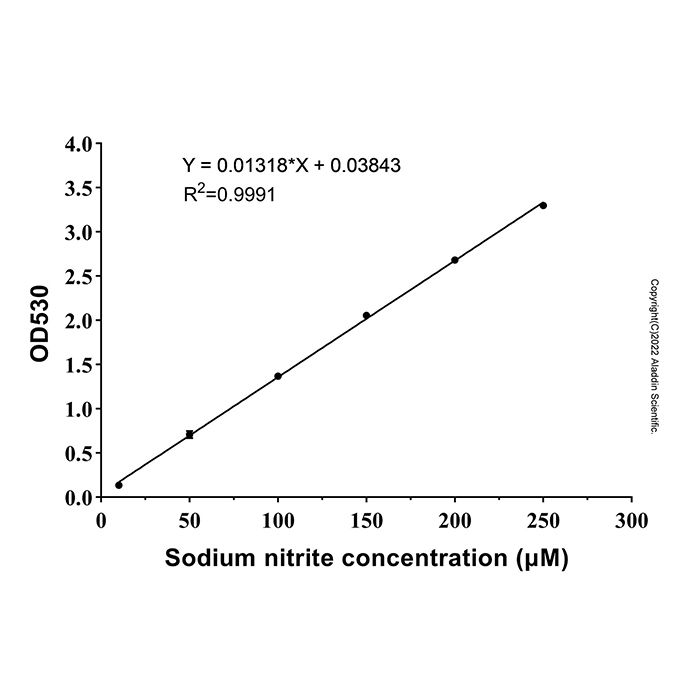
Zero the instrument with the blank control. Construct a standard curve using the NO₂⁻ standard concentrations (μM) as the abscissa (X axis) and the corresponding absorbance values as the ordinate (Y axis). Calculate the NO₂⁻concentration in the sample wells based on the standard curve.
(1) Soil samples:
Nitrite content (μmol/g fresh weight) = n × f × Vₑₓₜ / W = 2f × n
(2) Water samples:
Nitrite content (μmol/mL) = f × n
Where:
- n: NO₂⁻concentration obtained from the standard curve (μM)
- f: Dilution factor
- Vₑₓₜ: Volume of extraction solution
- W: Sample weight
5. Notes
(1) It is recommended that reagents be prepared and used immediately. Please use the reagents as soon as possible after opening to avoid affecting experimental results.
(2) The detection range of the kit is not equivalent to the concentration range of the analyte in the sample. If the analyte concentration in the sample is too high or too low, please dilute or concentrate the sample appropriately.
(3) This product is for research use only and not suitable for clinical diagnosis. For your safety and health, please wear a lab coat and disposable gloves during operation.
6. Results Presentation
Typical standard curve:
Y = 0.01318X + 0.03843, R² = 0.9991


 ZJ26F0434343