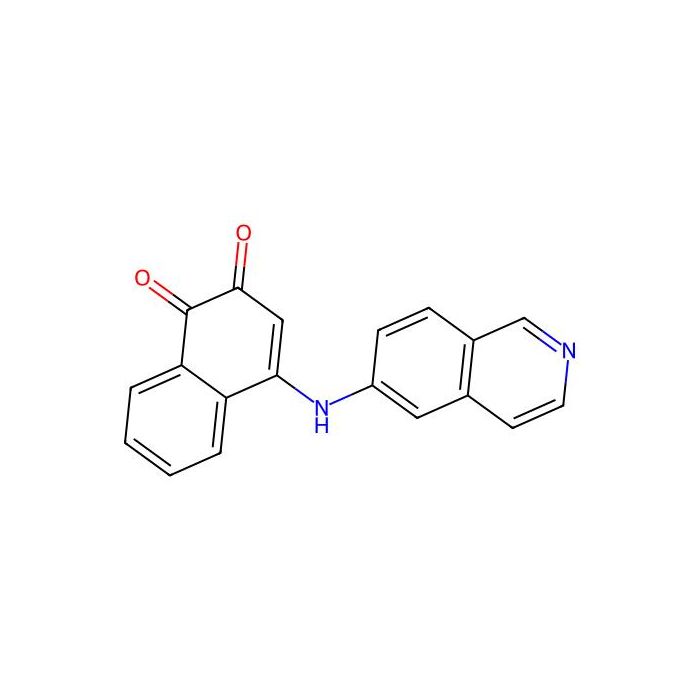
YZ129 is an inhibitor of the HSP90-calcineurin-NFAT pathway against glioblastoma, directly binding to heat shock protein 90 (HSP90) with an IC 50 of 820 nM on NFAT nuclear translocation. YZ129-induced GBM cell-cycle arrest at the G2/M phase promotes apoptosis and inhibited tumor cell proliferation and migration
Form:Solid
IC50& Target:HSP90
Especificaciones
Especificaciones y pureza
≥99%
Mecanismos bioquímicos y fisiológicos
YZ129 is an inhibitor of the HSP90-calcineurin-NFAT pathway against glioblastoma, directly binding to heat shock protein 90 (HSP90) with an IC 50 of 820 nM on NFAT nuclear translocation. YZ129-induced GBM cell-cycle arrest at the G2/M phase promotes apopt
Condiciones de almacenamiento de almacenamiento
Store at -20°C
Enviado en
Ice chest + Ice pads
Este producto requiere envío en cadena de frío. Los servicios terrestres y otros servicios económicos no están disponibles.
Pureza
≥99%
Nombres e identificadores
SMILES
O=C(C1=CC=CC=C1C(NC2=CC=C(C=NC=C3)C3=C2)=C4)C4=O
Peso molecular
300.31
Datos avanzados
Certificados (CoA, COO, BSE/TSE y tabla de análisis)
C of A & Other Certificates(BSE/TSE, COO):
Analytical Chart:
Propiedades químicas y físicas
Solubilidad
DMSO : 5.6 mg/mL (18.65 mM; ultrasonic and warming and heat to 80°C)
Calculadoras de soluciones
Molarity Calculator
Determine the necessary mass, volume, or concentration for preparing a solution.
Dilution Calculator
Determine the dilution needed to prepare a stock solution.
Reconstitution Calculator
Reseñas
Reseñas de cliente
Application Protocols
No vendor-validated protocols are provided for this item.
General small-molecule handling protocol (not item-specific):
Stock solution preparation
Warm vial to room temperature in a desiccator. Weigh an appropriate amount accurately (e.g., 1–5 mg).
Dissolve in anhydrous DMSO to 10–50 mM. Vortex and sonicate if necessary. If insoluble, consider DMF/NMP or mixed solvents.
Optionally sterile-filter through 0.22 µm PTFE for cell-free assays; record concentration by UV or qNMR.
Aliquoting and storage
Dispense single-use aliquots (10–50 µL) in low-bind, amber vials/plates. Store at −20°C or below per product guidance. Avoid repeated freeze–thaw.
Assay dosing
Dilute stock into assay buffer to achieve desired final concentration with 0.1–1.0% DMSO. Include matched vehicle controls.
Inspect for precipitation; if observed, reduce concentration, increase co-solvent slightly, or add non-ionic detergent if assay-compatible.
Documentation and QC
Record lot number (SKU Y648224), CAS 1643120-60-8, stock concentration, solvent, preparation date, and purity references from the CoA.
These steps are general best practices and should be adapted to your specific assay and institutional SOPs.
Biological Roles
Item-specific biological function or target information: Not specified for this item; refer to CoA/Spec Sheet or screening documentation if available.
General context (not item-specific):
Compounds within small-molecule libraries are typically designed or selected to explore chemical space relevant to biological targets (kinases, GPCRs, enzymes, protein–protein interactions), but any biological role of YZ129 remains unknown without structural/annotation data.
Before use in biochemical assays, evaluate Pan-Assay Interference Compounds (PAINS) filters and aggregator predictors, and confirm activity with orthogonal readouts to avoid false positives.
Determine key physicochemical parameters (cLogP, TPSA, pKa—computed from structure when available) to anticipate permeability, solubility, and non-specific binding trends in in vitro systems.
Best practices:
Establish vehicle control baselines (e.g., 0.1–1% DMSO) and assess compound stability in assay buffer over the measurement window.
Monitor redox activity or covalent reactivity (e.g., thiol reactivity assays) if structural motifs suggest potential promiscuity—this is general guidance pending structure disclosure.
Research-use notice:
For research use only. Not for diagnostic or therapeutic applications. No biological efficacy or safety is claimed for this product.
Buffer Applications
This product is not a buffering reagent, and no acid/base properties are provided.
Practical guidance for using small molecules in buffered assays (general, not item-specific):
Stock preparation: Dissolve in DMSO to 10–50 mM. For aqueous dosing, pre-dilute into buffer to achieve a final co-solvent level of 0.1–1.0% v/v.
Buffer selection: Choose buffers with minimal compound interaction and suitable pH stability (e.g., HEPES, PBS, Tris). Avoid buffers that can form adducts with reactive functionalities (e.g., primary amines in Tris with activated esters—general caution).
Surfactants: Add 0.01–0.05% non-ionic detergent (Tween-20, Pluronic F-68) to mitigate aggregation and adsorption to plastics if needed.
Adsorption control: Use low-binding plates/tubes for hydrophobic compounds; include BSA (0.1–0.5%) only if compatible with the assay readout.
Light/oxygen sensitivity: Work under low light and inert atmosphere if stability studies indicate sensitivity (no item-specific data provided).
Because pKa, solubility, and stability are not specified for YZ129, optimize buffer composition empirically and document final conditions alongside compound lot and concentration verification.
Green Alternatives
Because the chemical identity and solvent preferences of YZ129 are not specified, green chemistry considerations are presented in general terms (not item-specific):
Solvent selection (general greener choices):
Replace DMF/NMP with Cyrene, GBL, or propylene carbonate where compatible (noting viscosity and basicity differences).
Prefer 2-MeTHF or CPME over diethyl ether/THF for many extractions and reactions (better stability, reduced peroxide risk vs. ethers like THF; literature-general).
Use EtOAc, MeTHF, or IPA in place of chlorinated solvents for workups when feasible; reserve DCM/CHCl3 for cases where alternatives fail.
For assay stocks, DMSO remains common; consider glycerol, PEG-400, or ethanol where biological assay tolerance allows, balancing volatility and toxicity profiles.
Energy and waste minimization:
Store at −20°C as specified but avoid unnecessary deep-freeze dwell time by aliquoting for just-in-time use.
Employ miniaturized screening formats (96/384-well) to reduce solvent volumes and waste.
Use solid-supported scavengers and aqueous workups to limit hazardous waste where compatible with the molecule’s functionality (structure-dependent).
Tradeoffs to consider:
Greener solvents may alter solubility, reaction rates, or assay signal windows. Validate performance with small-scale pilots.
Always align with your organization’s solvent selection guide and regulatory constraints.
Pharmaceutical Uses
Item-specific pharmacopeial status or excipient role: Not specified for this item; refer to CoA/Spec Sheet if applicable.
General note (not item-specific):
YZ129 is offered strictly for research use only. There are no claims regarding suitability for human or veterinary use, GMP status, or inclusion in pharmacopoeias.
In a discovery setting, small molecules may be evaluated in pre-formulation studies (solubility screening, salt formation, polymorph screening) to support research; such activities should be performed under appropriate non-clinical R&D controls and are beyond the scope of this product listing.
If formulation studies are contemplated, typical solvent systems include aqueous buffers with co-solvents (DMSO, ethanol, PEG-400) or encapsulation approaches (cyclodextrins, lipid-based vehicles). These considerations are general and require compound-specific data (not provided here).
Compliance reminder:
Not for use in humans or clinical diagnostics. No statements are made regarding safety, efficacy, dosage, or therapeutic application.
Physical Properties
Item-specific data:
Appearance: Not specified for this item; refer to CoA/Spec Sheet.
Molecular weight: Not specified for this item; refer to CoA/Spec Sheet.
Molecular formula: Not specified for this item; refer to CoA/Spec Sheet.
Melting/boiling point, density, refractive index, pKa/logP, solubility: Not specified for this item; refer to CoA/Spec Sheet.
Interpretive notes (general, not item-specific):
Storage at −20°C and cold shipment suggest the compound may benefit from reduced-temperature handling to preserve integrity (minimize hydrolysis, oxidation, or volatilization), but the exact rationale depends on structure.
If the compound is a typical screening small molecule (MW 200–600 Da; literature-general), expect: possible crystalline solid or amorphous powder, limited aqueous solubility, and good solubility in polar aprotic solvents (DMSO/DMF) and many organic eluents (MeCN, MeOH).
Recommended characterization workflow (general):
Determine solubility in DMSO at 10–50 mM for stock solutions; check for precipitation upon dilution into aqueous buffers (final organic co-solvent 0.1–1% v/v commonly used in screening).
Use DSC or melting range to gauge phase behavior if solid; record water content by Karl Fischer if hygroscopic behavior is suspected.
Monitor stability with LC–MS over time and at different temperatures/light exposures to identify degradation pathways.
Please consult the CoA/SDS for definitive physical constants for this specific item.
Quality and Grades
Item-specific grade and purity:
Grade/purity: Not specified for this item; refer to CoA/Spec Sheet.
How to interpret grades (general guidance, not item-specific):
Screening/Discovery grade: Typically provided at high chemical purity (often ≥95% by HPLC/LC–MS in literature practice) with identity confirmed by MS and NMR. Exact thresholds vary by supplier and lot; rely on the CoA.
Analytical reagent (AR) or ACS grade: Typically used for solvents/inorganics; less relevant to discrete small-molecule actives where HPLC/LC–MS purity is more informative.
HPLC-grade designation is commonly for solvents, indicating low UV absorbance and low non-volatile residue; not generally used for discrete compounds.
Stabilizers and form:
Stabilizers, counterions, salt form, and residual solvents can influence solubility and assay readouts. These are not specified for this item; refer to the CoA for any stabilizers or salt information (e.g., HCl salt vs. free base).
Recommended QC on receipt (general best practice):
Verify identity by LC–MS; check purity by HPLC/UPLC with dual-wavelength UV and, if relevant, ELSD.
Record water content (Karl Fischer) if hygroscopic behavior is suspected; confirm mass balance with 1H NMR.
Archive the CoA/SDS with the lot number; label all aliquots with SKU Y648224, CAS 1643120-60-8, and receipt date.
Reaction and Applications
Manufacturer applications: Not specified for this item; the product is listed within a small-molecule/compound library category. No specific reaction role is indicated.
General applications for library compounds (not item-specific):
Chemical biology screening: Use as a test article in enzymatic or cell-free assays to generate primary activity hits; follow with orthogonal counterscreens to rule out assay interference (fluorescence quenchers, redox cyclers, aggregators).
SAR and reference controls: If YZ129 is part of a related series, compare activity and physicochemical profiles to build SAR trends.
Analytical benchmarking: Utilize for LC–MS method development or as a retention-time marker when chemical class is known.
Reaction chemistry considerations (if used as a reagent or intermediate; structure-dependent):
Without structural information, no specific transformations can be recommended. If the compound is repurposed synthetically, first confirm functionality (e.g., halides for cross-coupling, carbonyls for condensations) via spectroscopic data.
Assay practicality:
Prepare DMSO stocks with stringent documentation (mass, purity, concentration by UV or quantitative NMR). Validate stability by re-injecting LC–MS after storage.
Include solubility checks at working concentrations in relevant assay buffers; add non-ionic detergents (e.g., 0.01% Tween-20) if aggregation is suspected (general practice).
All uses are for research only; no clinical or diagnostic applications are claimed.
Reaction Conditions
Item-specific reaction conditions are not applicable because the structure and functional groups of YZ129 are not provided.
General guidance for handling small molecules in assays or exploratory chemistry (not item-specific):
Solution preparation: Prepare concentrated DMSO stocks (10–50 mM), confirm concentration by UV (if chromophore present) or quantitative 1H NMR with an internal standard.
Stability checks: Incubate aliquots at room temperature, 4°C, and 37°C in relevant media and analyze by LC–MS to establish acceptable handling windows.
Light/oxygen: If unknown, adopt conservative protection (amber vials, inert headspace) until stability is verified.
Workup/purification (if derivatized): Choose normal-phase or reversed-phase chromatography based on polarity; consider gradient water/MeCN with 0.1% formic acid or ammonium bicarbonate for MS-friendly methods.
Because no literature values specific to CAS 1643120-60-8 are provided here, users should determine optimal conditions empirically and document them alongside the lot-specific CoA.
Safety and Handling
Item-specific hazard data:
GHS classification, signal word, pictograms, H-statements: Not specified for this item; refer to SDS.
General laboratory safety for small screening molecules (not item-specific):
PPE: Safety glasses, lab coat, and appropriate chemically resistant gloves (e.g., nitrile). Avoid inhalation of dusts or vapors; handle powders in a fume hood or ventilated enclosure.
Storage: As specified, store at −20°C in a tightly closed container. Protect from moisture and light unless otherwise indicated on the CoA/SDS. Allow vials to equilibrate to room temperature in a desiccator before opening to minimize condensation.
Incompatibilities: Unknown for this specific item. As a precaution, segregate from strong oxidizers/reductants, strong acids/bases, and sources of ignition until specific compatibility is known.
First-aid overview: In case of skin/eye contact, rinse with water for several minutes; remove contaminated clothing. If inhaled, move to fresh air. If ingested, rinse mouth. Seek medical advice; bring the SDS.
Spill/cleanup: Avoid creating dust. Absorb liquids with inert material; collect solids carefully. Dispose of waste in accordance with institutional and regulatory requirements.
Thermal/light sensitivity: Cold shipment suggests potential sensitivity; limit freeze-thaw cycles by aliquoting solutions. Protect from light if the compound contains chromophores prone to photolysis (general guidance).
Always defer to the official SDS for authoritative hazard and handling information.
Solvent Selection
Item-specific solvent compatibility: Not specified for this item; refer to CoA/Spec Sheet.
General approach for small-molecule screening compounds (not item-specific):
Primary stock solvent: DMSO is the standard due to broad solvating power and assay compatibility. Start with 10–50 mM stocks; warm gently and vortex/sonicate if needed. Filter if particulate persists.
Alternatives: DMF or NMP (for very poorly soluble compounds), or volatile organics (MeCN, MeOH, EtOH) when rapid solvent removal is desired. For lipophilic solids, co-solvents like PEG-400 or mixed DMSO/EtOH can help.
Aqueous use: Most screening compounds require co-solvent when dosing into buffers. Keep final DMSO at 0.1–1.0% v/v to balance solubility and assay tolerance. Include a matching vehicle control.
Selection tips:
If the compound has ionizable groups (unknown here), adjust pH in aqueous media to favor the soluble form (bases as salts at low pH; acids as salts at high pH).
Avoid reactive solvents if functional groups could undergo solvolysis (e.g., methanolysis of acid chlorides—illustrative, general).
For preparative handling, choose solvents aligned with downstream workup: MeCN/Water for LC-based purification; EtOAc/Hexanes for normal-phase extraction.
Practical checks:
Perform a small-scale saturation test across candidate solvents; quantify by UV or LC to select an optimal vehicle.
Document solvent lot/grade and any observed polymorph or gelation behavior.
Storage and Reconstitution
Item-specific conditions:
Storage: Store at −20°C (per Product Data).
Shipment: Ice chest + ice pads.
Reconstitution guidance (general, not item-specific):
Solid material: Allow the sealed container to equilibrate to room temperature in a desiccator to prevent condensation. Open under dry air or nitrogen if moisture sensitivity is suspected. Dissolve in anhydrous DMSO to prepare 10–50 mM stocks unless the CoA suggests a different solvent.
Solution material: If supplied in solution, verify concentration on the label/CoA and aliquot immediately upon receipt to minimize freeze–thaw.
Aliquoting and storage practices:
Prepare single-use aliquots in amber, low-bind vials or plates. Label with compound ID (YZ129), SKU Y648224, CAS 1643120-60-8, solvent, concentration, and date.
Store aliquots at −20°C or lower. Protect from light as a precaution when the chromophoric character is unknown. Avoid frost-free freezers that cycle temperatures.
Freeze–thaw: Minimize cycles; thaw on ice or at room temperature just before use. Do not refreeze partially used aliquots if stability is uncertain—discard or use the same day.
Stability notes:
Specific stability, hygroscopicity, and photolability are not specified for this item; refer to the CoA/SDS. Verify integrity periodically with LC–MS/HPLC during long-term storage.
Structure and Identity
Brief overview: YZ129 (SKU: Y648224) is listed in our small-molecule/compound library category. Specific structural identifiers are not provided in the current product record.
Item-specific (from Product Data):
CAS: 1643120-60-8
Product name: YZ129
Category: Small molecules and compound libraries (screening compound)
Storage: Store at −20°C
Shipped: Ice chest + ice pads
Molecular formula: Not specified for this item; refer to CoA/Spec Sheet.
Molecular weight: Not specified for this item; refer to CoA/Spec Sheet.
SMILES: Not specified for this item; refer to CoA/Spec Sheet.
InChIKey: Not specified for this item; refer to CoA/Spec Sheet.
General guidance (not item-specific):
For an uncharacterized small molecule, identity is typically confirmed by a combination of LC–MS (exact mass), 1H/13C NMR, and HPLC purity assessment.
If the structure is later disclosed, key features to note include functional groups (e.g., heterocycles, amides, halogens), ring systems, and any stereogenic centers. These features drive solubility, stability, and assay behavior.
Best practice: Maintain the CAS and internal SKU on all aliquots and documentation to ensure unambiguous traceability during screening or SAR work.
Documentation:
Request the latest CoA/Spec Sheet and SDS for complete identifiers (SMILES/InChI, formula/MW) and analytical data supporting identity.
Synthetic Utility
Item-specific functional groups and reactivity: Not specified for this item; no structural information is provided.
General considerations (not item-specific):
If YZ129 is repurposed as a synthetic building block, first obtain or determine its structure (NMR, MS, IR) to identify transformable handles (e.g., aryl halides for cross-coupling, nitriles for reductions/hydrolysis, amines for acylation/alkylation).
Evaluate protecting-group needs and chemoselectivity, especially if multiple nucleophiles/electrophiles are present.
Check stability under common reaction conditions (acid/base, redox, heat, photolysis). Conduct small-scale trials and monitor by LC–MS/UPLC to map degradation pathways.
Workflow tips:
Establish a reference analytical method (gradient LC with UV/MS) before initiating derivatizations; retain samples of starting material and intermediates for spectral assignment.
If scale-up is needed, confirm polymorph/solvate form and drying behavior to ensure reproducible yields and purity.
Given the absence of structural data, no specific named reactions or retrosynthetic disconnections can be recommended for this item. Consult the CoA/Spec Sheet or contact technical support if a derivative program is planned.
Target Specificity
Not applicable; YZ129 is not an antibody or biological macromolecule, and no target-binding data are provided for this small molecule.
Item-specific target data: Not specified for this item; refer to CoA/Spec Sheet or your internal screening annotations if available.
General note (not item-specific):
For small molecules evaluated in target-based assays, define specificity through orthogonal assays, counterscreens against related isoforms, and selectivity panels. Confirm direct engagement via biophysical methods where possible (SPR, ITC, DSF), recognizing these recommendations are general and contingent on structure and assay design.
Preguntas frecuentes
How is this product shipped?
This product ships in an insulated container with ice pads. Unpack on arrival and transfer it to the storage condition stated above.
What is the purity of this product?
This product is supplied at ≥99% purity (chemical assay). Lot-specific values are stated on the Certificate of Analysis.
How should this product be stored?
Store at ?20 °C. Freezer storage is required to maintain the specified shelf life.
What are the CAS number, molecular formula and molecular weight?
The CAS Number is 1643120-60-8, the molecular formula is C19H12N2O2, and the molecular weight is 300.31 g/mol.
What documentation is provided?
Available product documentation, including Certificates of Analysis (COA), Safety Data Sheets (SDS), and specification sheets, is shown in the product document area. Document availability and access follow the current site policy.
Utilizamos cookies para garantizar el correcto funcionamiento del sitio web y, cuando esté permitido, para mejorar su experiencia. Puede gestionar sus preferencias en cualquier momento en Configuración. Más información en nuestra Política de Cookies.
¿Quieres que te enviemos un mensaje cuando tengamos descuentos disponibles?
Recordármelo más tarde
¡Gracias! Por favor, revisa tu bandeja de entrada de correo electrónico para confirmar.
Products are supplied to verified businesses, institutions, and qualified professionals for research and development use only. Not for use in humans, animals, diagnosis, or therapy.