
Determine the necessary mass, volume, or concentration for preparing a solution.
| Activity Type | Activity Value -log(M) | Mechanism of Action | Activity Reference | Publications (PubMed IDs) |
|---|
Moligand™, 10mM in DMSO Moligand™ for sensitive chromatographic and analytical workflows requiring minimal baseline interference.
Store at -80°C Ships Dry ice packs + Cold packs Check lot-specific COA for exact specifications.
SDS, COA, datasheet, and spec sheet available for download. Lot-specific COA accessible via lot number lookup.
Cited in 1 peer-reviewed publications across chromatography, organic synthesis, and cross-coupling reactions.
Information
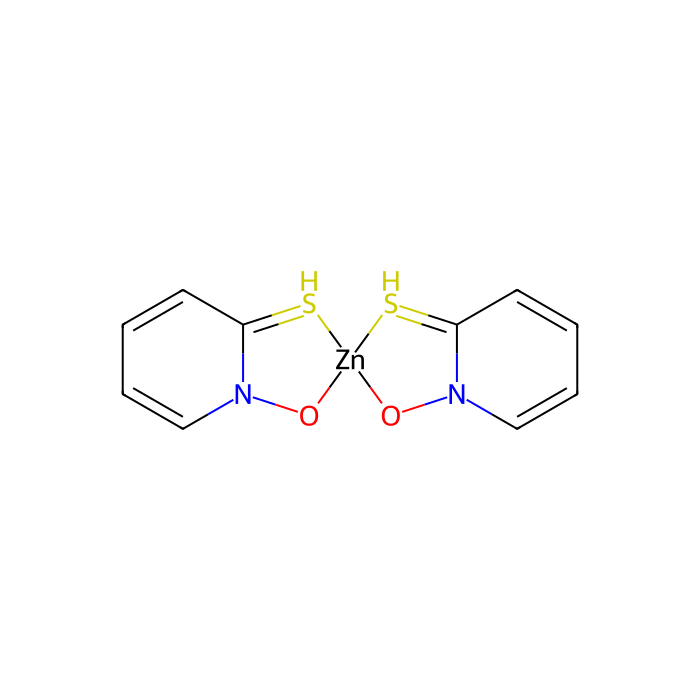
Zinc Pyrithione Zinc pyrithione (OM-1563) is an antifungal and antibacterial agent disrupting membrane transport by blocking the proton pump .
In vitro
Zinc pyrithione is considered as a coordination complex of zinc. The pyrithione ligands, which are formally monoanions, are chelated to Zn 2+ via oxygen and sulfur centers. In the crystalline state, zinc pyrithione exists as a centrosymmetric dimer, where each zinc is bonded to two sulfur and three oxygen centers. In solution, however, the dimers dissociate via scission of one Zn-O bond. Zinc pyrithione, which is a dimer but is probably biologically active as a monomer, induces plasma membrane depolarization with half-maximal effect (K1/2) of about 0.3 mM. Zinc pyrithione is an unusual synthetic potentiator that potently activates both heterologous and native M channels by inducing channel opening at the resting potential.
In vivo
Zinc pyrithione rapidly accumulated in the tissues of the exposed mussels, proportionately to both exposure concentration and time. Even though the 7-d median lethal concentration (LC50)\u2009= 8.27\u2009μM established here appears high with respect to reported ZnPT environmental concentrations, the results indicate that this biocide could represent a threat for marine organisms in coastal environments and that further investigations on its biological effects at sublethal doses are needed.
Cell Data
cell lines:
Concentrations:
Incubation Time:
Powder Purity:≥97%
| WGK Alemania | 3 |
|---|---|
| RTECS | ZH0950000 |
| Número ONU | 2811 |
| Grupo de embalaje | I |
| Peso molecular | 317.7 |
Comprehensive hazard, handling, storage, and regulatory compliance document.
Download SDS →Lot-specific quality data. Enter your lot number to retrieve the exact COA.
Look up COA →Full quality attributes and acceptance criteria for this grade.
View spec sheet →| Activity Type | Activity Value -log(M) | Mechanism of Action | Activity Reference | Publications (PubMed IDs) |
|---|
| Activity Type | Activity Value -log(M) | Mechanism of Action | Activity Reference | Publications (PubMed IDs) |
|---|
| Activity Type | Activity Value -log(M) | Mechanism of Action | Activity Reference | Publications (PubMed IDs) |
|---|
| Activity Type | Activity Value -log(M) | Mechanism of Action | Activity Reference | Publications (PubMed IDs) |
|---|
Find and download the COA for your product by matching the lot number on the packaging.
| Lot Number | Certificate Type | Fecha | Articulo |
|---|---|---|---|
 J2225456 J2225456 | Certificate of Analysis | Jun 30, 2026 | Z408773 |
| Solubilidad | Solubility (25°C) In vitro DMSO: 100 mg/mL (153.64 mM); |
|---|
| 1. Shu Zhou, Shukai Liu, Xiao Meng, Tianqi Liu, Xiaoyong Shi, Rongguo Su. (2024) Indirect photodegradation of zinc pyrithione: The effect of chromophoric dissolved organic matter components and seawater factors. Journal of Environmental Chemical Engineering, [PMID:] [10.1016/j.jece.2024.112421] |
Our grade selection guide covers purity, stabilizer status, and application suitability for all variants in our catalog.
View Moligand™ grade guide →