
Determine the necessary mass, volume, or concentration for preparing a solution.
ZL0580 - ≥99% , CAS No.2377151-10-3
Disponible para pedir
GRADE & PURITY ≥99%
Storage
Store at -20°C
Shipped In
Ice chest + Ice pads
≥99% for sensitive chromatographic and analytical workflows requiring minimal baseline interference.
Store at -20°C Ships Ice chest + Ice pads Check lot-specific COA for exact specifications.
SDS, COA, datasheet, and spec sheet available for download. Lot-specific COA accessible via lot number lookup.
Cited in 0 peer-reviewed publications across chromatography, organic synthesis, and cross-coupling reactions.
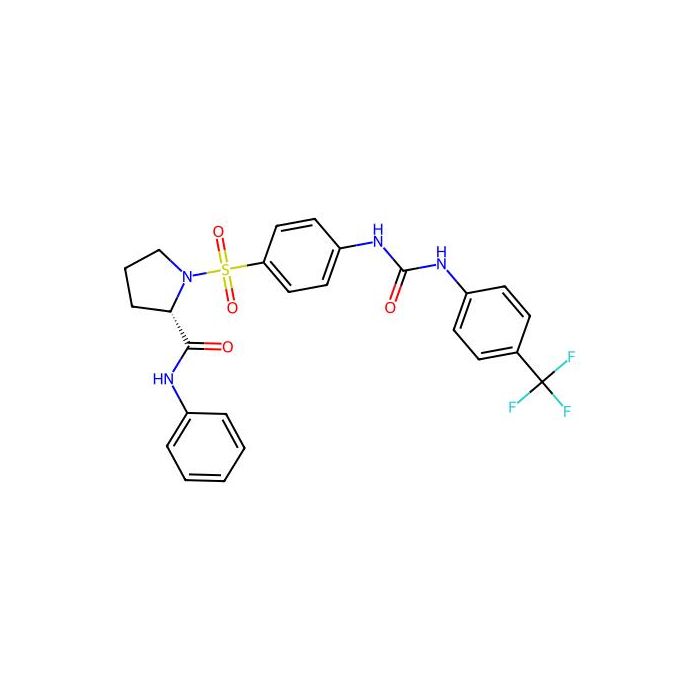
ZL0580, a structurally close analog of ZL0590, induces epigenetic suppression of HIV via selectively binding to BD1 domain of BRD4 . ZL0580 induces HIV suppression by inhibiting Tat transactivation and transcription elongation as well as by inducing repressive chromatin structure at the HIV promoter
In Vitro
ZL0580 (8 μM, 2 days, PBMCs of viremic HIV-infected individuals) induces HIV transcriptional suppression with low toxicity. ZL0580 treatment (10 μM) suppresses both PMA-stimulated and basal HIV transcription. MCE has not independently confirmed the accuracy of these methods. They are for reference only. Cell Viability AssayCell Line: HIV-infected human CD4+ T cells. Concentration: 0-8 μM. Incubation Time: 2 days. Result: Suppress HIV in primary CD4+ T cell. Single treatment (8 μM) led to almost completed loss of productive HIV infection in CD4+ T cells. RT-PCRCell Line: PBMCs of viremic HIV-infected individuals. Concentration: 8 μM. Incubation Time: 2 days. Result: Suppresses HIV transcription ex vivo in PBMCs of viremic HIV-infected individuals. Cell Cytotoxicity AssayCell Line: J-Lat cells. Concentration: 0-80 μM. Incubation Time: 1 and 3 days. Result: Did not cause significant cell death at concentrations below 40 μM. Treatment of J-Lat cells with ZL0580 (10 μM) also did not cause significant cell death on days 2, 7, and 14 compared with NC in both PMA-activated and unstimulated cells.
Form:Solid
IC50& Target:BRD4 (BD1)
| Sonrisas canónicas | C1CC(N(C1)S(=O)(=O)C2=CC=C(C=C2)NC(=O)NC3=CC=C(C=C3)C(F)(F)F)C(=O)NC4=CC=CC=C4 |
|---|---|
| IUPAC Name | (2S)-N-phenyl-1-[4-[[4-(trifluoromethyl)phenyl]carbamoylamino]phenyl]sulfonylpyrrolidine-2-carboxamide |
| InChIKey | DKFYGSWCJGXEJY-QFIPXVFZSA-N |
| INCHI | 1S/C25H23F3N4O4S/c26-25(27,28)17-8-10-19(11-9-17)30-24(34)31-20-12-14-21(15-13-20)37(35,36)32-16-4-7-22(32)23(33)29-18-5-2-1-3-6-18/h1-3,5-6,8-15,22H,4,7,16H2,(H,29,33)(H2,30,31,34)/t22-/m0/s1 |
| Isómeros SMILES | C1C[C@H](N(C1)S(=O)(=O)C2=CC=C(C=C2)NC(=O)NC3=CC=C(C=C3)C(F)(F)F)C(=O)NC4=CC=CC=C4 |
| PubChem CID | 139524511 |
| Peso molecular | 532.53 |
Comprehensive hazard, handling, storage, and regulatory compliance document.
Download SDS →Lot-specific quality data. Enter your lot number to retrieve the exact COA.
Look up COA →Full quality attributes and acceptance criteria for this grade.
View spec sheet →Taxonomy Tree
| Kingdom | Organic compounds |
|---|---|
| Superclass | Organic acids and derivatives |
| Clase | Carboxylic acids and derivatives |
| Subclass | Amino acids, peptides, and analogues |
| Intermediate Tree Nodes | Amino acids and derivatives - Alpha amino acids and derivatives |
| Direct Parent | Proline and derivatives |
| Alternative Parents | Alpha amino acid amides Trifluoromethylbenzenes N-phenylureas Benzenesulfonamides Anilides Pyrrolidinecarboxamides N-arylamides Fatty amides Sulfonyls Organosulfonic acids and derivatives Organic carbonic acids and derivatives Carboxylic acid amides Azacyclic compounds Organopnictogen compounds Organooxygen compounds Organofluorides Organic oxides Hydrocarbon derivatives Alkyl fluorides |
| Molecular Framework | Aromatic heteromonocyclic compounds |
| Substituents | Proline or derivatives - Alpha-amino acid amide - Trifluoromethylbenzene - N-phenylurea - Benzenesulfonamide - Anilide - N-arylamide - Pyrrolidine-2-carboxamide - Pyrrolidine carboxylic acid or derivatives - Fatty acyl - Benzenoid - Fatty amide - Monocyclic benzene moiety - Sulfonyl - Organosulfonic acid or derivatives - Pyrrolidine - Carbonic acid derivative - Carboxamide group - Azacycle - Organoheterocyclic compound - Organic nitrogen compound - Organic oxygen compound - Organopnictogen compound - Organic oxide - Hydrocarbon derivative - Organosulfur compound - Organooxygen compound - Organonitrogen compound - Organofluoride - Organohalogen compound - Alkyl halide - Alkyl fluoride - Aromatic heteromonocyclic compound |
| Descripción | This compound belongs to the class of organic compounds known as proline and derivatives. These are compounds containing proline or a derivative thereof resulting from reaction of proline at the amino group or the carboxy group, or from the replacement of any hydrogen of glycine by a heteroatom. |
| External Descriptors | Not available |
| Solubilidad | DMSO : 250 mg/mL (469.46 mM; Need ultrasonic) |
|---|---|
| Peso molecular | 532.500 g/mol |
| XLogP3 | 3.900 |
| Hydrogen Bond Donor Count | 3 |
| Hydrogen Bond Acceptor Count | 8 |
| Rotatable Bond Count | 6 |
| Exact Mass | 532.139 Da |
| Monoisotopic Mass | 532.139 Da |
| Topological Polar Surface Area | 116.000 Ų |
| Heavy Atom Count | 37 |
| Formal Charge | 0 |
| Complexity | 889.000 |
| Isotope Atom Count | 0 |
| Defined Atom Stereocenter Count | 1 |
| Undefined Atom Stereocenter Count | 0 |
| Defined Bond Stereocenter Count | 0 |
| Undefined Bond Stereocenter Count | 0 |
| The total count of all stereochemical bonds | 0 |
| Covalently-Bonded Unit Count | 1 |