This compound belongs to the class of organic compounds known as organochlorides. These are compounds containing a chemical bond between a carbon atom and a chlorine atom.
External Descriptors
Not available
1. Djoumbou Feunang Y, Eisner R, Knox C, Chepelev L, Hastings J, Owen G, Fahy E, Steinbeck C, Subramanian S, Bolton E, Greiner R, and Wishart DS. ClassyFire: Automated Chemical Classification With A Comprehensive, Computable Taxonomy. Journal of Cheminformatics, 2016, 8:61.
Determine the necessary mass, volume, or concentration for preparing a solution.
Dilution Calculator
Determine the dilution needed to prepare a stock solution.
Reconstitution Calculator
리뷰
고객 리뷰
Application Protocols
Not applicable. No validated bioassay protocols (e.g., WB, IHC, IF, FC) are associated with this small‑molecule reagent in the Product Data. For synthetic applications, refer to the Reaction Conditions and Synthetic Utility sections for general procedural guidance.
Biological Roles
1,5‑Dichloropentane is a synthetic haloalkane with no known natural biological role. It is generally used as a chemical intermediate/linker in organic synthesis rather than in biological systems.
General biochemistry considerations (literature):
Reactivity: As a bifunctional electrophile, it can alkylate nucleophiles (e.g., thiols, amines), which underlies its utility in synthesis but also potential cytotoxicity. This is not exploited for biological function in research workflows; handle to avoid unintended biomolecule modification.
Bioaccumulation and partitioning: Hydrophobic and nonpolar; expected to partition into lipid phases (high logP) and exhibit low water solubility. Biodegradation may be slow compared to unhalogenated hydrocarbons.
Metabolism (analogy to simple chlorinated alkanes): Oxidative dechlorination and omega‑oxidation pathways can occur in microorganisms and higher organisms but are typically inefficient; intermediates may form HCl.
Use note (from Product Data): For research use only. Not for food, drug, or household use. Avoid direct contact with biological samples unless specifically intended for a controlled chemical modification step in vitro.
Buffer Applications
Not typically applicable. 1,5‑Dichloropentane is a hydrophobic alkyl dihalide reagent and is not used to prepare or maintain aqueous buffers. If your work involves aqueous systems, focus instead on reaction extraction/partitioning and use standard buffer systems (e.g., phosphate, Tris) separately as needed.
Green Alternatives
As a reagent, the greenness focus is on solvent choice, activation strategy, and feedstock selection rather than replacing the carbon chain itself.
Greener tactics (general/literature):
Solvent substitution:
Replace DMF/DMSO with 2‑MeTHF, CPME, MeCN, propylene carbonate, or Cyrene where solubility and kinetics permit.
Use aqueous biphasic systems with phase‑transfer catalysis (e.g., TBAB, TBAI) to reduce reliance on polar aprotics.
Halide activation without heavy metals:
Finkelstein with catalytic NaI/TBAI in green(er) solvents enhances SN2 rates on chlorides, avoiding stronger bases or higher temperatures.
Alternative leaving groups and bio‑derived feedstocks:
Consider pentane‑1,5‑ditosylate or ‑dimesylate prepared from bio‑sourced 1,5‑pentanediol; sulfonates can be more reactive under milder conditions, potentially lowering energy input. Trade‑off: additional synthetic step and sulfonate waste.
Energy and workup:
Employ continuous flow for heat management and to minimize solvent volumes; in‑line extraction can reduce aqueous waste.
Tradeoffs summary:
1,5‑dichloropentane vs 1,5‑dibromopentane: chloride is less reactive (more energy/time) but generally less hazardous and cheaper; bromide increases reactivity but raises EHS footprint.
Green ethers (2‑MeTHF/CPME): safer and bio-based options but may need catalysts/PTC to match performance.
Pharmaceutical Uses
No excipient or formulation roles are typical for 1,5‑dichloropentane. It may serve as a chemical intermediate in the synthesis of active pharmaceutical ingredients or specialty materials, but it is not used directly in drug products.
Building block: Can introduce a five‑carbon spacer via double substitution (e.g., diamine/dithiol linkages) in API side‑chain construction or prodrug linker synthesis.
Process considerations: Residual 1,5‑dichloropentane is a chlorinated hydrocarbon impurity; process validation should include purge studies (distillation, extractions, carbon treatment) and specific GC testing.
Regulatory: Not a compendial excipient. Residual solvent classification does not apply directly (it is a reagent), but ICH Q3A/B impurity control principles are relevant. Establish appropriate acceptance criteria where used as a process intermediate.
No medical or clinical claims are made; this product is supplied strictly for research and laboratory use.
Physical Properties
Item-specific values are not provided for this catalog entry. Values below are general literature data for 1,5‑dichloropentane to aid method development; verify with CoA/SDS for the supplied lot.
Appearance (item-specific): Not specified for this item; refer to CoA/Spec Sheet.
Molecular formula / weight (item-specific): Not specified for this item; refer to CoA/Spec Sheet.
Literature/general properties (reference only):
Physical state: typically a colorless to pale yellow liquid (literature).
Boiling point: reported in the ~195–205 °C range at 1 atm (literature).
Melting point: expected well below 0 °C (literature, often reported < −40 °C for analogous dihalides).
Density (20–25 °C): ~1.08–1.14 g/mL (literature for C5 dichloroalkanes).
Refractive index n20/D: ~1.450–1.460 (literature estimates for linear dichloroalkanes).
Vapor pressure: low at ambient temperature relative to light solvents (literature qualitative).
Solubility: immiscible with water; miscible with common organic solvents such as dichloromethane, chloroform, toluene, THF, ethers, and acetone (literature).
LogP (octanol/water): high; consistent with hydrophobic haloalkanes (literature qualitative).
Notes for practitioners:
Primary alkyl chlorides are less reactive than bromides/iodides; reactivity can be enhanced by Finkelstein (NaI) in polar aprotic solvents.
Low water solubility and moderate density facilitate phase separations in biphasic substitutions. Always confirm exact values experimentally for process design.
Quality and Grades
Grade/purity (item-specific): Not specified for this item; refer to CoA/Spec Sheet.
Appearance (item-specific): Not specified for this item; refer to CoA/Spec Sheet.
Guidance for interpreting grade (general):
Research-grade haloalkanes are typically supplied with GC purity assessed and moisture/acid content controlled; when used in SN2 or polycondensation, trace alcohols, HCl, or unsaturated impurities can inhibit reactions.
HPLC grade is uncommon for this reagent class; for chromatographic applications (e.g., as a standard), low UV background and minimal volatile residues are desirable.
Stabilizers: Alkyl chlorides are generally shipped without stabilizers; if present (e.g., acid scavengers), they will be declared on the CoA. Presence of stabilizer can influence reactivity in sensitive nucleophilic substitutions.
Recommended verifications on receipt (best practice):
GC-FID or GC-MS to confirm single-component profile and assess halide integrity.
Karl Fischer water: useful if performing moisture-sensitive reactions (e.g., with strong bases, anhydrous conditions). If a value is required for your process: Not specified for this item; refer to CoA/Spec Sheet.
Acid number/HCl content: residual acidity can catalyze side reactions; neutralize or purify if necessary.
Lot documentation:
Request CoA for exact purity, residual solvent(s), and any stabilizer. If specific metals, peroxide, or UV‑cutoff limits are required: Not specified for this item; refer to CoA/Spec Sheet.
Reaction and Applications
1,5‑Dichloropentane is a versatile C5 bifunctional electrophile enabling step‑growth linkages, tether construction, and macrocyclizations via SN2 pathways.
Representative applications (literature/general):
Diamination and quaternization: Reaction with primary/secondary amines to furnish linear diamines (via displacement) or bis‑ammonium salts; quaternization of heterocycles (imidazole, pyridine) to generate bis‑azolium linkers for ionic liquids and organocatalysts.
Ether formation (Williamson): With diols or phenoxides to make diether‑linked spacers; segments for crown ether precursors or poly(arylene ether) synthesis.
Dinitrile synthesis: Double CN substitution with KCN/NaCN in polar aprotic solvent affords pimel(on)itrile (NC–(CH2)5–CN), a useful intermediate for adipic‑type derivatives (longer chain).
Sulfur chemistry: With thiolates to provide bis‑thioethers; valuable for linker installation in ligands and materials.
Wurtz-type coupling: Under sodium or radical conditions to couple to decane or cyclize (less common due to side reactions; bromide/iodide often preferred).
Finkelstein activation: NaI (acetone/MeCN) converts terminal chlorides to iodides in situ, boosting subsequent substitutions.
Practical tips:
Primary chlorides are moderate SN2 electrophiles; heat (60–120 °C) or iodide catalysis often improves conversions.
Control difunctional vs monofunctional substitution by stoichiometry and dilution; high dilution helps intramolecular cyclizations.
Use dry, oxygen‑free conditions for base‑sensitive nucleophiles; monitor by GC.
Manufacturer applications (from catalog): Not specified in Product Data; select from the above paradigms based on your synthesis goals.
Reaction Conditions
General literature guidance for common transformations of 1,5‑dichloropentane (verify in your system).
SN2 with alkoxides/phenoxides (Williamson etherification):
Solvent: DMF, DMSO, or MeCN; alternatively, 2‑MeTHF/CPME with PTC.
Base: NaH, K2CO3 (phenoxides), or t‑BuOK (harsher; may promote E2).
Temperature: 25–100 °C; 60–90 °C typical in DMF.
Tips: Add catalytic NaI/TBAI (5–20 mol%) to accelerate; high dilution for macrocyclizations.
Diamination/quaternization:
Nucleophile: excess primary/secondary amine or heterocycle (imidazole/pyridine).
Solvent: MeCN, ethanol (for quats), or neat.
Temperature: 50–120 °C; pressure-rated vessel for neat/low‑volatility setups.
Notes: Control bis‑ vs mono‑alkylation via stoichiometry and order of addition.
Cyanation to pimel(on)itrile:
Reagents: KCN/NaCN (handle with extreme caution).
Solvent: DMF/DMSO; phase-transfer in biphasic to limit cyanide in organic phase.
Temperature: 60–100 °C.
Additives: NaI or TBAI to boost rate; ensure rigorous waste neutralization.
Thioether formation:
Nucleophile: NaSR/KSR from thiols.
Solvent: DMF/DMSO or 2‑MeTHF with PTC.
Temperature: 25–80 °C.
Workup and purification:
Quench bases with care; extract into low‑polarity organics (toluene/EtOAc) and wash with brine.
Drying agents: MgSO4/Na2SO4. Purify by distillation under reduced pressure or column chromatography as needed.
Expected yields (indicative literature ranges): 60–90% for well‑tuned SN2 displacements on primary chlorides; lower for macrocyclizations without iodide catalysis.
Safety and Handling
Safety details below are general guidance for alkyl dichlorides and 1,5‑dichloropentane. Always consult the product’s SDS for authoritative information.
GHS classification (item-specific): Not specified for this item; refer to SDS.
Signal word, H‑statements, pictograms (item-specific): Not specified for this item; refer to SDS.
General hazards (literature/analog-based):
May cause skin and eye irritation; harmful if inhaled or swallowed. Prolonged exposure to chlorinated hydrocarbons can affect the CNS and liver.
Combustible; decomposition in fire can release HCl and phosgene—use appropriate firefighting media and wear SCBA.
Not an ether—does not form peroxides; however, it can generate HCl on hydrolysis at elevated temperatures or in strong acidic media.
Handling and PPE:
Work in a certified chemical fume hood. Wear nitrile gloves (double‑gloving for extended contact), lab coat, splash goggles/face shield.
Avoid breathing vapors; use local exhaust. Keep away from strong bases and nucleophiles unless intended for reaction; also avoid strong oxidizers and powdered metals.
First aid (overview; defer to SDS):
Inhalation: move to fresh air; medical attention if symptoms persist.
Skin/eye contact: rinse with water for at least 15 minutes; remove contaminated clothing; seek medical advice.
Ingestion: do not induce vomiting; rinse mouth; seek immediate medical attention.
Spill/fire response:
Absorb small spills with inert material (vermiculite). Prevent entry to drains. For fire, use dry chemical, CO2, or foam; cool containers with water spray.
Solvent Selection
This product is a reactive reagent (alkyl dihalide) rather than a general-purpose solvent. It is not typically used as the bulk solvent. For reaction media, choose based on the intended transformation.
Polarity and miscibility (literature/general):
Nonpolar to weakly polar chlorinated hydrocarbon; immiscible with water; miscible with many organic solvents (e.g., DCM, chloroform, toluene, ethers, acetone, MeCN to a degree).
Typical solvent choices for reactions involving 1,5‑dichloropentane:
Polar aprotic (DMF, DMSO, NMP, MeCN): enhance SN2 rates with hard nucleophiles (alkoxides, cyanide). Often used with phase-transfer catalysts as needed.
Biphasic (toluene or DCM + aqueous base) with PTC (e.g., TBAB, TBAI): effective for quaternization or etherification.
Alcoholic solvents (EtOH, i-PrOH): can lead to solvolysis/ether formation—use only if desired.
When to choose alternatives:
For greener media, consider 2‑MeTHF, CPME, or Cyrene for SN2 chemistry where solubility allows. For enhanced reactivity, converting to the diiodide in situ (NaI, acetone) may obviate harsher solvents.
Comparison (general):
DMF/DMSO: fastest SN2, higher EHS burden.
MeCN/acetone: moderate SN2 rates, easier workup, good for Finkelstein.
Toluene/CPME/2‑MeTHF: lower polarity; use with PTC or for hydrophobic substrates.
Storage and Reconstitution
Storage conditions (item-specific): Room temperature (per Product Data). Store tightly capped in a dry, well‑ventilated area away from strong bases, strong nucleophiles, and oxidizing agents. Protect from moisture ingress to prevent hydrolytic degradation over prolonged periods.
Shipped in: FedEx DG Service (per Product Data).
Reconstitution: Not applicable; supplied as a neat liquid (appearance not specified for this item; refer to CoA/Spec Sheet). If solidification occurs at low temperature, gently warm to ambient and homogenize before use.
Best practices (general):
Use dry dispensing techniques; if anhydrous conditions are critical, consider brief drying over molecular sieves (compatible grades) in a sealed container—verify no reaction with sieves in a small test.
After opening, blanket headspace with inert gas (N2/Ar) if long‑term storage is anticipated to limit oxidative/byproduct formation.
Avoid prolonged contact with reactive metals or strong light/heat. Segregate from acids/bases to prevent corrosion of caps and formation of HCl.
Shelf life: Check CoA for retest date. If purity is critical, reanalyze by GC before use after extended storage.
Research use note: For research use only.
Structure and Identity
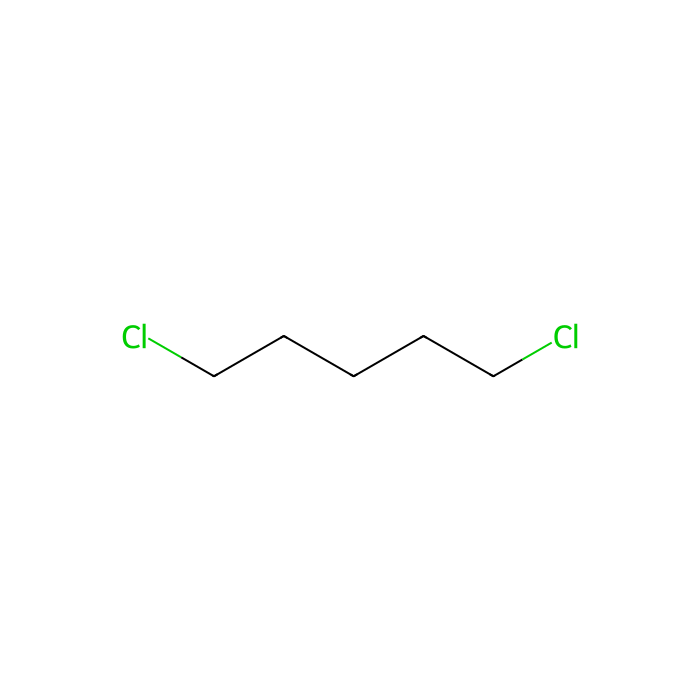
A linear, bifunctional alkyl dihalide featuring terminal chloromethyl groups on a five‑carbon chain. Useful as a C5 spacer/electrophile in SN2 chemistry and linker construction.
Item-specific facts (from Product Data):
SKU: D105687
Product name: 1,5-Dichloropentane
CAS: 628-76-2
PubChem CID: 12353
InChIKey: 195143 (as provided)
SMILES: Not specified for this item; refer to CoA/Spec Sheet.
Literature structural identifiers (for reference; not item specifications):
Common SMILES (literature): ClCCCCCCl
Molecular formula (literature): C5H10Cl2
Molecular weight (literature): ~141.04 g/mol
Structural features (general chemistry):
Open-chain saturated hydrocarbon (pentane backbone) bearing two primary chlorides (–CH2Cl) at C1 and C5.
No rings, unsaturation, heteroatoms beyond the two terminal chlorides; no stereogenic centers.
Functional groups: two benzylic-like? No—both are primary alkyl chlorides; behave as moderate SN2 electrophiles. The C5 spacing enables formation of five‑atom tethers in macrocyclizations and step‑growth polymerizations.
2D description: Cl–CH2–CH2–CH2–CH2–CH2–Cl, with freely rotatable C–C bonds; lowest-energy conformers are anti/extended, but many conformations accessible under ambient conditions.
Synthetic Utility
Functional role: bifunctional primary alkyl chloride (–CH2Cl … CH2Cl) on a C5 tether. Enables diverse SN2‑based bond constructions.
Quaternization chemistry: Generates bis‑ammonium or bis‑azolium cations as linkers for ionic liquids, phase‑transfer catalysts, and organocatalyst precursors.
Macrocyclizations: With di‑nucleophiles at high dilution to form macrocycles (C5 spacer adjusts ring size and flexibility). Iodide catalysis (TBAI/NaI) often improves cyclization yields.
Activation strategies: In situ Finkelstein (NaI, acetone/MeCN) to convert C–Cl to C–I, or tosylate/mesylate exchange from the corresponding diol provides more reactive leaving groups.
Polymer chemistry: Step‑growth polymerizations with di‑thiols/di‑phenolates to form poly(thioether)s or poly(ether)s featuring pentamethylene spacers.
Selectivity and control:
Monosubstitution vs disubstitution is tuned by stoichiometry and temperature; dilute conditions favor intramolecular closures over oligomerization.
Competing E2 eliminations are minimal for primary chlorides but can occur under strong base/heat; choose nucleophilic over basic conditions where possible.
Practical notes:
Dry, oxygen‑free conditions benefit sensitive nucleophiles. Monitor by GC/LC; confirm halide substitution by 35/37Cl isotope patterns in MS.
Target Specificity
Not applicable. This product is a small‑molecule reagent and is not an antibody, probe, or biologic. No target specificity data are provided.
자주 묻는 질문
What is the purity of this product?
This product is supplied at ≥99% purity (chemical assay). Lot-specific values are stated on the Certificate of Analysis.
How should this product be stored?
Store at room temperature.
How is this product shipped?
This product is classified as dangerous goods and ships via FedEx DG Service. Ground and other economy services are not available, and delivery to some destinations or address types may be restricted.
What are the CAS number, molecular formula and molecular weight?
The CAS Number is 628-76-2, the molecular formula is C5H10Cl2, and the molecular weight is 141.04 g/mol. InChIKey LBKDGROORAKTLC-UHFFFAOYSA-N.
What documentation is provided?
Available product documentation, including Certificates of Analysis (COA), Safety Data Sheets (SDS), and specification sheets, is shown in the product document area. Document availability and access follow the current site policy.
Products are supplied to verified businesses, institutions, and qualified professionals for research and development use only. Not for use in humans, animals, diagnosis, or therapy.

 K2116471