GRADE & PURITYMoligand™?Moligand™ — Aladdin's line of ligands and bioactive small molecules. Use for receptor, pathway, and binding studies needing defined small-molecule tools.≥99%
Moligand™, ≥99% Moligand™ for sensitive chromatographic and analytical workflows requiring minimal baseline interference.
🌡
Storage & shipping
Store at 2-8°C,Desiccated Ships Wet ice Check lot-specific COA for exact specifications.
📋
Quality documents
SDS, COA, datasheet, and spec sheet available for download. Lot-specific COA accessible via lot number lookup.
📚
Literature proof
Cited in 0 peer-reviewed publications across chromatography, organic synthesis, and cross-coupling reactions.
개요
Selective inhibitor of Akt/PKB. Inhibits IGF-1-stimulated phosphorylation and activation of Akt (complete inhibition at 2.5 μM), suppressing downstream activation of mTOR, p70 S6 kinase and S6 ribosomal protein. Shows no activity at PDK1, SGK1 or PI 3-kin
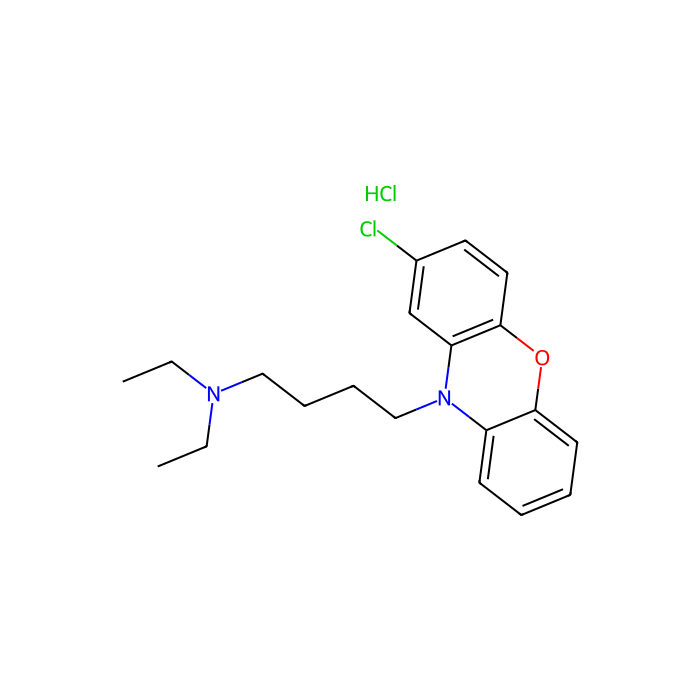
This compound belongs to the class of organic compounds known as n-substituted phenoxazines. These are phenoxyazines where the nitrogen atom is linked to an atom other than the hydrogen atom.
External Descriptors
Not available
1. Djoumbou Feunang Y, Eisner R, Knox C, Chepelev L, Hastings J, Owen G, Fahy E, Steinbeck C, Subramanian S, Bolton E, Greiner R, and Wishart DS. ClassyFire: Automated Chemical Classification With A Comprehensive, Computable Taxonomy. Journal of Cheminformatics, 2016, 8:61.
Soluble in water (1 mg/ml), DMSO (100 mM), and methanol.
굴절률
n20D1.57 (Predicted)
분자량
381.300 g/mol
XLogP3
Hydrogen Bond Donor Count
1
Hydrogen Bond Acceptor Count
3
Rotatable Bond Count
7
Exact Mass
380.142 Da
Monoisotopic Mass
380.142 Da
Topological Polar Surface Area
15.700 Ų
Heavy Atom Count
25
Formal Charge
0
Complexity
377.000
Isotope Atom Count
0
Defined Atom Stereocenter Count
0
Undefined Atom Stereocenter Count
0
Defined Bond Stereocenter Count
0
Undefined Bond Stereocenter Count
0
The total count of all stereochemical bonds
0
Covalently-Bonded Unit Count
2
솔루션 계산기
Molarity Calculator
Determine the necessary mass, volume, or concentration for preparing a solution.
Dilution Calculator
Determine the dilution needed to prepare a stock solution.
Reconstitution Calculator
리뷰
고객 리뷰
Application Protocols
No tested applications, methods, or recommended dilutions are provided in the Product Data for this SKU. The steps below are generic for small-molecule screening compounds and should be adapted only after confirming solubility and stability for 10-DEBC hydrochloride.
Preparation of master stock (general)
Weigh compound quickly in a low-humidity environment. Dissolve in anhydrous DMSO to 10–50 mM. Vortex and sonicate gently if needed. Filter through 0.22 µm PTFE if particulate remains.
Aliquot into low-bind tubes or 96/384-well source plates; seal and store at 2–8°C (short term) or −20/−80°C (long term) as permitted by stability; avoid repeated freeze–thaw by using single-use aliquots.
Working solution for biochemical assays (general)
Dilute DMSO stock into buffered assay media to desired final concentration, keeping DMSO ≤0.5–1% v/v or per assay tolerance. Include vehicle control.
Working solution for cell-based assays (general)
Prepare serial dilutions in complete medium; confirm no precipitation or cytotoxicity from vehicle. Equilibrate temperature and pH before dosing.
QC checks (general)
Verify concentration by UV or LC–MS if chromophore/ionization allows. Periodically recheck purity of aged stocks.
Refer to the CoA/SDS for any item-specific constraints before implementing protocols.
Biological Roles
Item-specific biological role information: Not specified for this item; refer to literature and the CoA if available. No target, pathway, or MOA is provided in the Product Data.
General guidance for small-molecule library members (not item-specific)
Library compounds are used as chemical probes to explore biochemical mechanisms in vitro and in cells under research conditions only.
Hydrochloride salts often enhance aqueous solubility, enabling preparation of assay-ready solutions and improving dosing accuracy.
Prior to biological testing, verify identity, purity, and chemical stability under assay conditions (pH, temperature, light), and assess nonspecific assay interference (e.g., aggregation, redox activity) using appropriate counterscreens.
Practical considerations (general)
Establish a solubility and stability profile in relevant media (complete cell culture medium, buffer with serum proteins, etc.).
Evaluate adsorption losses on plastics at low concentrations; low-bind labware may improve reproducibility.
Determine acceptable DMSO carryover for your assay system and include solvent controls.
No medical or clinical claims are made for this product. It is intended strictly for research use only (per Product Data).
Buffer Applications
This product is a small-molecule hydrochloride salt and is not a buffering reagent. Therefore, conventional buffer-system formulation guidance (e.g., phosphate, Tris, HEPES) does not directly apply.
Practical notes for assay buffers (general guidance)
If preparing aqueous working solutions, select a buffer compatible with your assay (e.g., phosphate, HEPES) and adjust pH to maintain the compound in its desired ionization state.
Maintain consistent ionic strength and include appropriate co-solvent (e.g., ≤1% DMSO) to aid solubility if required.
For precise pKa and solubility-driven buffer selection specific to 10-DEBC hydrochloride, consult the CoA/Spec Sheet or perform empirical titration/solubility screening.
Green Alternatives
In the absence of item-specific solvent and process requirements, the following recommendations focus on greener handling of small-molecule hydrochloride salts in screening workflows (general guidance).
Solvent choices and greener substitutions
Prefer water or buffered aqueous media where feasible; adjust pH to favor the protonated form for solubility.
DMSO is widely used but is not classed as “green.” Where compatibility allows, consider glycerol–water, polyethylene glycol (PEG 200/300) blends, or ethanol–water as co-solvent systems.
Avoid DMF and NMP when possible due to reproductive toxicity concerns; substitute with MeCN, EtOH, or water/DMSO blends if assay-compatible.
Operational practices
Use miniaturized screening formats (e.g., 384/1536-well) to reduce solvent volume and waste.
Implement sealed storage (septum or crimp vials) and inert headspace to extend stock life, minimizing remake frequency and waste.
Comparison snapshot (general)
DMSO: Excellent solvency; high boiling point facilitates storage but complicates waste handling.
Water (acidified): Greenest option; requires buffering for stability and may limit compatibility with hydrophobic targets.
EtOH/Water: Better EHS profile than many polar aprotics; may affect some bioassays at modest percentages.
Waste and EHS
Segregate halogenated from non-halogenated organic waste.
For aqueous assay plates, employ enzymatic or activated-carbon deactivation where institutional protocols permit.
These are general best practices; validate substitutions empirically for 10-DEBC hydrochloride.
Pharmaceutical Uses
No excipient role, compendial status, or formulation use is specified for this item in the Product Data. The following comments are general to small-molecule hydrochloride salts and do not constitute a use claim for this product.
General context (not item-specific)
Hydrochloride salts are commonly used during medicinal chemistry and preformulation studies to enhance solubility and solid-state stability of basic molecules.
Salt form can influence hygroscopicity, dissolution rate, and polymorphism; early salt screening is a standard practice in drug discovery.
Research/manufacturing considerations (general)
For preclinical formulation experiments, typical vehicles include aqueous buffers (pH-adjusted), PEG/water blends, or DMSO/solvent cosolvent systems. Compatibility must be validated case-by-case.
Analytical controls include salt-to-free-base conversion monitoring, water content (Karl Fischer), and counterion assay (e.g., argentometric or IC).
Compliance
This product is sold for research use only and is not intended for clinical, diagnostic, or therapeutic applications (per Product Data). Any development use requires independent qualification and regulatory assessment.
Physical Properties
Item-specific physico-chemical data are not included in the Product Data for this SKU. Values below are NOT item specifications and are provided only as general guidance for small-molecule hydrochloride salts.
Item-specific values (Product Data)
Appearance: Not specified for this item; refer to CoA/Spec Sheet.
Molecular weight: Not specified for this item; refer to CoA/Spec Sheet.
Molecular formula: Not specified for this item; refer to CoA/Spec Sheet.
Melting point: Not specified for this item; refer to CoA/Spec Sheet.
Boiling point: Not applicable for ionic solids; decomposition typically precedes boiling (general comment).
Density: Not specified for this item; refer to CoA/Spec Sheet.
Solubility: Not specified for this item; refer to CoA/Spec Sheet.
General/literature expectations for organic HCl salts (not item-specific)
Physical state: Often crystalline, hygroscopic solids.
Solubility profile: Frequently soluble in polar aprotic solvents (e.g., DMSO, DMF) and aqueous media, with solubility enhanced under acidic conditions; free bases are typically more soluble in organic solvents like MeOH/EtOH/MeCN (general chemistry knowledge).
Partitioning: Cationic salts generally exhibit lower logP and higher logD in acidic aqueous media than their free bases (literature trend).
Refractive index: Not applicable to solids; measure in solution if required.
Always consult the Certificate of Analysis (CoA) for lot-specific properties and the SDS for handling-related properties.
Quality and Grades
Item-specific grade (from Product Data)
Grade/Purity: Moligand™. No numeric purity, residual solvent, or metal limits are specified for this item; refer to CoA/Spec Sheet.
What Moligand™ typically implies (general description of catalog grade; not a specification)
Designed for small-molecule and compound libraries used in screening, target validation, and SAR exploration.
Emphasis on structural identity and suitability for in vitro research. Typical customer use includes preparation of DMSO stocks for biochemical/cellular assays.
Documentation commonly provided: CoA (purity/ID methods such as HPLC/LC–MS/NMR), and SDS. Actual methods and acceptance criteria are lot-specific.
Practical implications for users (general guidance)
Verify purity and identity with in-house QC (e.g., LC–MS, 1H NMR) prior to sensitive assays.
If low-UV applications (e.g., HPLC detection at 210–254 nm) are planned, assess background absorbance of solvent and analyte.
If counterion content or water content are critical for your workflow, request the lot CoA or Spec Sheet; Karl Fischer or ion chromatography data may be available upon request (not item-specified here).
Stabilizers/inhibitors
None specified for this item; refer to CoA/Spec Sheet.
Regulatory note
For research use only; not for human or veterinary use, clinical diagnostics, or food/cosmetic applications (from Product Data).
Reaction and Applications
Catalog application focus (from Product Data and category)
Listed under small-molecule/compound libraries with Moligand™ grade, indicating intended use in discovery screening, target engagement studies, and SAR development. No specific biological target or application is provided for this item.
Typical research applications for library compounds (general, not item-specific)
Biochemical binding or enzymatic assays to explore hit identification across diverse targets.
Cellular assays to probe pathway modulation, phenotypic screening, or chemogenomic studies (research use only).
Development of analytical methods (LC–MS retention, MS/MS spectra) to support ADME and in vitro profiling.
Practical tips (general)
Prepare concentrated DMSO stocks (e.g., 10–50 mM) under dry conditions; aliquot to avoid repeated freeze–thaw.
Assess compound stability under assay conditions (pH, temperature, light). Many hydrochloride salts are more stable dry and at low temperature.
If converting to free base for specific studies, neutralize carefully and confirm identity/speciation by NMR or LC–MS.
Synthetic chemistry use
Without structural details, no specific reaction roles can be assigned. If the compound bears a nucleophilic amine (common for HCl salts), derivatization may require basification to the free base before coupling (general practice).
Consult the CoA/SDS and, where available, literature on 10-DEBC derivatives for any target- or pathway-specific uses before experimental design.
Reaction Conditions
No reaction conditions specific to 10-DEBC hydrochloride are provided. The guidance below is general for handling organic hydrochloride salts when used as reagents/intermediates (not item-specific):
Converting to free base (general)
Dissolve the HCl salt in minimal water or alcohol/water and basify (e.g., NaHCO3 or Na2CO3 to pH 9–11) to liberate the free base; extract into an organic solvent (EtOAc, MTBE), dry, and use immediately or re-salt.
Typical solvents and temperatures (general)
N-acylation: Use DCM/DMF/MeCN with a non-nucleophilic base (DIPEA, TEA) at 0–25°C.
Amide couplings: DMF/MeCN/DCM with HATU/EDC reagents, 0–25°C; monitor by LC–MS.
N-alkylation: Polar aprotic solvents (MeCN/DMF); base (K2CO3/Cs2CO3); 0–50°C depending on electrophile reactivity.
Expected yields (literature, broad ranges; not item-specific)
Amide couplings and acylations commonly provide moderate to high yields (60–90%) when the free base is cleanly generated.
Stability notes (general)
Avoid strong base or high temperature if other base-labile groups may be present.
Minimize water during moisture-sensitive steps; many HCl salts are hygroscopic.
Use these as starting points only after confirming the actual functional groups of 10-DEBC hydrochloride from the CoA/structure.
Safety and Handling
Safety data specific to this item are not provided in the Product Data. The following guidance is general to small-molecule hydrochloride salts used in research labs. Always defer to the SDS for authoritative information.
GHS classification and labeling (item-specific)
Signal word: Not specified for this item; refer to SDS.
Hazard statements (H-phrases): Not specified for this item; refer to SDS.
Pictograms: Not specified for this item; refer to SDS.
General laboratory precautions (general chemistry knowledge)
Avoid inhalation of dust or aerosols; handle powders in a fume hood or ventilated enclosure.
Wear appropriate PPE: lab coat, safety glasses, and chemically resistant gloves (e.g., nitrile). Avoid skin and eye contact.
Prevent moisture uptake; many HCl salts are hygroscopic. Keep containers tightly closed with desiccant present.
Incompatibilities: Strong oxidizers; strong bases (which may liberate the free base); reactive acylating/alkylating agents.
First-aid overview (general)
Inhalation: Move to fresh air; seek medical attention if symptoms persist.
Skin/eye contact: Rinse with water for 15 minutes; remove contaminated clothing; obtain medical attention if irritation persists.
Ingestion: Rinse mouth; do not induce vomiting; get medical help.
Spill and disposal (general)
Avoid dust formation; collect solids by gentle sweeping or HEPA vacuum. Dispose in accordance with institutional and local regulations.
For definitive hazards, exposure limits, and transport information, consult the SDS for 10-DEBC hydrochloride (SKU D335507).
Solvent Selection
Item-specific solubility data are not provided. The guidance below reflects common practice for small-molecule hydrochloride salts in discovery workflows (general chemistry knowledge), and should be verified empirically for this compound.
Primary choices for stock solutions
DMSO: Often the first-line solvent for 10–50 mM master stocks due to broad solvating power and assay compatibility at low final %.
Water or aqueous buffers: HCl salts frequently show good water solubility, especially at mildly acidic pH (e.g., pH 3–6). If solubility is limited, add co-solvent (DMSO, MeOH) or adjust pH.
Co-solvent strategies
For limited aqueous solubility, prepare a concentrated DMSO stock, then dilute into buffer with vigorous mixing to minimize precipitation. Keep final DMSO ≤0.5–1% v/v for sensitive bioassays, if possible.
Ethanol or methanol can aid dissolution for some cationic organic salts but may be less compatible with certain assays.
Avoid/consider with caution
Nonpolar solvents (hexanes, toluene) are typically unsuitable for ionic salts.
Strongly basic media may convert the salt to the free base, changing solubility and speciation.
Quick comparison (general)
Water (acidified) — maximizes ionization and often solubility; best for immediate aqueous assays.
DMSO — highest likelihood of rapid dissolution; good for frozen master stocks.
MeCN/MeOH — useful as intermediates or blend components; verify assay compatibility.
Confirm actual solubility, stability, and pKa-dependent speciation using small-scale trials and the lot-specific CoA.
Keep tightly closed in the original container with desiccant present. Minimize headspace moisture; consider inert gas backfill for long-term storage.
Stability considerations (general)
Many hydrochloride salts are hygroscopic; limit ambient exposure. Record open/close events and cumulative time at room temperature.
Protect from prolonged light and heat sources unless stability data indicate otherwise.
Reconstitution guidance (general, not item-specific)
For screening use, dissolve in anhydrous DMSO to prepare a 10–50 mM master stock. Alternatively, dissolve in water or buffer adjusted to mildly acidic pH if soluble.
Filter sterilize through 0.22 µm if aseptic solutions are required. Prepare small, single-use aliquots to avoid freeze–thaw cycles.
Solution storage (general)
DMSO stocks: Typically stable for weeks at 2–8°C and months at −20/−80°C; verify by LC–MS/NMR for this specific compound.
Aqueous solutions: Use promptly; store at 2–8°C for short periods only, monitoring for precipitation or degradation.
For definitive shelf life, purity limits, and solubility for 10-DEBC hydrochloride (SKU D335507), consult the lot-specific CoA/Spec Sheet.
Structure and Identity
Brief description: 10-DEBC hydrochloride is listed as a Moligand small-molecule hydrochloride salt intended for screening and research use. Item-specific structure descriptors are not provided in the Product Data.
Item-specific identifiers (from Product Data)
CAS: 201788-90-1
CID: 16760284
InChIKey: 346427 (as provided)
SMILES: Not specified for this item; refer to CoA/Spec Sheet.
Molecular formula: Not specified for this item; refer to CoA/Spec Sheet.
Molecular weight: Not specified for this item; refer to CoA/Spec Sheet.
Structural features (general context for hydrochloride salts; not item-specific)
Hydrochloride designations typically indicate a protonated basic center (commonly an amine) paired with chloride as counter‑anion.
Many small-molecule HCl salts exhibit improved solid stability and water/DMSO solubility relative to the free base (general chemistry knowledge).
2D structural description (general, not item-specific)
Cationic organic scaffold (protonated base) with Cl− counterion; specific ring systems, heteroatoms, and substituent patterns are not provided for this listing. Consult CoA/SDS for the definitive structural representation.
Synonymy and registry
“10-DEBC hydrochloride” is the catalog/trade name used in Moligand screening libraries. Definitive IUPAC name and synonyms are not provided here; see CoA/Spec Sheet.
Synthetic Utility
Item-specific functional groups are not provided. The following notes are general for organic hydrochloride salts that contain protonated amine functionalities; applicability to 10-DEBC hydrochloride should be verified from the CoA/structure.
Typical transformations after basification (general)
Amide formation: Convert to the free base, then couple with activated carboxylic acids using carbodiimides (EDC/HOBt, HATU) or acid chlorides.
Alkylation/acylation: Free amines can undergo N-alkylation (e.g., with alkyl halides under basic conditions) or N-acylation (anhydrides/acyl chlorides) with appropriate base and solvent.
Salt metathesis: Exchange HCl for alternative counterions (e.g., sulfate, mesylate, tosylate) by neutralization and re-salting to modify solid-state or solubility properties.
Protection strategies (general)
If multifunctional, protect nucleophilic sites (Boc, Cbz, Fmoc) after liberating the free base; confirm full neutralization to avoid reduced yields.
Purification and analysis (general)
Monitor speciation by LC–MS and 1H NMR; chloride counterion can be quantified by IC or argentometric titration.
For solid isolation, choose antisolvent crystallization or triturations mindful of hygroscopicity.
Because the precise structure of 10-DEBC hydrochloride is not specified here, plan any derivatizations only after confirming the functional groups from the CoA or primary literature.
Target Specificity
Item-specific target information: Not specified for this item; refer to CoA/Spec Sheet and primary literature. No antigen/epitope, enzyme, receptor, or pathway annotations are provided in the Product Data for 10-DEBC hydrochloride.
General note for Moligand™ library members (not item-specific)
Such compounds are typically deployed in unbiased or focused screens; any target specificity must be established experimentally under defined conditions.
For definitive target annotations, consult peer-reviewed sources indexed to CAS 201788-90-1 or CID 16760284 and validate with orthogonal assays.
Need help choosing the grade?
Our grade selection guide covers purity, stabilizer status, and application suitability for all variants in our catalog.
Products are supplied to verified businesses, institutions, and qualified professionals for research and development use only. Not for use in humans, animals, diagnosis, or therapy.