This compound belongs to the class of organic compounds known as alkyl-phenylketones. These are aromatic compounds containing a ketone substituted by one alkyl group, and a phenyl group.
External Descriptors
Not available
1. Djoumbou Feunang Y, Eisner R, Knox C, Chepelev L, Hastings J, Owen G, Fahy E, Steinbeck C, Subramanian S, Bolton E, Greiner R, and Wishart DS. ClassyFire: Automated Chemical Classification With A Comprehensive, Computable Taxonomy. Journal of Cheminformatics, 2016, 8:61.
P305+P351+P338:IF IN EYES: Rinse cautiously with water for several minutes. Remove contact lenses if present and easy to do - continue rinsing.
P264+P265:Wash hands [and …] thoroughly after handling. Do not touch eyes.
P337+P317:If eye irritation persists: Get medical help.
솔루션 계산기
Molarity Calculator
Determine the necessary mass, volume, or concentration for preparing a solution.
Dilution Calculator
Determine the dilution needed to prepare a stock solution.
Reconstitution Calculator
리뷰
고객 리뷰
Application Protocols
No standardized bioassay or immunoassay protocols are associated with this small-molecule building block.
General laboratory usage suggestions (non-binding, literature-based):
Stock solutions: Prepare 10–100 mM stocks in dry DMSO, DMF, acetonitrile, or ethanol for screening chemistry; filter through 0.2 µm PTFE if particulate is present.
Reaction setup: For moisture-sensitive steps (e.g., BBr3 demethylation), flame- or oven-dry glassware; maintain inert atmosphere (N2/Ar).
Purification: Silica gel chromatography using hexanes/EtOAc or DCM/MeOH gradients; monitor at 254 nm. Recrystallization from ethanol or EtOAc/hexanes as appropriate.
For biological testing or materials fabrication, develop application-specific protocols and consult primary literature. Always verify solubility and stability under your exact conditions.
Biological Roles
This compound is a synthetic aromatic ketone and does not have a known endogenous biological role.
General/literature context (for research use only; no clinical claims):
Trimethoxyphenyl fragments appear in numerous bioactive research scaffolds as electron-rich aryl donors. 2,4,6-Trimethoxy substitution can modulate lipophilicity, electronics, and conformational preferences in small-molecule libraries.
The acetophenone handle enables formation of chalcones and related enones, which are widely explored as chemical probes and as intermediates toward flavonoids and aurones in chemical biology studies.
Following O-demethylation, the corresponding polyphenolic derivatives (e.g., 2,4,6-trihydroxyacetophenone) can act as chelators and hydrogen-bond donors/acceptors in supramolecular and metalloenzyme-mimetic research.
Caveats:
Any observations of biological activity for molecules derived from this building block are system- and structure-dependent. They do not imply properties for this product itself.
Use strictly for laboratory research. Handle with standard precautions to avoid confounding biological assays (e.g., ensure solvent and impurity backgrounds are controlled).
Buffer Applications
Not typically applicable. 2',4',6'-Trimethoxyacetophenone is a neutral organic building block, not used as a buffering agent.
Practical guidance:
If dissolution into aqueous systems is required (e.g., for assay preparation), prepare concentrated stock solutions in miscible organic solvents such as DMSO, DMF, or ethanol, then dilute into the aqueous medium while monitoring final cosolvent content to avoid precipitation and biological interference.
Adjust pH using an appropriate buffer system independent of this compound (e.g., phosphate, HEPES, Tris) suited to your assay’s pH range.
Green Alternatives
This product is a solid building block; greener considerations largely relate to solvent/catalyst choices in its transformations.
Greener solvent swaps (general guidance):
Replace dichloromethane with ethyl acetate or 2-methyltetrahydrofuran (2-MeTHF) where compatible (workups, extractions, some reactions).
Favor ethanol or isopropanol for base-catalyzed condensations instead of DMF/DMSO when feasible.
Use toluene or anisole (safer aromatics) rather than chlorinated solvents for high-temperature SEAr where solvent polarity is not critical.
Comparison (general, not item specs):
DCM: excellent solvency/inertness; high environmental and health impacts.
EtOAc: biodegradable, low toxicity; good crystallization solvent; lower solvency for very nonpolar substrates.
2-MeTHF: biorenewable, higher boiling than THF; water-immiscible aiding separations; may coordinate less to some metals.
Ethanol: biorenewable, benign; supports base-mediated aldol/Claisen–Schmidt; limited for very low-solubility substrates.
Catalyst/auxiliary choices:
Prefer organocatalytic aldol/condensation methods or heterogeneous bases (e.g., basic alumina) to reduce waste and simplify workup.
Consider demethylation with greener alternatives (e.g., aqueous HBr under pressure) only if selectivity and safety are acceptable; BBr3 remains a common choice but requires careful handling and quench.
Process intensification:
Solvent recycling, telescoped steps (e.g., in situ enolization/condensation), and crystallization-driven purifications can significantly reduce E-factors.
Evaluate green metrics (atom economy, PMI) for your chosen route and adjust conditions accordingly.
Pharmaceutical Uses
No excipient or pharmacopeial role is specified for this item; refer to CoA/Spec Sheet if a compendial grade exists.
Research/manufacturing context (no therapeutic claims):
Synthetic intermediate: The 2,4,6-trimethoxyphenyl ketone motif is useful for assembling trimethoxyaryl-containing fragments via aldol condensations (chalcones), reductions to secondary alcohols, or further functionalization followed by cross-coupling after strategic halogenation.
Protecting-group strategy: The methoxy groups can serve as latent phenols, revealed by O-demethylation (e.g., BBr3), allowing stepwise access to polyphenolic pharmacophore precursors.
Process considerations: Strong UV chromophore aids in in-process control by HPLC/UPLC detection. Solid-state crystallinity can facilitate isolation and drying compared to oily intermediates.
If pharmaceutical development is intended, ensure:
Appropriately qualified grade, impurity profiling, and residual solvent controls per ICH Q3 guidelines.
Verified identity by orthogonal methods (NMR, HRMS) and stability studies under proposed storage conditions.
Physical Properties
Item-specific specifications:
Appearance: Not specified for this item; refer to CoA/Spec Sheet.
Grade/Purity: Not specified for this item; refer to CoA/Spec Sheet.
Storage & shipping (from Product Data):
Storage: Room temperature
Shipping: Normal
Literature/computed (for reference only; not product specifications):
Molecular formula: C11H14O4
Formula weight: ~210.23 g/mol
Exact mass (monoisotopic): ~210.0892 Da
Physical state: typically a crystalline solid for analogous trimethoxyacetophenones; color may range from off-white to pale yellow (literature observation).
Solubility: expected to be soluble in common organic solvents (e.g., dichloromethane, chloroform, ethyl acetate, THF, acetone, methanol/ethanol); low solubility in water (general aromatic ether/ketone behavior).
Volatility: low (solid, aromatic ketone).
UV characteristics: aromatic methoxy substituents confer strong UV absorbance in near-UV; exact λmax not compiled here (literature generalization).
Practical handling notes (general):
Recrystallization solvents often include ethanol, methanol, or ethyl acetate/hexanes mixtures; optimal choice should be determined empirically.
For quantitative properties such as melting point, boiling point, density, logP, pKa, and refractive index: Not specified for this item; consult primary literature or measure under your lab conditions.
Quality and Grades
Item-specific quality details:
Grade/Purity: Not specified for this item; refer to CoA/Spec Sheet.
General guidance on quality expectations for aromatic building blocks:
Typical research-grade materials are supplied at high assay (often ≥95%) with identity confirmed by NMR and/or MS and purity assessed by HPLC/GC. When not specified here, the definitive values are in the Certificate of Analysis (CoA) included per lot.
UV/Chromatography behavior: Methoxy-substituted aromatics show strong UV absorbance, facilitating HPLC detection at 254–280 nm (general observation). If HPLC-grade purity or low-UV impurity levels are required for photochemical or analytical applications, specify at ordering.
Stabilizers: This product is not typically stabilized. If any stabilizers/inhibitors were used, they would be listed explicitly on the CoA/SDS. For this item: Not specified; refer to CoA.
Impurity considerations: Possible process-related residues may include anisole-like ethers, unreacted precursors, or O-demethylated phenolics. If your application is sensitive to phenolic traces (e.g., metal-catalyzed couplings or redox chemistry), consider prewashing with base or performing a quick recrystallization.
Documentation: Request CoA, NMR, and MS on a per-lot basis to confirm identity and purity for regulated workflows.
Storage per Product Data: Room temperature; keep container tightly closed and protected from light and oxidants to maintain quality.
Reaction and Applications
Roles in synthesis (literature/general):
Aromatic ketone platform: The acetophenone moiety participates in base-catalyzed condensations (e.g., Claisen–Schmidt) to access chalcones and diaryl enones, frequently leveraging the electron-rich 2,4,6-trimethoxyphenyl unit.
Alpha-functionalization: Enolization under basic conditions enables α-halogenation (e.g., NBS/acid or Br2/AcOH), Mannich reactions, and subsequent elaboration to heterocycles.
O-Demethylation: Treatment with BBr3, BCl3, or AlCl3/thiols converts methoxy groups to phenols, providing 2,4,6-trihydroxyacetophenone (phloracetophenone) motifs valuable in polyphenol chemistry and ligand design.
Reductive transformations: Carbonyl reduction (NaBH4, catalytic hydrogenation) affords the corresponding secondary alcohol; further manipulations (esterification, etherification) are enabled by the phenyl ether pattern.
Electrophilic aromatic substitution (SEAr): The three methoxy substituents strongly activate the ring; regioselectivity is constrained by existing ortho/para occupation, making positions 3 and 5 the principal remaining sites (though less activated). Nitration, sulfonylation, or halogenation may be feasible under controlled conditions.
Applications:
Precursor to trimethoxyphenyl-containing pharmacophore fragments (research only) and to natural product analogs via chalcone/flavonoid synthesis (no clinical claims).
Photophysical materials: Trimethoxyaryl units are used in donor–acceptor systems; the acetyl facilitates further coupling/condensation (general materials-chemistry context).
Practical tips:
Ensure anhydrous conditions for Lewis acid-mediated O-demethylation (BBr3/DCM). Quench carefully at 0 °C to manage exotherm.
For condensations, remove water (Dean–Stark in toluene or molecular sieves in aprotic solvents) to drive equilibrium when base strength is limited.
Reaction Conditions
General literature guidance (not product specifications; optimize for your system):
O-Demethylation to 2,4,6-trihydroxyacetophenone:
Reagent: BBr3 (1.0–3.0 equiv per OMe, depending on stepwise vs full demethylation)
Solvent: anhydrous CH2Cl2; 0 to −78 °C addition, then warm to 0–25 °C, 1–16 h
Quench: slow addition of MeOH or ice–water at 0 °C (exothermic)
Typical outcomes: high conversions with careful moisture exclusion; monitor by TLC/HPLC.
Base: KOH (10–40% aq) or NaOH in EtOH/MeOH; room temp to reflux, 2–24 h
Alternative: Piperidine or amine catalysts in EtOH under reflux with azeotropic water removal
Workup: neutralization, extraction, crystallization; yields often moderate to high depending on aldehyde partner.
α-Bromination:
Reagents: Br2/AcOH or NBS with catalytic acid
Solvent: AcOH, CHCl3, or MeCN; 0–25 °C
Notes: Control equivalents to avoid ring bromination; confirm regioselectivity.
Carbonyl reduction:
NaBH4 in MeOH/EtOH or THF/H2O; 0–25 °C, 0.5–2 h
Catalytic hydrogenation (Pd/C) in EtOH/EtOAc at ambient H2 pressure for clean reductions.
Analytical monitoring:
Strong UV at 254–280 nm enables HPLC/UPLC tracking.
1H NMR: diagnostic singlets for three OMe (~3.7–3.9 ppm) and acetyl methyl (~2.5–2.7 ppm); aromatic protons limited to two signals (positions 3 and 5).
Safety and Handling
Item-specific hazard information:
Signal word / H-statements / GHS classification / pictograms: Not specified for this item; refer to the SDS.
General safety considerations for aromatic ketones and anisole derivatives (literature/industry practice):
Hazards: May cause skin/eye irritation; harmful if swallowed; combustible solid. Avoid dust generation and ignition sources.
Incompatibilities: Strong oxidizers (risk of exotherm/oxidation), strong acids or Lewis acids under heated conditions (can promote demethylation/cleavage), strong bases (alpha-deprotonation of the ketone).
PPE: Safety glasses, lab coat, and appropriate chemically resistant gloves (e.g., nitrile). Use in a fume hood to avoid inhalation of dust or solvent vapors.
Handling: Minimize airborne dust. When weighing, avoid static buildup; ground metal spatulas if necessary.
First aid (overview; defer to SDS for details):
Inhalation: Move to fresh air; seek medical attention if symptoms persist.
Skin contact: Wash with soap and water; remove contaminated clothing.
Eye contact: Rinse cautiously with water for several minutes; remove contact lenses if present and easy; seek medical advice if irritation persists.
Ingestion: Rinse mouth; do not induce vomiting; seek medical attention.
Fire-fighting: Use CO2, dry chemical, or foam. Combustion may produce CO/CO2; firefighters should wear self-contained breathing apparatus.
Spill response: Avoid dust; sweep up carefully; place in suitable container for disposal per local regulations.
Always consult the product-specific SDS for authoritative hazard classifications and response procedures.
Solvent Selection
Applicability: This product is a solid building block, not used as a solvent. Solvent selection pertains to dissolving/processing it in synthesis or purification.
Poor solubility: water and highly nonpolar alkanes at ambient temperature.
Selection guidance by task:
Reaction medium for base-catalyzed condensations (e.g., Claisen–Schmidt): ethanol or methanol with aqueous KOH; or polar aprotic solvents (DMF, DMSO) for stronger bases.
O-Demethylation (e.g., BBr3): anhydrous dichloromethane commonly used due to low nucleophilicity and good solvating power.
Electrophilic aromatic substitutions (if pursued): nonpolar to moderately polar aromatic/halogenated solvents (toluene, DCM, nitrobenzene—depending on reagent and temperature).
Recrystallization: ethanol or ethyl acetate/hexanes mixtures are typical starting points; optimize empirically.
Small comparison (general):
DCM vs EtOAc: DCM maximizes solubility and inertness but is less green; EtOAc is greener and often adequate for workups and crystallizations.
THF vs 2-MeTHF: 2-MeTHF offers similar solvency with better sustainability metrics; try as a greener alternative where compatible.
Always validate solvent choices against your reagents, catalyst system, and desired selectivity.
Storage and Reconstitution
Item-specific storage (from Product Data):
Storage conditions: Room temperature
Shipped: Normal
General storage guidance (literature/practice):
Keep tightly closed in a dry, well-ventilated place. Protect from strong oxidizers and moisture. Store away from strong acids/bases and sources of ignition.
If long-term storage is anticipated, consider an amber container or cabinet to minimize light exposure, though the compound is generally light-stable as a solid.
Reconstitution and solution handling (general):
Prepare stock solutions in dry organic solvents (e.g., DMSO, DMF, acetonitrile, ethanol, dichloromethane) depending on downstream use.
For analytical stocks, filter through 0.2 µm PTFE and record concentration gravimetrically or by UV if standards are available.
Solution stability: Aromatic ketone/anisole solutions are typically stable for days at 2–8 °C in dry, inert conditions; however, hydrolysis or oxidative degradation may occur over prolonged periods. Prepare fresh solutions when critical.
If any item-specific solution stability or reconstitution instructions are required for your application: Not specified for this item; refer to CoA/Spec Sheet.
Research use only: As noted in Product Data.
Structure and Identity
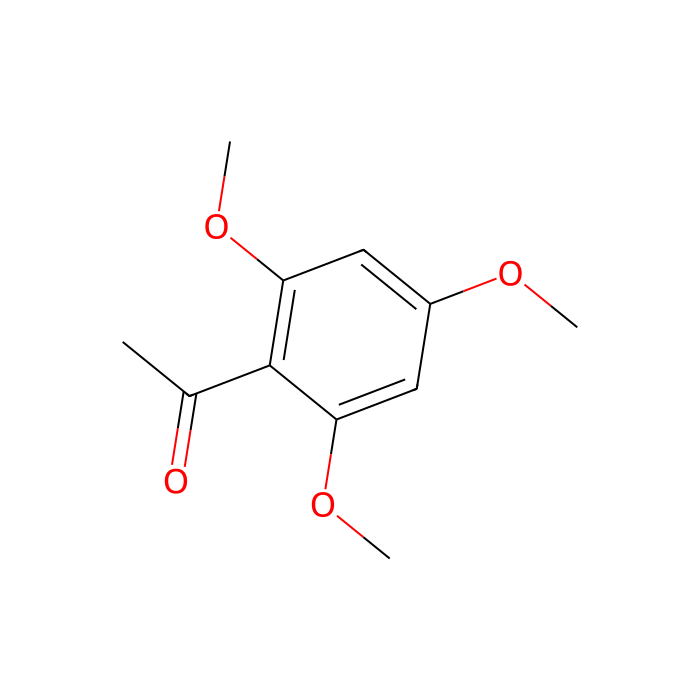
Brief: 2',4',6'-Trimethoxyacetophenone is an anisole-rich aromatic ketone (1-(2,4,6-trimethoxyphenyl)ethan-1-one) featuring a para- and ortho-disubstituted anisole motif flanking an acetyl group.
Item-specific (from Product Data):
CAS: 832-58-6
PubChem CID: 123089
InChIKey: 186551 (as provided)
Literature/computed identifiers (for reference; not item specifications):
2D structural description: a benzene ring bearing an acetyl (–CO–CH3) at C1; methoxy (–OCH3) substituents at C2, C4, and C6. Remaining ring positions C3 and C5 are hydrogen.
Functional groups: aryl ketone (acetophenone), three aryl methoxy ethers (anisole-type).
The three methoxy groups are strong o/p directors and net ring activators toward SEAr at unsubstituted positions; the carbonyl is m-directing and deactivating. The juxtaposition creates characteristic regioselectivity in further functionalization and facilitates O-demethylation to the corresponding phloracetophenone.
Synthetic Utility
Key functional elements:
Carbonyl (acetophenone): amenable to enolization, α-functionalization (halogenation, alkylation), condensations (Claisen–Schmidt), and reductions to secondary alcohols.
Three aryl methoxy groups: strong ring activators and directing groups; convertible to phenols via O-demethylation, offering a route to polyphenolic derivatives.
O-Demethylation: BBr3 or BCl3 in DCM at low temperature → 2,4,6-trihydroxyacetophenone; stepwise demethylation possible by tuning equivalents and temperature.
α-Bromination: Br2/AcOH or NBS with acid catalysis to give the bromoacetyl derivative, enabling SN2 coupling to nucleophiles or access to heterocycles (e.g., imidazoles via condensation with diamines).
Claisen–Schmidt condensation: With aromatic/heteroaromatic aldehydes under basic ethanol or NaOH/EtOH conditions to yield enones (chalcones) bearing a 2,4,6-trimethoxy donor ring.
Reduction: NaBH4 or catalytic hydrogenation to secondary alcohol; subsequent Mitsunobu or acylation furnishes diversified ethers/esters.
Electrophilic aromatic substitution: Despite existing o/p occupancy, positions 3 and 5 can be functionalized under suitably activating conditions (e.g., halogenation with NBS/NCS under Lewis acid mediation), though selectivity must be validated experimentally.
Retrosynthetic value:
Serves as a convergent donor ring module; after elaboration, demethylation unlocks H-bonding capacity for binding studies and coordination chemistry.
Target Specificity
Not applicable. This product is a small-molecule chemical and is not an antibody, enzyme, or biologic. No target specificity data (antigen, epitope, species reactivity, clone, isotype) are associated with this item.
Products are supplied to verified businesses, institutions, and qualified professionals for research and development use only. Not for use in humans, animals, diagnosis, or therapy.

 F2104245