This compound belongs to the class of organic compounds known as phenylpyridines. These are polycyclic aromatic compounds containing a benzene ring linked to a pyridine ring through a CC or CN bond.
External Descriptors
Not available
1. Djoumbou Feunang Y, Eisner R, Knox C, Chepelev L, Hastings J, Owen G, Fahy E, Steinbeck C, Subramanian S, Bolton E, Greiner R, and Wishart DS. ClassyFire: Automated Chemical Classification With A Comprehensive, Computable Taxonomy. Journal of Cheminformatics, 2016, 8:61.
Determine the necessary mass, volume, or concentration for preparing a solution.
Dilution Calculator
Determine the dilution needed to prepare a stock solution.
Reconstitution Calculator
리뷰
고객 리뷰
Application Protocols
No item-specific, tested biological or analytical protocols are provided in the Product Data.
General lab usage examples (literature/contextual, not validated for this item):
Ligand preparation for metal complex synthesis: dissolve the compound in dry CH2Cl2 or EtOAc, combine with the metal precursor under inert atmosphere, and heat/stir per the selected literature method; isolate by precipitation or column chromatography.
DoM functionalization: cool a solution in dry THF to −78 °C, add alkyllithium base, age, then quench with electrophile; standard aqueous workup and purification.
Users should develop and validate their own protocols under appropriate safety and quality systems. Refer to the SDS and CoA for handling and analytical verification prior to use.
Biological Roles
This product is intended for research use only. No biological roles are specified in the Product Data.
General/literature context:
2,4-Diphenylpyridine is a synthetic heteroaromatic compound without known endogenous biological role. The basic pyridine nitrogen could engage in nonspecific interactions with biomolecules in vitro (e.g., hydrophobic and π–π interactions), but such behavior is context-dependent and not a defined biological function.
In biochemical method development, arylpyridines may be used as model hydrophobic bases to benchmark partitioning, binding of heteroaromatics to proteins or membranes, or as spectroscopic standards due to characteristic UV absorbance. Such uses are assay- and protocol-specific and require empirical validation.
No clinical or therapeutic claims are made or implied. For any biological testing, ensure appropriate controls, solvent vehicles (e.g., DMSO at low percent), and safety assessments per institutional guidelines.
Buffer Applications
Not typically applicable. 2,4-Diphenylpyridine is a neutral organic solid with low aqueous solubility and is not used as a biological buffer component. If it must be introduced into aqueous systems, it is usually delivered via a miscible organic co-solvent (e.g., DMSO) at low percentage, with attention to precipitation and assay interference.
For practical usage considerations, see the Solvent Selection and Reaction & Applications sections.
Green Alternatives
Greener strategy focuses on solvent and process choices, as the substrate is a fixed aromatic heterocycle.
Preferred greener solvents (literature guidance):
2-MeTHF vs THF for strong-base chemistry: similar performance, bio-based origin, higher boiling point, and improved safety profile.
Ethyl acetate or isopropyl acetate for workups/recrystallization instead of chlorinated solvents when feasible.
Propylene carbonate or Cyrene for polar aprotic needs where temperature and solubility allow.
Energy and waste minimization:
Employ catalytic C–H activation or cross-couplings under flow/microwave to reduce time/energy.
Optimize recrystallization to avoid repeated chromatographic purifications.
EtOAc: moderate solubility, green profile; may require heating or co-solvent.
2-MeTHF: enables low-temperature base chemistry; forms peroxides more slowly than ethers like THF, but still monitor.
Tradeoffs:
Greener solvents may change crystallization behavior and impurity profiles; small-scale screens are essential.
Certain metalation or cyclometalation protocols still require specific legacy solvents for performance; validate substitutions experimentally.
Pharmaceutical Uses
No pharmacopeial status, excipient role, or formulation use is specified for this item in the Product Data. This compound is supplied strictly for research use.
General/literature context (non-clinical):
Aromatic heterocycles like diphenylpyridines may appear as exploratory scaffolds in medicinal chemistry for SAR studies due to their rigid, lipophilic cores and a basic nitrogen. However, 2,4-diphenylpyridine itself is primarily a research chemical, more commonly encountered as a ligand/precursor in coordination and materials chemistry rather than as a formulated pharmaceutical component.
If used in pre-formulation research, solubilization typically requires organic vehicles or cyclodextrin inclusion complexes; such work is highly application-specific and not an indicated use for this catalog item.
Physical Properties
This item’s detailed physical specifications (exact melting point, boiling point, density, refractive index, water content, UV cutoff, metal limits) are not listed in the provided Product Data.
Item-specific (from Product Data):
Appearance: Not specified for this item; refer to CoA/Spec Sheet.
Storage: Room temperature (ambient).
Literature/general characteristics for 2,4-diphenylpyridine (for context, not item specifications):
State: Typically a crystalline solid at room temperature for related diphenyl-substituted pyridines.
Solubility: Expected to be sparingly soluble in water; soluble in common organic solvents (e.g., dichloromethane, chloroform, toluene, THF, ethyl acetate) due to hydrophobic aryl content and limited polarity.
Polarity/logP: Hydrophobic, elevated logP relative to pyridine; exact values vary by source.
Acid–base: Contains a basic pyridine nitrogen (pKa of conjugate acid for similar pyridines typically ~5–6, literature), enabling protonation and coordination to metals.
Spectroscopy: Strong aromatic UV absorbance (200–300 nm range typical for triaryl heteroarenes; literature), useful for HPLC/UV tracking.
Not specified for this item; refer to CoA/Spec Sheet:
Melting point, boiling point, density, refractive index, exact solubility values, partition coefficient (logP), pKa (measured), DSC/TGA data.
Quality and Grades
Item-specific grade/purity: Not specified for this item; refer to CoA/Spec Sheet.
Guidance on grades (general information):
“Research grade” materials are suitable for most synthetic and analytical research applications. If low UV background, trace metal limits, or specific residual solvent/water limits are critical (e.g., photophysical studies, catalysis, OLED precursor preparation), request HPLC-grade or trace-metal-checked materials and review the CoA.
UV-sensitive applications: If the compound is used as a ligand or emitter precursor in photophysical studies, low levels of fluorescent impurities and defined purity metrics (HPLC area %, NMR) are recommended. Request spectral purity profiles when relevant.
Stabilizers: None are indicated in the Product Data for this item. If a stabilizer is present in a specific lot, it will be disclosed on the CoA/SDS; stabilizers can influence catalysis and photophysics.
What to check on receipt (best practices):
Identity: Verify by 1H/13C NMR and HRMS; aromatic fingerprints are diagnostic.
Purity: HPLC/UPLC or GC if soluble/volatile; melting range can also be indicative for crystalline materials.
Moisture/volatiles: Karl Fischer and TGA if your application is moisture/solvent sensitive (no item-specific limits provided).
Reaction and Applications
Use cases derive from its pyridyl nitrogen (Lewis basic site) and extended aromatic system.
Acts as an N-donor ligand; related 2-arylpyridines can cyclometalate (C^N) with late metals (e.g., Ir(III), Pt(II)) under appropriate conditions, forming luminescent complexes used in materials research. 2,4-Substitution modulates sterics/electronics versus 2-phenylpyridine.
Synthetic building block (literature):
Electrophilic aromatic substitution is deactivated on the pyridine ring but possible on phenyl rings with directing strategies.
Directed ortho-metalation adjacent to pyridyl nitrogen enables further functionalization (formylation, halogenation, borylation after quench).
N-oxidation (to pyridine N-oxide) followed by rearrangements can access otherwise challenging substitution patterns (Meerwein–Pyridine chemistry).
Materials/analytical contexts (literature):
Useful reference heteroarene for studying photophysics of arylpyridines; strong π–π transitions and tunable emission when complexed to metals.
Practical tips (general):
Ensure dryness for strong-base steps; dry glassware and inert gas recommended.
For metalation, start ≤ −78 to −40 °C in ethereal solvents; quench cautiously.
If preparing metal complexes, pre-dry ligand and base (e.g., carbonate) to avoid hydrolysis of metal precursors.
Item-specific application notes from catalog: None provided beyond research use; the above are literature-based illustrative uses.
Reaction Conditions
No item-specific reaction conditions are provided. The following are literature-based general guidelines for common transformations involving 2-arylpyridines and closely related systems:
Directed ortho-metalation (DoM):
Base/solvent: s-BuLi or n-BuLi with TMEDA in dry THF or 2-MeTHF.
Temperature: −78 to −40 °C for lithiation; gradual warm-up for electrophile quench (e.g., DMF for formylation, B(OMe)3 for borylation).
Oxidant: mCPBA or peracids in CH2Cl2 at 0 °C to rt; control equivalents to avoid over-oxidation.
N-oxide rearrangements (e.g., Boekelheide) typically require acylation and heating.
Cyclometalation to Ir(III)/Pt(II) (illustrative):
Metal precursors: [IrCl2(COD)]2 or K2[PtCl4]; base (e.g., Na2CO3, Ag salts when needed) in mixed solvents (2-ethoxyethanol/H2O or EtOAc/MeCN), reflux to elevated temps (80–130 °C) depending on system.
Cross-coupling on functionalized derivatives:
Catalyst: Pd(0/II) systems with phosphine or NHC ligands.
All parameters should be optimized for the specific substrate, scale, and catalyst system. Consult primary literature for exact procedures.
Safety and Handling
Always consult the SDS for authoritative hazard information and procedures.
Item-specific hazard listing: Not specified for this item; refer to SDS.
Signal word: Not specified for this item; refer to SDS.
H-statements: Not specified for this item; refer to SDS.
GHS classification and pictograms: Not specified for this item; refer to SDS.
General safety considerations for aromatic heterocycles (literature/general guidance):
Expected hazards: May cause skin/eye irritation and respiratory tract irritation if dust is generated. Avoid inhalation of dust/particulates and contact with skin/eyes.
Personal protective equipment (PPE): Lab coat, safety glasses/goggles, and appropriate chemically resistant gloves (e.g., nitrile). Handle in a fume hood to minimize exposure to dust or solvent vapors during dissolution.
Handling: Avoid generating dust; use anti-static precautions when weighing fine powders. Keep away from strong oxidizers. If used in heated reactions, ensure adequate ventilation.
First aid (general): Inhalation—move to fresh air; Skin—wash with soap and water; Eyes—rinse cautiously with water for several minutes; Ingestion—rinse mouth. Seek medical attention if symptoms persist. Follow SDS instructions.
Fire safety: Aromatic solids are combustible; in case of fire use CO2, dry chemical, or foam. Avoid water jets on solvent-borne fires.
Spill/cleanup: Avoid dust formation; collect mechanically or with HEPA-filtered vacuum and dispose of in accordance with local regulations.
Solvent Selection
2,4-Diphenylpyridine is a hydrophobic, π-rich heteroaromatic. Solvent choice is driven by desired solubility, reaction compatibility, and downstream isolation.
Poor: Water and very nonpolar alkanes at ambient temperature; hot solvents or co-solvents may be needed.
Selection guidance:
Synthesis/metalation: Dry, polar aprotic solvents (THF, 2-MeTHF, MTBE, or ether mixtures) for directed ortho-metalation or lithiation under inert atmosphere.
Cross-coupling on further-functionalized analogs: DMF, dioxane, or toluene with catalytic systems; choose by catalyst solubility and temperature window.
Photophysical studies and complexation: Chlorinated aromatics (CH2Cl2, PhCl) or acetonitrile can provide clean UV–vis baselines; verify spectral background.
Workup and crystallization:
Often recrystallizable from ethanol/IPA–water, toluene/hexanes, or EtOAc/hexanes (literature practice). Optimize by small-scale screens.
Quick comparison (literature perspective):
Toluene: high solubility when warm; good for high-temperature steps.
CH2Cl2: rapid dissolution at rt; easy removal but halogenated waste.
Item-specific storage and shipping (from Product Data):
Storage conditions: Room temperature.
Shipped in: Normal.
General storage guidance (applicable to aromatic heterocycles):
Keep container tightly closed in a dry, well-ventilated place. Protect from prolonged exposure to light and ambient humidity to maintain purity.
If long-term storage is planned, consider storing in an amber glass bottle with desiccant/inert headspace, especially if repeated opening is expected.
Reconstitution/dissolution (general):
For stock solutions: dissolve in an appropriate organic solvent (e.g., CH2Cl2, THF, toluene, DMF, or DMSO) based on downstream use. Filter through a PTFE syringe filter (0.2–0.45 μm) if particulate is present.
For biological assays: prepare concentrated stocks in DMSO and dilute into assay media to low final DMSO percentages (≤0.5–1%), monitoring for precipitation.
Stability notes:
The compound is expected to be stable under recommended storage; avoid strong oxidants and strong acids/bases unless required by the intended reaction. No shelf-life or impurity growth data are specified; verify integrity by NMR/HPLC before critical experiments.
Not specified for this item; refer to CoA/Spec Sheet:
Any stabilizers, exact shelf-life, and solution stability timelines.
Structure and Identity
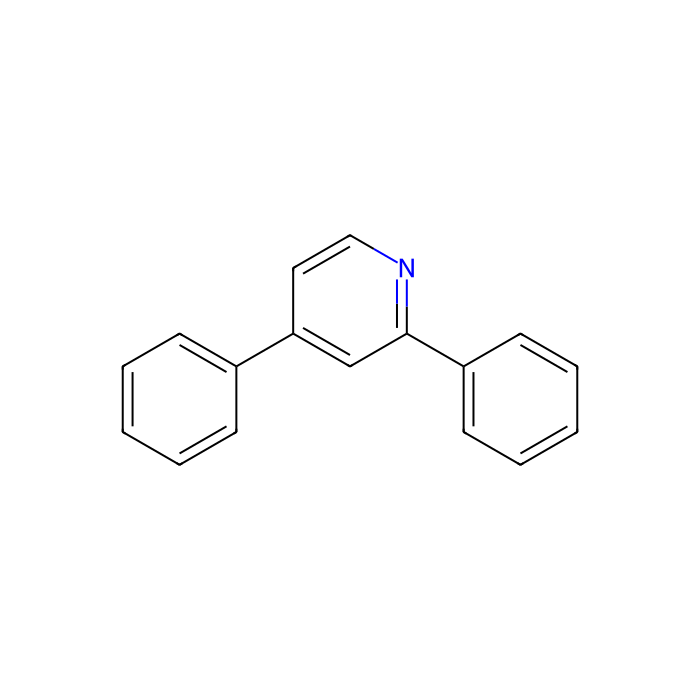
Brief overview: 2,4-Diphenylpyridine is a disubstituted pyridine bearing phenyl groups at the 2- and 4-positions, making it a rigid, hydrophobic, π-rich heteroaromatic scaffold useful in synthesis and coordination chemistry.
Core features: a pyridine ring (one ring nitrogen) substituted by phenyl rings at C-2 (ortho) and C-4 (para relative to N). No stereocenters; planarity favored but with possible torsion between aryl rings.
Functional groups: basic heteroaromatic nitrogen (pyridine) and two electron-rich phenyl rings.
Molecular formula (literature): C17H13N; Calculated molecular weight (literature): ~231.29 g/mol.
2D description: The pyridine ring nitrogen is position 1; phenyl groups are bonded at positions 2 and 4, creating a triaryl-type, conjugated framework.
Not specified for this item; refer to CoA/Spec Sheet:
2,4-Diphenylpyridine offers a versatile heteroaromatic platform with a Lewis-basic nitrogen and two appended phenyl rings.
Functional group reactivity (literature):
Pyridine nitrogen: protonation, N-oxidation, quaternization (e.g., N-alkylation) to tune solubility/electronics.
Aryl C–H sites: amenable to directed ortho-metalation adjacent to the nitrogen or to transition-metal-catalyzed C–H activation, enabling formylation, halogenation, borylation, and arylation.
Phenyl rings: electrophilic substitution under controlled conditions; cross-couplings applicable when derivatives bear halide/triflate handles.
Coordination chemistry:
Acts as an N-donor or as a component in cyclometalated C^N ligand sets with late transition metals (Ir, Pt, Pd) under appropriate conditions, useful in luminescent complex synthesis and catalysis research.
Retrosynthetic value:
Accessible via condensation/arylation routes (e.g., Suzuki/Mizoroki–Heck using halopyridines/boronic acids or oxidative biaryl couplings), providing modular entry to analogs with varied substituents on the phenyl rings.
Practical notes:
For base-mediated steps, rigorously exclude moisture/air; pre-dry solvent and glassware.
Purification often achieved by recrystallization or silica gel chromatography using moderately polar eluents (e.g., hexanes/EtOAc or toluene/EtOAc).
Target Specificity
Not applicable. This product is a small-molecule heteroaromatic reagent and is not an antibody, enzyme, or biological targeting agent. No antigen/epitope, clone, isotype, or species reactivity information applies.
자주 묻는 질문
What is the purity of this product?
This product is supplied at ≥97% purity (chemical assay). Lot-specific values are stated on the Certificate of Analysis.
How should this product be stored?
Store at room temperature.
How is this product shipped?
This product ships under standard ambient conditions. No temperature-controlled packaging is required.
What are the CAS number, molecular formula and molecular weight?
The CAS Number is 26274-35-1, the molecular formula is C17H13N, and the molecular weight is 231.29 g/mol. InChIKey YASXBDJBCBUIHT-UHFFFAOYSA-N.
What documentation is provided?
Available product documentation, including Certificates of Analysis (COA), Safety Data Sheets (SDS), and specification sheets, is shown in the product document area. Document availability and access follow the current site policy.
Products are supplied to verified businesses, institutions, and qualified professionals for research and development use only. Not for use in humans, animals, diagnosis, or therapy.

 A2002145