This compound belongs to the class of organic compounds known as 2-halobenzoic acids and derivatives. These are benzoic acids or derivatives carrying a halogen atom at the 2-position of the benzene ring.
External Descriptors
benzamides - dichlorobenzene
1. Djoumbou Feunang Y, Eisner R, Knox C, Chepelev L, Hastings J, Owen G, Fahy E, Steinbeck C, Subramanian S, Bolton E, Greiner R, and Wishart DS. ClassyFire: Automated Chemical Classification With A Comprehensive, Computable Taxonomy. Journal of Cheminformatics, 2016, 8:61.
Determine the necessary mass, volume, or concentration for preparing a solution.
Dilution Calculator
Determine the dilution needed to prepare a stock solution.
Reconstitution Calculator
리뷰
고객 리뷰
Application Protocols
Not applicable for antibody/assay protocols. For chemical use, consider the following general lab workflows (literature guidance):
Sample preparation for analysis: Dissolve a known amount in ACN, MeOH, or DMSO to prepare 1–10 mg/mL stock; filter (PTFE, 0.2 µm) before HPLC/UPLC.
Recrystallization: Trial EtOAc/hexanes or IPA/water systems; adjust solvent ratio to achieve slow crystallization and high purity.
Reaction setup: Dry glassware; select solvent per Solvent Selection; monitor by TLC/HPLC; quench cautiously, then extract and dry (Na2SO4) prior to concentration.
Always adapt to your SOPs and risk assessments. These are general suggestions, not validated procedures for this specific item.
Biological Roles
This compound is a synthetic aromatic amide and does not have a recognized physiological role. The following notes are general, literature-based observations about aromatic amides and are not specific biological claims for this product:
Structural motif: Aromatic amides are common scaffolds in medicinal chemistry due to their planarity, hydrogen-bonding capacity, and metabolic stability relative to esters.
Metabolic considerations: Primary benzamides can undergo Phase I hydrolysis to the corresponding acid and amine under enzymatic or chemical conditions, although amides are generally more resilient compared to esters (literature).
Binding: The –CONH2 group can act as both H‑bond donor and acceptor, aiding in ligand–protein interactions in research models (literature generality).
No medical, diagnostic, or therapeutic uses are implied. For research use only, as stated in the Product Data.
Buffer Applications
Not typically applicable. 2,6-Dichlorobenzamide is a hydrophobic organic building block, not a buffering agent. For aqueous work, choose compatible buffer systems based on your biological assay. If dissolution of this compound in buffered media is required, consider co‑solvents (e.g., DMSO at low percentages) and verify that pH and solvent do not promote amide hydrolysis.
Green Alternatives
While 2,6-dichlorobenzamide is a substrate (not a solvent), greener choices often relate to how it is processed.
Solvent selection (literature guidance)
Prefer ethyl acetate, 2‑MeTHF, cyclopentyl methyl ether (CPME), or isopropanol where feasible instead of dichloromethane or DMF.
Use water or water‑lean biphasic systems for hydrolysis or crystallization when compatible with kinetics and purity.
Reagent choices
For amide → aniline (Hofmann), consider in situ NaOCl from bleach under controlled conditions to minimize specialized oxidant waste. For amide dehydrations, explore PPA or catalytic dehydration approaches versus SOCl2/POCl3 when viable.
Energy and workup
Employ continuous flow for hazardous rearrangements to enhance heat/mass transfer and reduce inventory of reactive intermediates.
Optimize crystallizations to avoid extensive chromatographic purification.
Comparison (qualitative; literature)
DMF vs 2‑MeTHF: 2‑MeTHF is bio‑derived and easier to separate from water; DMF offers superior polarity but is problematic from a health/environment standpoint.
DCM vs EtOAc: EtOAc is less toxic and biodegradable; DCM provides better density for extractions but carries higher environmental/health concerns.
Trade-offs
Greener solvents may alter solubility and rates; run small‑scale screens (DoE) to confirm performance before scale‑up.
Pharmaceutical Uses
This product is offered strictly for research use. It is not an excipient and has no pharmacopeial monograph known to the supplier for use as a formulation aid.
Literature/general context
Aromatic benzamides can serve as synthetic intermediates en route to active pharmaceutical ingredient (API) candidates, anilines (via Hofmann), or ureas/thioureas (via coupling with isocyanates/isothiocyanates). Such usage pertains to chemical process development and SAR studies, not to finished drug products.
Process considerations
If used in process R&D, ensure impurity control (e.g., unreacted acid/amine, hydrolysis byproducts) and residual solvent limits are defined in internal specs.
Confirm compatibility with GMP if ever transitioning to regulated work—this material is not supplied for clinical use.
Physical Properties
Item-specific specifications
Appearance: Not specified for this item; refer to CoA/Spec Sheet.
Grade/Purity: Not specified for this item; refer to CoA/Spec Sheet.
Literature/general values (for reference; not item specifications)
Physical state: typically a crystalline solid (literature for benzamide derivatives).
Melting point: often reported around ~160–166 °C for 2,6-dichlorobenzamide (literature; consult primary sources/CoA for exact lot values).
Boiling point: high; aromatic amides commonly decompose before boiling at atmospheric pressure (literature).
Solubility: sparingly soluble in water; soluble in polar aprotic organics (DMSO, DMF, NMP) and moderately in chlorinated and ethereal solvents (DCM, THF, EtOAc) (literature trends).
LogP (octanol/water): expected moderate lipophilicity due to two aryl chlorides countered by an amide (literature trend for dichloro benzamides).
pKa: amide N–H is very weakly acidic (pKa > 15 in water; far less acidic than phenols); conjugate acid of the amide is strongly acidic (pKaH < 0) (literature generalities).
Density/refractive index: typically not reported for crystalline solids of this class; consult CoA if needed.
Notes
Reported values vary with measurement method and purity; always verify against the lot-specific CoA when planning process parameters.
Quality and Grades
Item-specific
Grade/Purity: Not specified for this item; refer to CoA/Spec Sheet.
Guidance for chemists (general)
Research grade benzamide building blocks are commonly supplied at high assay (e.g., ≥97–99% by HPLC/GC). However, confirm exact specifications (assay, individual impurity limits, residual solvents, and water content) on the lot-specific CoA.
Stabilizers: None are typically required for benzamides; if any stabilizer or inhibitor is present, it will be declared on the CoA. Not specified for this item; refer to CoA/Spec Sheet.
UV/Chromatography: If planning analytical or preparative HPLC, check UV cutoff/blank profiles of your chosen solvent system rather than the solid itself; the compound’s aromatic chromophore absorbs in the UV, which is advantageous for detection but can affect baseline at shorter wavelengths.
Regulatory notes: For research use only. Not for diagnostic, therapeutic, or human/animal consumption.
Recommendations
Request CoA and, if needed, a detailed Specification Sheet for: assay method and result, impurity profile, residual solvent panel, water (KF), and any elemental analysis—especially important for scale‑up or regulated environments.
Reaction and Applications
As a chlorinated benzamide, 2,6-dichlorobenzamide is a versatile intermediate. Typical research applications (literature) include:
Rearrangements to anilines
Hofmann (NaOCl/NaOH) or Schmidt/Curtius-type sequences (from the corresponding acid/azide) convert benzamides to anilines; here, 2,6-dichloroaniline is accessible from 2,6-dichlorobenzamide via Hofmann rearrangement.
Functional group interconversions of the amide
Hydrolysis to 2,6-dichlorobenzoic acid under acidic (H2SO4, reflux) or basic (NaOH, reflux) conditions; the acid can be re‑functionalized (acid chlorides, esters, amides).
Dehydration to the corresponding nitrile using POCl3, SOCl2, or P2O5 (literature for primary amides → nitriles).
Reduction to the benzylamine derivative using strong hydride donors (e.g., LiAlH4) or stepwise via the imidoyl chloride (literature routes).
Aryl chloride chemistry on the ring
Nucleophilic aromatic substitution at activated positions is limited for a non‑nitro substrate but can proceed under forcing conditions or with strong nucleophiles/metalation strategies.
Cross‑coupling: Each aryl chloride can participate in Pd-catalyzed Suzuki, Buchwald–Hartwig, and related couplings using appropriate catalysts/ligands that activate aryl chlorides (e.g., biaryl phosphines).
Protecting/directing effects
The amide acts as a directing group in metalation or C–H activation chemistry; the 2,6‑dichloro pattern adds steric control, influencing regioselectivity and suppressing ortho approaches.
Use as a handle in agrochem./materials research
Aromatic dichloro benzamides serve as intermediates toward substituted anilides, ureas, and heterocycles; the 2,6‑pattern imparts steric bulk valued in ligand and materials design (literature context).
Reaction Conditions
General literature guidance (illustrative; adjust to your system and scale):
Hydrolysis (amide → acid)
Basic: 2–5 M NaOH or KOH, reflux in EtOH/H2O or neat H2O, 2–12 h; acidify to precipitate the acid. Acidic: 6 M HCl, reflux 4–12 h. Monitor by HPLC.
Hofmann rearrangement (amide → aniline)
Reagents: NaOCl (bleach) or Br2 in NaOH; 0–25 °C addition, then warm to 40–70 °C for 1–4 h. Quench, extract, and isolate 2,6-dichloroaniline. Alternative: hypervalent iodine (e.g., PhI(OAc)2) with base.
Dehydration (amide → nitrile)
Reagents: POCl3, SOCl2, or P2O5 in toluene/DMF; 60–110 °C, 2–8 h. Triethylamine/pyridine as base where applicable. Take care with exotherm and HCl/SO2 off‑gas.
Reduction (amide → amine or aldehyde equivalents)
LiAlH4 in THF/Et2O, 0 °C to reflux, 2–16 h, affords the benzylamine derivative. Alternatively, BH3·THF can reduce amides under milder conditions.
Cross‑coupling on aryl chlorides
Suzuki–Miyaura: Pd2(dba)3 or Pd(OAc)2 with bulky biaryl phosphines (e.g., SPhos/Buchwald ligands), base (K3PO4, Cs2CO3), 70–110 °C in toluene/1,4‑dioxane/EtOH–H2O mixtures, 4–24 h.
Buchwald–Hartwig amination: Pd precatalyst with BrettPhos or tBuBrettPhos, NaOtBu or Cs2CO3, 80–120 °C, dioxane/toluene.
Notes
Steric hindrance from 2,6‑dichloro substitution can slow couplings; employ more active catalysts/ligands and higher temperatures as needed. Validate conditions by small‑scale screens.
Safety and Handling
Item-specific hazard information
GHS Classification: Not specified for this item; refer to SDS.
Signal Word / H-Statements / Pictograms: Not specified for this item; refer to SDS.
General safety considerations (literature/good practice; defer to SDS for authoritative guidance)
Likely hazards: Aromatic amides can cause skin/eye irritation and may be harmful if swallowed or inhaled. Avoid dust generation and inhalation of particulates.
PPE: Use appropriate lab coat, safety goggles, and nitrile gloves. Handle solids in a fume hood to avoid dust exposure.
Storage incompatibilities: Keep away from strong oxidizing agents and strong acids/bases that could hydrolyze or degrade the amide. Avoid prolonged exposure to moisture if hydrolysis is a concern in your application.
First aid (overview): In case of skin contact, wash with soap and water; for eye contact, rinse cautiously with water for several minutes and seek medical attention if irritation persists. If inhaled, move to fresh air; if ingested, rinse mouth and seek medical advice. Always follow your institution’s EHS procedures.
Fire safety: Combustible organic solid. Use standard extinguishing media (CO2, dry chemical, foam). Thermal decomposition may produce HCl, NOx, and CO/CO2—firefighters should use SCBA.
Stability: Typically stable under ambient laboratory conditions; avoid unnecessary heating.
Always consult the product SDS for definitive hazard classification and response measures.
Solvent Selection
Context: 2,6-Dichlorobenzamide is a solid building block. Solvent selection focuses on dissolution for reaction, recrystallization, and analysis rather than on use as a solvent.
Polarity/miscibility (literature trends)
Water: sparingly soluble; solubility may improve with mild base (risk of hydrolysis at high pH).
Polar aprotics: DMSO, DMF, NMP—good solubility; useful for coupling, rearrangements, and NMR.
Moderately polar organics: ethyl acetate, acetone, acetonitrile—moderate solubility; good for workups and crystallizations.
Chlorinated: dichloromethane, chloroform—moderate to good solubility; suitable for extractions and chromatography.
Ethers: THF, 2-MeTHF—moderate solubility; advantageous for many base-mediated steps.
Practical guidance
For reactions requiring bases or dehydrating agents, choose high‑boiling polar aprotics (DMF, NMP) with care for downstream removal.
For crystallization, screen EtOAc/hexanes, IPA/water, or toluene/EtOAc systems; ortho-dichloro substitution often affords good crystallinity.
For LC analysis, ACN/water with 0.1% acid can give strong UV response; avoid strongly basic eluents that could promote hydrolysis over long exposures.
Comparison (literature, qualitative)
DMF vs DMSO: DMF eases removal and supports amide coupling; DMSO offers superior solvation but is harder to strip.
DCM vs EtOAc: DCM extracts efficiently but is less green; EtOAc is preferable where partitioning allows.
Storage and Reconstitution
Item-specific
Storage Conditions: Room temperature (as provided).
Shipped In: Normal (ambient) conditions.
General guidance
Container: Store tightly closed in a dry, well‑ventilated place. Use the original container or an amber glass bottle to limit light exposure during long storage, although aromatic amides are typically light stable.
Stability: Typically stable at ambient temperature. Avoid prolonged exposure to strong acids/bases or high humidity to prevent hydrolysis.
Reconstitution/stock solutions: For analytical or biological assays, prepare concentrated stocks (e.g., 10–100 mM) in DMSO or DMF. For synthetic use, dissolve in a suitable reaction solvent (EtOAc, THF, DCM, ACN) with gentle warming if needed. Filter to remove particulates.
Freeze–thaw: Solid materials tolerate routine lab handling; for solution stocks, aliquot and store at 2–8 °C or −20 °C depending on solvent stability to minimize freeze–thaw cycles.
Always refer to the lot-specific CoA/SDS for detailed stability and handling information.
Structure and Identity
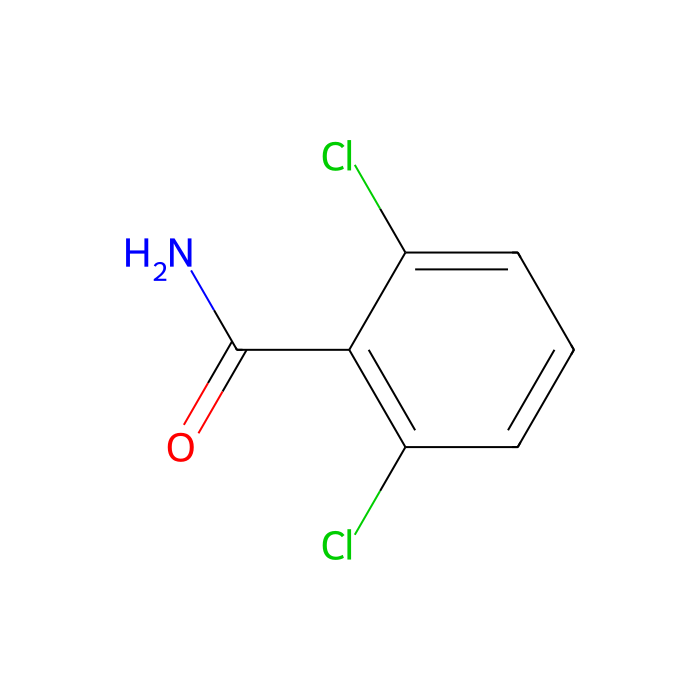
Brief description: 2,6-Dichlorobenzamide is a chlorinated benzamide building block featuring two ortho chlorine substituents flanking the amide-bearing carbon.
Item-specific (from Product Data)
SKU: D182551
Product Name: 2,6-Dichlorobenzamide
CAS: 2008-58-4
PubChem CID: 16183
InChIKey (as provided): 160782
SMILES: Not specified for this item; refer to CoA/Spec Sheet.
Literature/computed identifiers (general reference; not item-specific specs)
Core: benzene ring bearing an amide (benzamide) at C-1.
Substitution: chloro substituents at the 2- and 6-positions (ortho to the amide carbonyl), creating steric encumbrance around the amide.
Functional groups: primary carboxamide (–CONH2); two aryl chlorides.
2D description: planar aromatic ring; amide carbonyl conjugated with the aryl ring; ortho chlorines increase steric hindrance, twisting the amide slightly out of plane relative to the ring (literature trend for 2,6-disubstituted benzamides).
Synthetic Utility
Key reactive elements
Primary amide (–CONH2): platform for hydrolysis, reduction, dehydration to nitrile, and rearrangements to aniline (Hofmann/Beckmann via oxime of the corresponding ketone; Curtius from the acid).
Two aryl chlorides: potential handles for Pd‑catalyzed cross‑couplings (Suzuki, Buchwald–Hartwig, Sonogashira) using aryl‑chloride‑competent catalysts/ligands.
Applications (literature)
Access to 2,6-dichloroaniline (Hofmann rearrangement of the amide) → routes to diaryl ureas, carbamates, and heterocycles.
Installation of diverse substituents via sequential, chemoselective coupling on the aryl chloride positions, exploiting steric differentiation imparted by the ortho chlorides and the amide directing capacity.
Formation of imidoyl chlorides from the amide with SOCl2/POCl3, enabling further transformations (e.g., to amidines or aldehydes upon reduction/hydrolysis sequences).
Retrosynthetic value
Serves as a convergent node connecting 2,6-dichlorobenzoic acid (via hydrolysis) and 2,6-dichloroaniline (via Hofmann), enabling bidirectional diversification depending on project needs.
Practical tips
Maintain anhydrous conditions for dehydrations and reductions; control temperature during rearrangements to manage byproducts. Use appropriate Pd/ligand systems (e.g., BrettPhos-type) for aryl chloride activation.
Target Specificity
Not applicable. This product is a small-molecule chemical building block, not a biological targeting reagent. No antigen/epitope, species reactivity, clone, or isotype information applies.
We use cookies to ensure the website functions properly and, where permitted, to improve your experience. You can manage your preferences at any time in Settings. Learn more in our Cookie Policy.
Shall we send you a message when we have discounts available?
Remind me later
Thank you! Please check your email inbox to confirm.
Products are supplied to verified businesses, institutions, and qualified professionals for research and development use only. Not for use in humans, animals, diagnosis, or therapy.

 L1902057