Determine the necessary mass, volume, or concentration for preparing a solution.
Taxonomy Tree
| Kingdom | Organic compounds |
|---|---|
| Superclass | Benzenoids |
| 분류 | Phenols |
| Subclass | Halophenols |
| Intermediate Tree Nodes | Chlorophenols |
| Direct Parent | O-chlorophenols |
| Alternative Parents | M-iodophenols Iodobenzenes Chlorobenzenes 1-hydroxy-4-unsubstituted benzenoids 1-hydroxy-2-unsubstituted benzenoids Aryl iodides Aryl chlorides Organooxygen compounds Organoiodides Organochlorides Hydrocarbon derivatives |
| Molecular Framework | Aromatic homomonocyclic compounds |
| Substituents | 3-iodophenol - 2-chlorophenol - 1-hydroxy-4-unsubstituted benzenoid - 1-hydroxy-2-unsubstituted benzenoid - Chlorobenzene - Halobenzene - Iodobenzene - Aryl chloride - Aryl halide - Aryl iodide - Monocyclic benzene moiety - Hydrocarbon derivative - Organic oxygen compound - Organooxygen compound - Organoiodide - Organochloride - Organohalogen compound - Aromatic homomonocyclic compound |
| 설명 | This compound belongs to the class of organic compounds known as o-chlorophenols. These are chlorophenols carrying a iodine at the C2 position of the benzene ring. |
| External Descriptors | Not available |
Find and download the COA for your product by matching the lot number on the packaging.
| Lot Number | Certificate Type | 날짜 | 항목 |
|---|---|---|---|
| Certificate of Analysis | Mar 30, 2026 | C183453 | |
| Certificate of Analysis | Nov 07, 2024 | C183453 | |
| Certificate of Analysis | Nov 07, 2024 | C183453 | |
| Certificate of Analysis | Nov 07, 2024 | C183453 | |
| Certificate of Analysis | Nov 07, 2024 | C183453 | |
| Certificate of Analysis | Nov 07, 2024 | C183453 |
| 감도 | light sensitive |
|---|---|
| 분자량 | 254.45 |
| XLogP3 | 2.800 |
| Hydrogen Bond Donor Count | 1 |
| Hydrogen Bond Acceptor Count | 1 |
| Rotatable Bond Count | 0 |
| Exact Mass | 253.9 Da |
| Monoisotopic Mass | 253.9 Da |
| Topological Polar Surface Area | 20.200 Ų |
| Heavy Atom Count | 9 |
| Formal Charge | 0 |
| Complexity | 99.100 |
| Isotope Atom Count | 0 |
| Defined Atom Stereocenter Count | 0 |
| Undefined Atom Stereocenter Count | 0 |
| Defined Bond Stereocenter Count | 0 |
| Undefined Bond Stereocenter Count | 0 |
| The total count of all stereochemical bonds | 0 |
| Covalently-Bonded Unit Count | 1 |
H302:Harmful if swallowed
H312:Harmful in contact with skin
H315:Causes skin irritation
H318:Causes serious eye damage
H332:Harmful if inhaled
H335:May cause respiratory irritation
P261:Avoid breathing dust/fume/gas/mist/vapors/spray.
P264:Wash hands [and …] thoroughly after handling.
P270:Do not eat, drink or smoke when using this product.
P271:Use only outdoors or in a well-ventilated area.
P280:Wear protective gloves/protective clothing/eye protection/face protection.
P321:Specific treatment (see ... on this label).
P330:Rinse mouth.
P302+P352:IF ON SKIN: wash with plenty of water.
P304+P340:IF INHALED: Remove person to fresh air and keep comfortable for breathing.
P362+P364:Take off contaminated clothing and wash it before reuse.
P405:Store locked up.
P403+P233:Store in a well-ventilated place. Keep container tightly closed.
P501:Dispose of contents/container to an approved waste disposal plant.
P264+P265:Wash hands [and …] thoroughly after handling. Do not touch eyes.
P301+P317:IF SWALLOWED: Get medical help.
P305+P354+P338:IF IN EYES: Immediately rinse with water for several minutes. Remove contact lenses if present and easy to do. Continue rinsing.
P317:Get emergency medical help.
P332+P317:If skin irritation occurs: Get medical help.
P319:Get medical help if you feel unwell.
No assay/application protocols are specified for this item. As a synthetic building block, conditions should be adapted from standard organic synthesis procedures (e.g., Suzuki, Sonogashira, Williamson etherification), with substrate-specific optimization.
For project reproducibility:
This compound is a synthetic halophenol building block with no established physiological role.
General context (literature):
Use in life-science research:
No medical, diagnostic, or therapeutic use is intended or implied. For research use only (per Product Data).
Not typically used as a buffer component. Phenolic halogenated aromatics do not form conventional biological or analytical buffers in aqueous media.
Practical note: If aqueous work is required (e.g., bioconjugation of derivatives), solubilize this compound in a water-miscible organic co-solvent (DMSO, DMF, or ethanol) before dilution into the buffered system, ensuring final co-solvent content is compatible with the assay.
Opportunities to improve sustainability center on solvent and catalyst/base choices rather than changing the building block itself.
Greener solvent substitutions (literature guidance):
Base/catalyst considerations:
Process-intensification:
Comparison (typical trade-offs):
Note: Green substitutions should be verified experimentally for this specific substrate/coupling partner combination; kinetics and selectivity can vary with solvent and base.
No direct role as a pharmacopeial excipient is known or implied. This product is intended for research use only.
Relevant context for process chemists (general):
Any application in human or veterinary medicine would require separate development, analytical qualification, and regulatory evaluation that are outside the scope of this research-grade product.
Item-specific physicochemical specifications (bp/mp/density/assay/UV cutoff, etc.): Not specified for this item; refer to CoA/Spec Sheet.
General/literature-based guidance for 2-halophenols (context only):
Notes for practical handling (general):
Always consult the item-specific CoA/SDS for definitive properties before designing quantitative processes.
How to interpret common grades (general guidance):
Stabilizers/inhibitors:
Recommendation:
The aryl iodide moiety is highly reactive in cross-coupling, while the phenolic OH provides orthogonal derivatization. Representative applications (literature/general):
Pd-catalyzed cross-coupling at Ar–I:
Orthogonal functionalization strategies:
Metal–halogen exchange:
Directed ortho chemistry:
These features make 2-chloro-5-iodophenol a valuable bifunctional building block for iterative C–C/C–N/O-functionalization sequences in medicinal and materials chemistry.
General literature conditions for aryl iodides and phenols (guidance; optimize per substrate):
Suzuki–Miyaura coupling:
Sonogashira coupling (terminal alkyne):
Buchwald–Hartwig amination:
Williamson etherification (O-alkylation):
Halogen–lithium exchange at Ar–I:
Note: Protect or manage the phenolic OH as needed to avoid competitive O-arylation or deprotonation under basic or organolithium conditions.
General safety considerations for halogenated phenols (informational, not item-specific):
Always defer to the current SDS for this specific catalog item.
This compound is a moderately polar, halogenated aromatic phenol. It is generally handled as a solid and dissolved for reactions or analyses.
Polarity/miscibility (general):
Typical choices by use case:
Comparison (practical):
Dry, oxygen-free solvents are recommended for metal-catalyzed reactions and base-sensitive operations.
Practical guidance (general):
Always refer to the batch-specific CoA/SDS for any additional storage constraints or stability information.
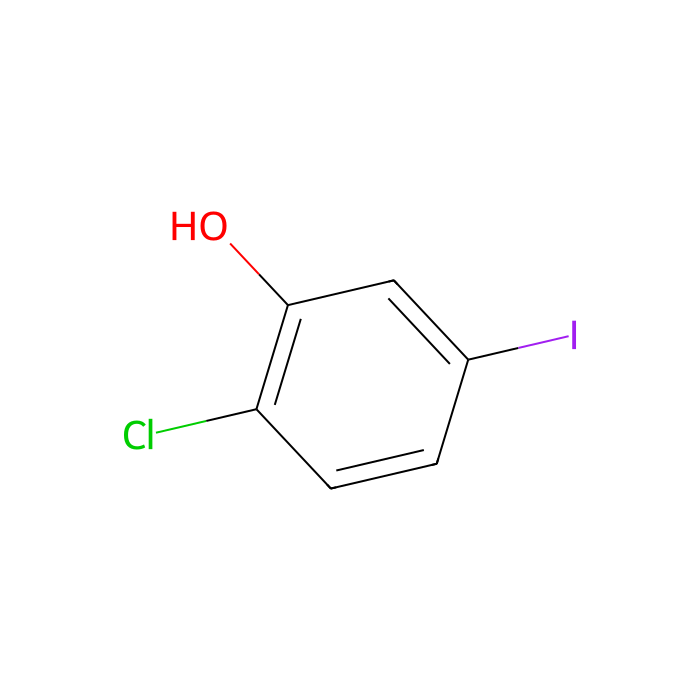
An ortho/meta-disubstituted halophenol featuring a phenolic OH with adjacent chloro (2-position) and a meta iodo (5-position) on the benzene ring.
Item-specific identifiers (from Product Data):
Computed/literature structural data (general, not item-specific specs):
Stereochemistry: None (achiral, planar aromatic core).
Key reactivity elements:
Retrosynthetic value:
Typical transformations (literature examples):
Not applicable. This product is a small-molecule chemical building block, not a biological affinity reagent. No antigen/epitope, clone, isotype, or species reactivity data apply.