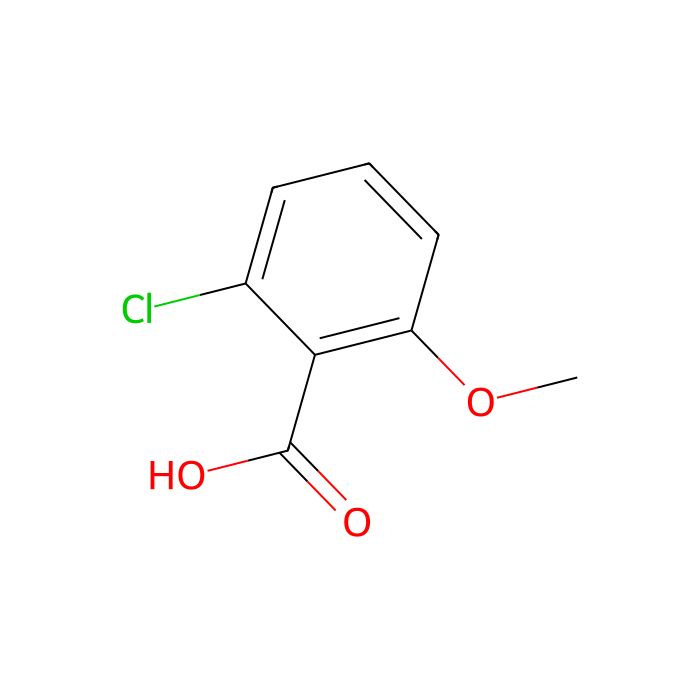
2-클로로-6-메톡시벤조산 - ≥96% , CAS No.3260-89-7

CAS: 3260-89-7 Cat. No.: C192742 분자식: C8H7ClO3 분자량: 186.59 EC 번호: 221-863-1
주문 가능
등급 & 순도 ≥96%
Synonyms
2-chloro-6-methoxybenzoicacid|Benzoic acid, 2-chloro-6-methoxy-|2-Chloro-6-methoxybenzoic acid|2-Chloro-6-methoxy-benzoic acid|2-chloro-6-(methyloxy)benzoic acid
Storage
실내 온도
Shipped In
보통
★
크기
USA
독일 (EU)*
가격
수량
50mg
C192742-50mg
3 재고 있음
—
US$9.90
250mg
C192742-250mg
1 재고 있음
—
US$10.90
1g
C192742-1g
2 재고 있음
—

US$11.90

US$17.90
저장 US$6.00 (33.52%)
5g
C192742-5g
1 재고 있음
—

US$49.90

US$74.90
저장 US$25.00 (33.38%)
10g
C192742-10g
2 재고 있음
—

US$94.90

US$142.90
저장 US$48.00 (33.59%)
Enter a quantity for the sizes you want to add.

사양

동의어
2-chloro-6-methoxybenzoicacid | Benzoic acid, 2-chloro-6-methoxy- | 2-Chloro-6-methoxybenzoic acid | 2-Chloro-6-methoxy-benzoic acid | 2-chloro-6-(methyloxy)benzoic acid
사양 및 순도
≥96%
보관 조건
실내 온도
배송
보통
순수함
≥96%
이름과 식별자
Pubchem Sid
Pubchem Sid Url
https://pubchem.ncbi.nlm.nih.gov/substance/488185325
SMILES
COC1=C(C(=CC=C1)Cl)C(=O)O
IUPAC Name
2-chloro-6-methoxybenzoic acid
InChIKey
JUOHBAJZQDTICO-UHFFFAOYSA-N
InChI
1S/C8H7ClO3/c1-12-6-4-2-3-5(9)7(6)8(10)11/h2-4H,1H3,(H,10,11)
이성체 SMILES
COC1=C(C(=CC=C1)Cl)C(=O)O
분자량
186.59
Reaxys
2692863
Reaxys-RN_link_address
https://www.reaxys.com/reaxys/secured/hopinto.do?context=S&query=IDE.XRN=2692863&ln=

고급 데이터

Taxonomic Classification

Taxonomy Tree

KingdomOrganic compounds
SuperclassBenzenoids
분류Benzene and substituted derivatives
SubclassBenzoic acids and derivatives
Intermediate Tree Nodes Methoxybenzoic acids and derivatives
Direct ParentO-methoxybenzoic acids and derivatives
Alternative Parents 2-halobenzoic acids  Halobenzoic acids  Benzoic acids  1-carboxy-2-haloaromatic compounds  Phenoxy compounds  Anisoles  Methoxybenzenes  Benzoyl derivatives  Alkyl aryl ethers  Chlorobenzenes  Aryl chlorides  Vinylogous halides  Monocarboxylic acids and derivatives  Organic oxides  Organochlorides  Hydrocarbon derivatives  
Molecular FrameworkAromatic homomonocyclic compounds
Substituents O-methoxybenzoic acid or derivatives - 2-halobenzoic acid or derivatives - Halobenzoic acid or derivatives - 2-halobenzoic acid - Halobenzoic acid - Benzoic acid - Methoxybenzene - Anisole - 1-carboxy-2-haloaromatic compound - Phenol ether - Benzoyl - Phenoxy compound - Alkyl aryl ether - Halobenzene - Chlorobenzene - Aryl chloride - Aryl halide - Vinylogous halide - Carboxylic acid derivative - Carboxylic acid - Monocarboxylic acid or derivatives - Ether - Organohalogen compound - Organochloride - Organooxygen compound - Organic oxygen compound - Organic oxide - Hydrocarbon derivative - Aromatic homomonocyclic compound
설명This compound belongs to the class of organic compounds known as o-methoxybenzoic acids and derivatives. These are benzoic acids in which the hydrogen atom at position 2 of the benzene ring is replaced by a methoxy group.
External Descriptors Not available
3D 구조
상호 작용 화학 구조 모델


인증서(CoA, COO, BSE/TSE 및 분석 차트)
C of A & Other Certificates(BSE/TSE, COO):
Analytical Chart:

Find and download the COA for your product by matching the lot number on the packaging.

6 results found

Lot NumberCertificate Type날짜항목
J2111269J2111269Certificate of AnalysisJul 17, 2024 C192742
J2111270J2111270Certificate of AnalysisJul 17, 2024 C192742
J2111388J2111388Certificate of AnalysisJul 17, 2024 C192742
J2111389J2111389Certificate of AnalysisJul 17, 2024 C192742
J2111390J2111390Certificate of AnalysisJul 17, 2024 C192742
L2416305L2416305Certificate of AnalysisJul 17, 2024 C192742
화학 및 물리적 특성
분자량186.59
XLogP31.200
Hydrogen Bond Donor Count1
Hydrogen Bond Acceptor Count3
Rotatable Bond Count2
Exact Mass186.008 Da
Monoisotopic Mass186.008 Da
Topological Polar Surface Area46.500 Ų
Heavy Atom Count12
Formal Charge0
Complexity172.000
Isotope Atom Count0
Defined Atom Stereocenter Count0
Undefined Atom Stereocenter Count0
Defined Bond Stereocenter Count0
Undefined Bond Stereocenter Count0
The total count of all stereochemical bonds0
Covalently-Bonded Unit Count1
안전 및 위험(GHS)
픽토그램(들)
신호
Warning
위험 문구

H302:Harmful if swallowed

H315:Causes skin irritation

H319:Causes serious eye irritation

H335:May cause respiratory irritation

주의 문구

P261:Avoid breathing dust/fume/gas/mist/vapors/spray.

P264:Wash hands [and …] thoroughly after handling.

P270:Do not eat, drink or smoke when using this product.

P271:Use only outdoors or in a well-ventilated area.

P280:Wear protective gloves/protective clothing/eye protection/face protection.

P321:Specific treatment (see ... on this label).

P330:Rinse mouth.

P302+P352:IF ON SKIN: wash with plenty of water.

P304+P340:IF INHALED: Remove person to fresh air and keep comfortable for breathing.

P305+P351+P338:IF IN EYES: Rinse cautiously with water for several minutes. Remove contact lenses if present and easy to do - continue rinsing.

P362+P364:Take off contaminated clothing and wash it before reuse.

P405:Store locked up.

P403+P233:Store in a well-ventilated place. Keep container tightly closed.

P501:Dispose of contents/container to an approved waste disposal plant.

P264+P265:Wash hands [and …] thoroughly after handling. Do not touch eyes.

P301+P317:IF SWALLOWED: Get medical help.

P337+P317:If eye irritation persists: Get medical help.

P332+P317:If skin irritation occurs: Get medical help.

P319:Get medical help if you feel unwell.

Reaxys
2692863
Reaxys-RN_link_address
https://www.reaxys.com/reaxys/secured/hopinto.do?context=S&query=IDE.XRN=2692863&ln=
솔루션 계산기
리뷰

고객 리뷰

Application Protocols

No item-specific, validated protocols are provided for this product.

General laboratory workflows (literature/practice-based; adapt to your system):

  • Cross-coupling setup:
    1. Charge oven-dried vial with aryl acid, boronic partner/amine, Pd source, ligand, and base.
    2. Add solvent (e.g., 2-MeTHF/H2O or dioxane) under inert atmosphere.
    3. Heat (80–110°C) with stirring; monitor by LC/MS.
    4. Quench, extract, acid/base wash as appropriate; purify by column or crystallization.
  • Amide library synthesis:
    1. Dissolve acid in DMF; add HATU (1.1 equiv) and DIPEA (3 equiv) at 0–5°C.
    2. Add amine (1.1–1.5 equiv); stir 1–4 h at RT.
    3. Quench with water; extract with EtOAc; wash, dry, and concentrate; purify.
  • Demethylation to phenol:
    1. Cool solution in dry DCM to −78°C; add BBr3 dropwise (1–3 equiv).
    2. Warm to RT; quench with MeOH/water cautiously; work up and purify.

Always perform appropriate controls and safety assessments. For detailed, step-by-step SOPs, consult primary literature or internal method repositories.

Biological Roles

This product is a synthetic aromatic carboxylic acid and is not a native metabolite or cofactor. No item-specific biological data are provided.

General, literature-based context (not product-specific):

  • Structural motif: The benzoic acid core is common in natural products and xenobiotics; substituents (Cl, OMe) modulate lipophilicity and electronic properties, affecting membrane partitioning and protein binding in model systems.
  • Biotransformation tendencies: Aryl methoxy groups can undergo O-demethylation (e.g., via cytochrome P450 in biological systems) to phenolic metabolites; carboxylic acids may form acyl glucuronides in vivo. Halogen substituents can reduce metabolic turnover on the ring.
  • Assay utility: Such substituted benzoic acids can serve as standards or probes in enzymology of acylation/deacylation, conjugation studies, or as ligands in protein crystallography screening, though specific binding roles are case-dependent.

No claims are made regarding pharmacology, toxicity thresholds, or clinical relevance. For any biological testing, ensure appropriate controls, and consult institutional biosafety guidance.

Buffer Applications

Not typically used as a buffering agent.

  • Rationale: As a weak monocarboxylic acid with limited aqueous solubility in its neutral form, this compound is not part of standard biological/biochemical buffer systems.
  • Practical note: If aqueous manipulation is required, transient solubilization as the carboxylate (e.g., sodium salt formed with NaHCO3 or NaOH) can aid extractions and phase transfers, but this is a workup strategy rather than a true buffer application.

For pH control, select established buffers (e.g., acetate, phosphate, Tris, HEPES) matched to your target pH range.

Green Alternatives

While the substance itself is a target/intermediate rather than a solvent, greener choices can be made around how it is synthesized, coupled, and processed (literature guidance):

  • Solvent selection:
    • Prefer 2-MeTHF or CPME over THF/MTBE for extractions and couplings where compatible.
    • Use EtOAc or MeCN instead of chlorinated solvents (DCM/CHCl3) when feasible.
    • For amide couplings, consider propylene carbonate or dimethyl isosorbide as greener polar aprotic alternatives to DMF/DMAc (check solubility/catalyst compatibility).
  • Reagents/catalysts:
    • Employ catalytic, low-loading Pd systems with ligand recycling; explore Ni-catalyzed couplings to reduce reliance on Pd.
    • Choose coupling reagents with better E-factors (e.g., T3P) and implement in situ activation to minimize waste.
  • Workup/waste minimization:
    • Switch bicarbonate and brine washes to minimal volumes; recover and recycle EtOAc/2-MeTHF.
    • Apply continuous flow for hazardous transformations (e.g., acid chloride formation) to reduce inventory and exposure.

Illustrative comparison (general):

  • THF vs 2-MeTHF: similar polarity; 2-MeTHF from renewable sources, higher hydrophobicity aids phase splits; THF forms peroxides and is fossil-derived.
  • DCM vs EtOAc: DCM offers excellent solvency but higher environmental/health concerns; EtOAc is biodegradable, lower toxicity, and often adequate.

Trade-offs must be balanced against solubility, reaction rates, and selectivity; verify with small-scale trials.

Pharmaceutical Uses

No item-specific pharmacopeial status or excipient role is provided for this product.

General formulation/manufacturing context (literature-based; not a therapeutic claim):

  • Role in discovery and process chemistry: Substituted benzoic acids like 2-chloro-6-methoxybenzoic acid are common building blocks for medicinal chemistry libraries, enabling rapid diversification via cross-coupling, amidation, and esterification.
  • Salt/derivative formation: Conversion to esters (pro-masks in medicinal chemistry) or amides (scaffolds) is routine. Formation of reactive acyl derivatives (acid chlorides, anhydrides) supports downstream coupling in API intermediate synthesis.
  • Analytical references: May serve as an analytical standard or impurity marker in method development for related APIs bearing chloro/methoxy-benzoate motifs.

If a compendial grade (USP/EP) or GMP documentation is required, contact Aladdin Scientific for availability; otherwise, this catalog item is intended for research use only.

Physical Properties
  • Item-specific specifications: Not specified for this item; refer to CoA/Spec Sheet.

  • Literature/general properties for 2-chloro-6-methoxybenzoic acid (for reference only; not product specifications):

    • Physical state: typically a crystalline solid (aromatic carboxylic acids of this class)
    • Acidity: weak carboxylic acid; pKa expected in the benzoic-acid range, modulated by ortho Cl (–I) and ortho OMe (+M) substituents (literature trend)
    • Solubility profile: sparingly soluble in water; soluble in polar organic solvents (e.g., methanol, ethanol, acetone, ethyl acetate, DMSO); good solubility in moderately polar aprotic media (literature trend)
    • Partitioning: aromatic acid with one halogen and one methoxy group—expect moderate lipophilicity vs. benzoic acid; ionization state strongly affects apparent logP/logD (literature trend)
    • UV behavior: aromatic chromophore with substituents; shows typical benzoate π→π* absorption in the UV region (literature trend)

Practical implications:

  • For analytical sample prep, dissolve in MeOH, MeCN, DMSO, or THF; adjust with a small amount of base if rapid dissolution is needed.
  • For aqueous work, convert to the corresponding carboxylate salt (e.g., with NaHCO3) to enhance water solubility; re-acidify for isolation.

Always confirm exact values (mp, purity, residuals, water content, UV cutoff, etc.) from the item’s CoA/Spec Sheet before method development.

Quality and Grades
  • Item-specific grade/purity and stabilizers: Not specified for this item; refer to CoA/Spec Sheet.

How to interpret common grades for this compound class (general guidance; not product-specific):

  • Research/technical grade: Suitable for most synthetic transformations. Trace impurities (e.g., isomers, residual solvents) may be higher; verify if using in sensitive catalysis or analytical applications.
  • ≥98–99% assay (typical literature ranges for fine chemicals): Adequate for cross-coupling, amidation, esterification. For photophysical studies or trace analysis, consider higher-purity material and low-UV/low-metal certifications.
  • HPLC/LC-MS suitability: If intended for analytical methods, request a low-UV-absorbing solvent profile and information on non-volatile residues.

Recommendations:

  • Check isomeric purity (positional isomers of chloro/methoxy) by NMR or GC/LC as needed for structure–activity or SAR work.
  • For catalysis (e.g., Pd-catalyzed couplings), low sulfur/phosphorus and trace metal background are beneficial; consult the CoA for metals if critical.
  • If solid-state form matters (hydrate/solvate/polymorph), confirm by DSC/TGA and PXRD; not typically an issue for simple benzoic acids but relevant for crystallization behavior.
Reaction and Applications

As an ortho-disubstituted benzoic acid bearing an aryl chloride and a methoxy group, 2-chloro-6-methoxybenzoic acid is a versatile aromatic building block. Typical research uses (literature-based; expand as suitable):

  • Cross-coupling at aryl chloride:
    • Suzuki–Miyaura coupling to introduce aryl/heteroaryl groups; modern Pd catalysts (e.g., Pd-PEPPSI, Pd(dba)2 with SPhos/XPhos) facilitate aryl chloride activation.
    • Buchwald–Hartwig amination to afford anilines; use bulky biaryl phosphines or BrettPhos-type ligands.
    • Negishi/Kumada couplings from organozinc/magnesium partners when appropriate.
  • Carboxyl group derivatization:
    • Amide coupling (EDC·HCl, HATU, T3P) to access benzamides; ortho substitution may influence reactivity/sterics.
    • Esterification: Fischer (acid-catalyzed in alcohol), Steglich (DMAP/DCC) for mild conditions.
    • Activation to acid chlorides (SOCl2, oxalyl chloride) followed by acyl transfer.
  • Methoxy handle transformations:
    • Demethylation to phenol using BBr3, AlCl3/thiols, or HBr under controlled conditions; provides 2-chloro-6-hydroxybenzoic acid derivatives.
    • Directed ortho-metalation adjacent to OMe possible on suitably protected derivatives; caution due to existing ortho substituents.
  • Decarboxylative strategies:
    • Photoredox or transition-metal-catalyzed decarboxylative cross-couplings (via redox-active esters) to functionalize the ring while leveraging the carboxylate.

Applications include preparation of substituted salicylic-acid analogs, herbicide/pigment intermediates, and SAR libraries where para Cl/OMe relationship modulates electronics and sterics.

Reaction Conditions

General literature guidance for typical transformations with 2-chloro-6-methoxybenzoic acid (verify and optimize for your system):

  • Suzuki–Miyaura coupling (at Ar–Cl):
    • Catalyst: Pd2(dba)3 (1–2 mol% Pd) + SPhos/XPhos (2–4 mol%); or Pd-PEPPSI-IPr (0.5–1 mol%).
    • Base: K3PO4, K2CO3, or Cs2CO3 (2–3 equiv).
    • Solvent: 1,4-dioxane/H2O, toluene/H2O, or 2-MeTHF/H2O.
    • Temp/time: 80–110°C, 4–16 h. Electron-rich aryl chlorides may need higher T or stronger ligands.
  • Buchwald–Hartwig amination:
    • Catalyst: Pd(OAc)2 (1–2 mol%) with BrettPhos or RuPhos (2–4 mol%).
    • Base: NaOtBu or Cs2CO3.
    • Solvent: tBuOH, toluene, dioxane.
    • Temp: 90–110°C; monitor by LC.
  • Amide coupling (from acid):
    • Reagents: HATU (1.1–1.2 equiv) or T3P (50% in EtOAc); base DIPEA (2–3 equiv).
    • Solvent: DMF, NMP, or EtOAc (for T3P).
    • Temp: 0–25°C for activation, then 25–40°C to completion.
  • Esterification (Fischer):
    • Reagents: anhydrous ROH (solvent), catalytic H2SO4 or TsOH, Dean–Stark for higher alcohols.
    • Temp: reflux until completion (4–24 h).
  • Demethylation to phenol:
    • Reagent: BBr3 (1–3 equiv) in DCM at −78 to 0°C, then warm to RT; quench carefully to avoid overbromination.

Yields vary with substrates/conditions; run small-scale screens to optimize ligand/base/solvent combinations, especially for aryl-chloride activation.

Safety and Handling
  • Item-specific GHS data: Not specified for this item; refer to the SDS for authoritative hazard classification, H-statements, and pictograms.

General safety considerations for halogenated aromatic carboxylic acids (literature/experience-based guidance; not product-specific):

  • Likely hazards: May cause skin/eye irritation and respiratory tract irritation if dusts are generated. Avoid inhalation of particulates and contact with skin/eyes.
  • PPE: Lab coat, safety glasses or chemical splash goggles, and suitable gloves (e.g., nitrile). Use in a fume hood when weighing or transferring powders.
  • Handling: Avoid dust formation. Ground and bond equipment if transferring larger quantities of fine powder to minimize static accumulation.
  • Incompatibilities: Strong bases (will form carboxylate salts and potentially promote undesired reactions), strong oxidizers, and strong reducing agents. Avoid contact with acid chlorides or dehydrating agents unless intended for synthesis.
  • First aid (overview; consult SDS for full guidance):
    • Skin/eyes: Rinse with water for at least 15 minutes; remove contaminated clothing; seek medical advice if irritation persists.
    • Inhalation: Move to fresh air; seek medical attention if symptoms occur.
    • Ingestion: Rinse mouth; do not induce vomiting; seek medical advice.
  • Spill response: Avoid dust; collect mechanically; place in suitable container for disposal in accordance with local regulations.
  • Fire: Use CO2, dry chemical, or foam. Combustion may produce HCl, CO/CO2.
Solvent Selection

This product is a solid building block rather than a solvent. Solvent choice pertains to its dissolution and use in synthesis/processing.

  • Polarity/acid–base profile (general): Weak aromatic carboxylic acid; neutral form is organic-soluble, conjugate base is water-soluble.
  • Practical dissolution choices (literature trends):
    • Polar protic: methanol, ethanol, isopropanol (good); water (poor unless basified)
    • Polar aprotic: acetone, acetonitrile, DMF, DMSO, THF, ethyl acetate (good)
    • Nonpolar: toluene, chlorinated solvents (CH2Cl2, CHCl3) show moderate solubility depending on temperature.
  • When to choose what:
    • Couplings/derivatizations: DMF, DMAc, NMP, dioxane, or 2-MeTHF depending on catalyst/base compatibility.
    • Esterifications (Fischer): anhydrous alcohol solvents (MeOH, EtOH) with acid catalysis and water removal.
    • Workups: Partition between organic (EtOAc/MTBE/DCM) and aqueous bicarbonate to shuttle between acid and carboxylate forms.

Small comparison (literature guidance):

  • DMF/DMSO: maximal solubility for activation/coupling; difficult removal.
  • EtOAc/2-MeTHF: greener, volatile; may require warming for full dissolution.
  • MeCN/acetone: good balance of polarity and volatility; compatible with many catalysts.

Always confirm solvent compatibility with chosen reagents/catalysts and consult CoA for any solvent-residual constraints.

Storage and Reconstitution
  • Item-specific storage and shipping (from Product Data):

    • Storage Conditions: Room temperature
    • Shipped In: Normal
  • Additional handling guidance (general; not product-specific):

    • Keep container tightly closed in a dry, well-ventilated place. Protect from prolonged exposure to strong light and moisture to prevent caking or hydrolysis of activated derivatives.
    • Avoid storing near strong acids/bases or oxidizers. No stabilizers/reagents are indicated for this item.
    • If forming solutions, prepare fresh in dry solvent (e.g., DMSO, DMF, MeOH) and store aliquots at 2–8°C or −20°C as appropriate to minimize degradation; bring to room temperature before opening to avoid moisture condensation.
  • Reconstitution: As a small-molecule solid, no aqueous reconstitution is required by default. For stock solutions, typical research concentrations are 10–100 mM in DMSO or MeOH; filter through 0.2 µm PTFE/RC if particulate is present.

For definitive storage limits, solution stability, and retest dates, consult the product’s CoA/Spec Sheet and SDS.

Structure and Identity

A halogenated, ortho-disubstituted benzoic acid featuring an electron-donating methoxy group and an electron-withdrawing chloro substituent para to one another across the aromatic ring.

  • Product Data (item-specific):
    • CAS: 3260-89-7
    • SKU: C192742
    • InChIKey: 170499 (as provided)
    • Storage: Room temperature; shipped under normal conditions
    • Research Use: For research use only
  • Literature/computed identity (for reference; not item-specific specs):
    • Preferred name: 2-Chloro-6-methoxybenzoic acid (aka 6-methoxy-2-chlorobenzoic acid)
    • Molecular formula: C8H7ClO3 (literature)
    • Molecular weight: ~190.59 g/mol (literature, calculated from formula)
    • SMILES (one representation): COc1c(Cl)cccc1C(=O)O (literature)
    • 2D structural description: A benzene ring bearing a carboxylic acid at C1, a chloro substituent at C2 (ortho), and a methoxy substituent at C6 (ortho to CO2H, para to Cl). Functional groups: aryl chloride, aryl methyl ether, carboxylic acid.

Notes: Where literature identifiers differ from catalog entries, defer to the product CoA/Spec Sheet for definitive item-specific identity data.

Synthetic Utility

Key functional elements and how they can be exploited (literature/practice-based guidance):

  • Aryl chloride (para to methoxy):
    • Cross-coupling handle for Suzuki, Buchwald–Hartwig, and related Pd/Ni-catalyzed couplings. Electron-rich aryl chlorides benefit from bulky, electron-rich phosphine ligands (e.g., SPhos, XPhos, BrettPhos) or NHC–Pd catalysts.
  • Methoxy group:
    • Protecting/directing group convertible to phenol by BBr3 or HBr/AcOH; enables late-stage access to salicylic-acid analogs.
    • Can modulate regioselectivity in electrophilic aromatic substitutions if further ring modifications are pursued (though sterically hindered by ortho substitution).
  • Carboxylic acid:
    • Platform for amide libraries (EDC/HATU/T3P); ester formation for profragment assembly; activation to acyl chlorides for Friedel–Crafts acylation of external arenes.
    • Decarboxylative couplings (via NHPI esters) to introduce C–C/C–heteroatom bonds without prefunctionalized halides at that position.

Retrosynthetic value:

  • Enables parallel synthesis: keep the acid constant while varying the aryl chloride via coupling, or fix the aryl substitution and diversify the acid-derived function (amide/ester). Orthogonal handles (Cl vs CO2H) allow stepwise divergence with high chemoselectivity.

Purification tips:

  • Acid/base extraction toggling (carboxylate vs neutral) streamlines crude cleanup.
  • For close-boiling byproducts, convert to an ester/amide to shift polarity, then back-transform after purification.
Target Specificity

Not applicable. This product is a small-molecule chemical and not an antibody, enzyme, or targeted biological reagent.

  • Item-specific bio-target data: Not specified for this item; refer to CoA/Spec Sheet if any binding/assay validations are provided in future.
  • Guidance: If used as a probe or ligand in bespoke assays, target specificity must be established empirically (e.g., binding constants, selectivity panels).

자주 묻는 질문

What is the purity of this product?
This product is supplied at ≥96% purity (chemical assay). Lot-specific values are stated on the Certificate of Analysis.
How should this product be stored?
Store at room temperature.
How is this product shipped?
This product ships under standard ambient conditions. No temperature-controlled packaging is required.
What are the CAS number, molecular formula and molecular weight?
The CAS Number is 3260-89-7, the molecular formula is C8H7ClO3, and the molecular weight is 186.59 g/mol. InChIKey JUOHBAJZQDTICO-UHFFFAOYSA-N.
What documentation is provided?
Available product documentation, including Certificates of Analysis (COA), Safety Data Sheets (SDS), and specification sheets, is shown in the product document area. Document availability and access follow the current site policy.

Shall we send you a message when we have discounts available?

Remind me later

Thank you! Please check your email inbox to confirm.

Oops! Notifications are disabled.