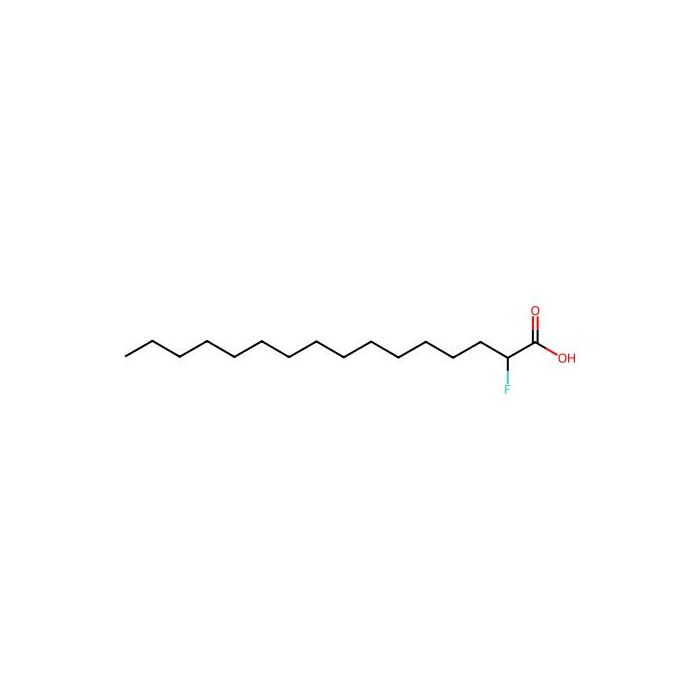
2-Fluoropalmitic acid, an acyl-CoA synthetase inhibitor, acts as a candidate anti-glioma agent. 2-Fluoropalmitic acid suppresses the viability and stem-like phenotype of glioma stem cells (GSCs). 2-Fluoropalmitic acid also inhibits proliferation and invasion of glioma cell lines.
2-Fluoropalmitic acid, an acyl-CoA synthetase inhibitor, acts as a candidate anti-glioma agent. 2-Fluoropalmitic acid suppresses the viability and stem-like phenotype of glioma stem cells (GSCs). 2-Fluoropalmitic acid also inhibits proliferation and invas
This compound belongs to the class of organic compounds known as long-chain fatty acids. These are fatty acids with an aliphatic tail that contains between 13 and 21 carbon atoms.
External Descriptors
Halogenated fatty acids
1. Djoumbou Feunang Y, Eisner R, Knox C, Chepelev L, Hastings J, Owen G, Fahy E, Steinbeck C, Subramanian S, Bolton E, Greiner R, and Wishart DS. ClassyFire: Automated Chemical Classification With A Comprehensive, Computable Taxonomy. Journal of Cheminformatics, 2016, 8:61.
Determine the necessary mass, volume, or concentration for preparing a solution.
Dilution Calculator
Determine the dilution needed to prepare a stock solution.
Reconstitution Calculator
리뷰
고객 리뷰
Application Protocols
No assay‑specific, item‑validated protocols are provided for this product. For general laboratory use:
Stock preparation (research use only)
Prepare 50–200 mM stocks in DMSO or 10–50 mg/mL in chloroform or ethanol. Warm gently (30–40°C) and vortex/sonicate if needed.
For aqueous assays, dilute organic stocks into buffer containing carrier protein (e.g., 0.1–1% BSA) or cyclodextrin; maintain final organic co‑solvent ≤1–2% v/v when possible.
Derivatization examples
NHS ester formation for bioconjugation: Activate with DCC/NHS in dry CH2Cl2; purify and store at −20°C, desiccated.
Methyl ester for GC: Convert with TMS‑diazomethane and analyze on a non‑polar column (e.g., DB‑5ms).
These are general recommendations; tailor to your system and consult primary literature for detailed, peer‑reviewed procedures.
Biological Roles
General biochemical context (literature; no clinical claims)
Structural class: saturated fatty acid analog (C16) with an α‑fluorine. Mimics palmitate in hydrophobicity but exhibits altered reactivity at the α‑position.
Enzymatic processing: The α‑F can modulate activation by acyl‑CoA synthetases and downstream transformations (e.g., β‑oxidation), often slowing steps that rely on enolization or α‑deprotonation. This makes α‑fluorinated fatty acids useful mechanistic probes in cell‑free systems.
Spectroscopic handle: The 19F nucleus provides a background‑free NMR signal, enabling tracking of fluorinated lipid derivatives in model membranes, protein–lipid interactions, and enzymatic assays.
Membrane interactions: Long saturated chains promote insertion into bilayers; the polar headgroup (CO2H or derivatives such as esters/amides) controls localization. The single F typically does not disrupt chain packing dramatically but can influence order parameters detectable by NMR.
Research applications (examples)
Preparation of 19F‑labeled acyl‑CoA analogs for enzyme kinetics in vitro.
Incorporation into peptide/lipid conjugates to study membrane anchoring and raft partitioning.
Use as a calibrant or reporter in 19F NMR of lipid assemblies.
Note: Use is for research only. Cellular exposure studies require appropriate controls for solubilization (e.g., BSA carriers) and careful assessment of concentration‑dependent effects.
Buffer Applications
This compound is a hydrophobic carboxylic acid and is not typically used to prepare aqueous buffer systems. If dispersion into buffers is required for in vitro assays:
Prepare concentrated DMSO or ethanol stocks and dilute into buffer with vigorous mixing; include carrier proteins (e.g., BSA) or cyclodextrins to aid solubilization.
Adjust pH with base (e.g., NaOH) to form the soluble carboxylate salt, noting that high ionic strength and surfactants may be needed to prevent precipitation.
For routine buffer formulation (PBS, Tris, HEPES, etc.), refer to standard buffer reagents rather than this fatty acid.
Green Alternatives
Assessing greener choices involves balancing performance, safety, and environmental fate.
Environmental considerations (general)
Organofluorine persistence: Even single‑F compounds can resist biodegradation more than non‑fluorinated analogs. Minimize releases and manage waste per institutional and regulatory guidance.
Alternatives by function (literature-based)
Non‑fluorinated analog: Palmitic acid (hexadecanoic acid) offers similar chain length and hydrophobicity without C–F persistence. Useful when the fluorine handle is not essential for 19F detection or electronic tuning.
Shorter chains (C12–C14) for improved handling/biodegradability when high melting points or extreme hydrophobicity are problematic.
Solvent choices: Replace CH2Cl2/CHCl3 with 2‑MeTHF, CPME, or EtOAc where reaction compatibility allows; favor ethanol or isopropanol for workups.
Practical mitigation if 2‑fluoropalmitic acid is required
Scale minimization and closed‑system processing.
Solvent recycling and substitution (e.g., 2‑MeTHF for THF; EtOAc for CH2Cl2 when feasible).
Use catalytic over stoichiometric reagents in couplings (e.g., catalytic DMAP; avoid excessive carbodiimide).
Document your green chemistry choices in method sections for transparency and continuous improvement.
Pharmaceutical Uses
No pharmacopeial/excipient status is provided for this item. This material is supplied strictly for research use only.
General formulation relevance (literature)
Fatty acid derivatives (esters/amides) can serve as hydrophobic anchors, pro-moieties, or excipient components in research formulations. The α‑fluorine may be leveraged for 19F NMR analytics of formulations and release testing.
In lipid nanoparticle or micelle research, fluorinated lipids can modulate particle stability and analytical traceability; however, suitability must be established case‑by‑case.
Compliance reminder
Not specified for this item; refer to CoA/Spec Sheet for purity and residual solvent limits if performing preclinical enabling studies. No claims are made regarding GMP status, compendial compliance, or suitability for human/animal administration.
Physical Properties
Item-specific properties (as supplied)
Appearance: Not specified for this item; refer to CoA/Spec Sheet.
Grade/Purity: Not specified for this item; refer to CoA/Spec Sheet.
Molecular Formula: Not specified for this item; refer to CoA/Spec Sheet.
Molecular Weight: Not specified for this item; refer to CoA/Spec Sheet.
Literature/general reference values (non-spec; for planning only)
Empirical formula: C16H31FO2 (literature)
Formula weight: ~274.42 g/mol (literature, calculated from standard atomic weights)
Physical state: waxy solid to low‑melting solid typical of long-chain fatty acids (literature observation for analogous compounds)
Solubility: poor in water; soluble in nonpolar and polar aprotic organics (e.g., chloroform, dichloromethane, toluene, THF, DMSO). Alcohol solubility improves with slight warming or base (literature trends for C16 fatty acids).
Acid pKa: carboxylic acids in aliphatic series typically pKa ~4.5–5; α‑F can slightly modulate acidity (literature; qualitative).
Partitioning: expected high logP due to C16 chain; α‑F generally increases lipophilicity (literature trend).
BP/MP/density/refractive index: Not reliably established in peer-reviewed compilations for this specific isomer; consult primary literature or measure under your conditions.
Notes: Treat the above as general guidance. For method validation and specifications, rely on the lot-specific CoA and measure properties under your laboratory conditions.
Quality and Grades
Item-specific quality information
Grade/Purity: Not specified for this item; refer to CoA/Spec Sheet.
How to interpret grade and documentation (general guidance)
CoA/Spec Sheet: Provides lot-specific purity, analytical method (e.g., GC, HPLC, NMR), and acceptance criteria. For fluorinated fatty acids, 1H/13C/19F NMR and GC-FID/GC-MS are commonly used to confirm α‑fluoro substitution and chain integrity.
Impurities to consider (general): residual solvents, unfluorinated palmitic acid, over‑fluorinated byproducts, positional isomers (e.g., 3‑fluorohexadecanoic acid), and peroxides (if exposed to air/UV in certain preparations, though saturated fatty acids are not classic peroxide formers like ethers).
Stabilizers: Typically none are needed for saturated fatty acids; any stabilizer or antioxidant present would be disclosed on the CoA. If stability modifiers are listed, assess compatibility with your application.
Recommended QC on receipt (best practice)
Identity: 1H/13C/19F NMR; IR (sharp C=O ~1700 cm−1); HRMS to confirm exact mass for C16H31FO2.
Purity: GC (>250°C capillary column) or HPLC with ELSD/CAD; melting behavior (DSC) as a supportive metric.
Water and residual solvent: KF coulometry and GC‑headspace as appropriate for your application.
For regulated workflows, document traceability and retain CoA copies with lot/exp dates.
Reaction and Applications
This α‑fluorinated fatty acid is a versatile building block for fluorinated lipid chemistry and for probing fatty acid processing pathways in vitro (research use only).
Derivatization chemistry (literature)
Esterification: Fischer (acid-catalyzed, Dean–Stark) or DCC/EDC-mediated with alcohols to give methyl/benzyl or complex glycolipid esters. α‑F is retained.
Amidation: EDC·HCl/HOBt or HATU/DIPEA coupling to amines (e.g., aminosugars, peptides) yields fluorinated amide lipids for membrane and enzyme studies.
Acid chloride route: SOCl2 or (COCl)2 converts to the acyl chloride; subsequent acylation of nucleophiles proceeds efficiently at 0–25°C.
Anhydride/mixed anhydride: Useful for selective acyl transfers under mild conditions.
Reactivity considerations
The α‑F substituent reduces enolization and suppresses side reactions (e.g., self‑condensation) while increasing the electrophilicity of the carbonyl slightly via −I effect.
C–F is robust; nucleophilic substitution at C2 is generally unfavorable under standard acylation conditions.
Application areas (examples from literature)
Synthesis of fluorinated phospholipids/triglyceride mimetics for NMR/19F-MRI method development and membrane biophysics.
Enzyme mechanism studies (acyl‑CoA synthetases, thioesterases) using α‑fluoro tags to modulate reactivity or enable 19F detection.
Surface and materials modification where low surface energy fluorinated alkyl chains are desired but full perfluorination is not required.
Note: Optimize reaction conditions for solubility; mild warming and dry, oxygen‑free solvents typically improve outcomes.
Reaction Conditions
General conditions below are literature guidance for saturated fatty acids and α‑fluoro analogs; optimize for your substrate and scale.
Esterification
Fischer: ROH (neat or toluene), catalytic H2SO4 or p‑TsOH, Dean–Stark where applicable, 60–120°C, 2–12 h. For sensitive alcohols, use DCC/DMAP in CH2Cl2 at 0–25°C.
Methylation for GC: BF3–MeOH (55–80°C, 30–60 min) or TMS‑diazomethane at RT (caution: toxicity), quantitative in most cases.
Amidation
EDC·HCl (1.1–1.5 eq) + HOBt/HOAt or HATU (1.1 eq) with DIPEA (2–3 eq) in DMF/CH2Cl2, 0–25°C, 1–6 h; typical isolated yields 70–95% (literature ranges) for unhindered amines.
Acid chloride formation and acylation
SOCl2 (3–5 eq) with catalytic DMF in CH2Cl2 or toluene, reflux 1–3 h; remove volatiles, use crude acid chloride directly for acylations at 0–25°C with pyridine or triethylamine base.
Saponification/salt formation
NaOH or KOH in ethanol/water (1:1), 0–25°C to form carboxylate soaps; useful for preparing aqueous dispersions.
Notes specific to α‑F acids
Avoid strongly basic, high‑temperature conditions that might risk elimination or C–F activation in rare cases; standard acylations are F‑tolerant.
The α‑F can modestly slow acyl‑enzyme turnover in biocatalysis; extend reaction times if using lipases.
All conditions should be verified experimentally; monitor by TLC, 19F/1H NMR, or LC/MS.
Safety and Handling
GHS information (from Product Data)
Signal Word: Not specified for this item; refer to SDS.
H-Statements: Not specified for this item; refer to SDS.
GHS Classification: Not specified for this item; refer to SDS.
Pictograms: Not specified for this item; refer to SDS.
General safety considerations for long-chain α‑fluorocarboxylic acids (literature/industry practice)
Hazards: May cause skin/eye irritation; harmful if swallowed. Carboxylic acids can be irritant; fluorinated organics may pose additional environmental persistence concerns. Avoid aerosol formation.
PPE: Lab coat, safety glasses or face shield, and chemical-resistant gloves (e.g., nitrile). Use in a fume hood to avoid inhalation of dusts or vapors from hot solutions.
Storage incompatibilities: Avoid strong bases (uncontrolled saponification), strong oxidizers, and strong reducing agents. Separate from reactive acylation agents unless in controlled use.
Handling tips: Warm gently (30–50°C) to improve solubility for weighing/transfer; do not overheat. Use dry glassware when preparing acid chlorides or anhydrides.
First-aid overview (defer to SDS for authoritative guidance)
Skin/eye contact: Rinse with water for ≥15 min; remove contaminated clothing. Seek medical attention if irritation persists.
Inhalation: Move to fresh air; monitor for respiratory irritation.
Ingestion: Rinse mouth; do not induce vomiting; seek medical advice.
Always consult the official SDS for the specific lot before use.
Solvent Selection
2-Fluoropalmitic acid is a hydrophobic, long-chain carboxylic acid. Solvent choice governs handling, derivatization, and formulation.
Polarity and miscibility (literature/experience)
Water: Practically insoluble at ambient conditions.
Alcohols: Limited solubility at RT; solubility increases upon warming or in presence of base to form alkoxides/soaps.
Chlorinated/nonpolar: Good solubility in CHCl3, CH2Cl2, toluene, hexanes (better when warmed).
Polar aprotics: Readily soluble in THF, dioxane, DMF, DMSO.
Selection by task
Esterification/amidation: Use dry CH2Cl2, THF, or DMF. For carbodiimide couplings, dichloromethane or DMF with catalytic DMAP is common.
Acid chloride formation: Anhydrous CH2Cl2 or toluene with SOCl2/oxalyl chloride under reflux; add a catalytic DMF drop if needed.
Biochemical stock solutions: DMSO stocks (e.g., 50–200 mM) are convenient; dilute into media with albumin carriers for dispersion (experimental practice; validate for your system).
Chromatography: Normal‑phase silica with hexanes/EtOAc gradients works well; add a trace of acetic acid or 0.1% TEA to minimize tailing if needed.
Brief comparison (literature-based)
DMSO vs CHCl3: DMSO is safer and miscible with aqueous buffers (on dilution) but may complicate workups; chloroform offers easy evaporation but higher toxicity.
THF vs CPME/2‑MeTHF: THF is versatile but forms peroxides; 2‑MeTHF/CPME can be greener alternatives with similar solvation.
Storage and Reconstitution
Item-specific instructions (from Product Data)
Storage Conditions: Store at −20°C.
Shipped In: Ice chest + ice pads.
Best practices (general for fatty acids)
Keep tightly sealed under dry, inert atmosphere (e.g., nitrogen/argon) to minimize moisture uptake and oxidative discoloration.
Allow container to warm to room temperature before opening to prevent condensation. Warm gently (30–40°C) if the material is waxy/solidified to facilitate accurate weighing.
If repeated use is expected, prepare single‑use aliquots in amber vials to avoid multiple freeze–thaw cycles.
Solution stability (general guidance)
DMSO and CHCl3 stock solutions are typically stable for weeks at −20°C when protected from light and air; verify by 19F/1H NMR or LC/MS before critical experiments.
Avoid prolonged storage in basic aqueous media; form salts fresh if needed.
Reconstitution
Choose solvent based on application: DMSO or DMF for biochemical assays; CH2Cl2, THF, or toluene for synthetic transformations. Sonication and mild heating can aid dissolution.
Always follow your institution’s chemical hygiene plan and consult the lot‑specific CoA/SDS for definitive handling and stability information.
Structure and Identity
A saturated long‑chain fatty acid analog bearing a single α‑fluorine substituent (at C2) on a palmitic acid backbone.
Item-specific identifiers (from Product Data)
SKU: F647550
Product Name: 2-Fluoropalmitic acid
CAS: 16518-94-8
CID: 1560
InChIKey: 159964
SMILES: Not specified for this item; refer to CoA/Spec Sheet.
Computed/literature structural information (for reference; not item specifications)
Key functional groups/features: carboxylic acid (–CO2H), single C–F at the α-position, fully saturated C16 chain (no double bonds). The α-carbon is stereogenic; commercial material is often racemic unless specified.
2D description: a terminal carboxylate at C1, an sp3 carbon at C2 bearing F and the C3 chain, followed by a linear C3–C16 alkyl segment.
Structural implications
The α‑F exerts a strong −I effect, decreasing acidity of the α‑C–H and suppressing enolization relative to palmitic acid.
The C–F bond increases lipophilicity relative to the parent acid and can modulate membrane interaction in lipid derivatives.
Conversion to acyl chloride (SOCl2/(COCl)2) for rapid acylations of sterically hindered nucleophiles.
Formation of N‑hydroxysuccinimide (NHS) esters for bioconjugation workflows.
Retrosynthetic value
Serves as a C16 hydrophobic synthon incorporating a 19F NMR handle. Useful for assembling fluorinated glycerides, phospholipids, sphingolipids, and lipopeptides without concern for olefin chemistry.
Purification/analysis tips
Normal‑phase silica with hexanes/EtOAc; add 0.1% acetic acid or TEA if tailing.
Characterize by 19F NMR (single α‑F resonance), IR (strong C=O), and MS ([M–H]− in ESI). GC analysis feasible after methyl ester derivatization (BF3–MeOH or TMS‑diazomethane).
Target Specificity
Not applicable. This product is a small-molecule fatty acid analog, not an antibody, nucleic acid, or targeted biological reagent. No antigen/epitope/clone information applies.
자주 묻는 질문
What is the purity of this product?
This product is supplied at ≥98% purity (chemical assay). Lot-specific values are stated on the Certificate of Analysis.
How should this product be stored?
Store at ?20 °C. Freezer storage is required to maintain the specified shelf life.
How is this product shipped?
This product ships in an insulated container with ice pads. Unpack on arrival and transfer it to the storage condition stated above.
What are the CAS number, molecular formula and molecular weight?
The CAS Number is 16518-94-8, the molecular formula is C16H31FO2, and the molecular weight is 274.41 g/mol. InChIKey JGRIJJOLCNCSNX-UHFFFAOYSA-N.
What documentation is provided?
Available product documentation, including Certificates of Analysis (COA), Safety Data Sheets (SDS), and specification sheets, is shown in the product document area. Document availability and access follow the current site policy.
Products are supplied to verified businesses, institutions, and qualified professionals for research and development use only. Not for use in humans, animals, diagnosis, or therapy.